

You write “data usage” in a report, and something looks off. Should there be an “e” before the “a”? It is a small doubt, but it can make a professional document look careless.
The answer is simple. This guide explains which spelling is right, why the other one fails, and how “usage” differs from “use,” with examples you can borrow.
Quick Answer: Is It Usage or Useage?
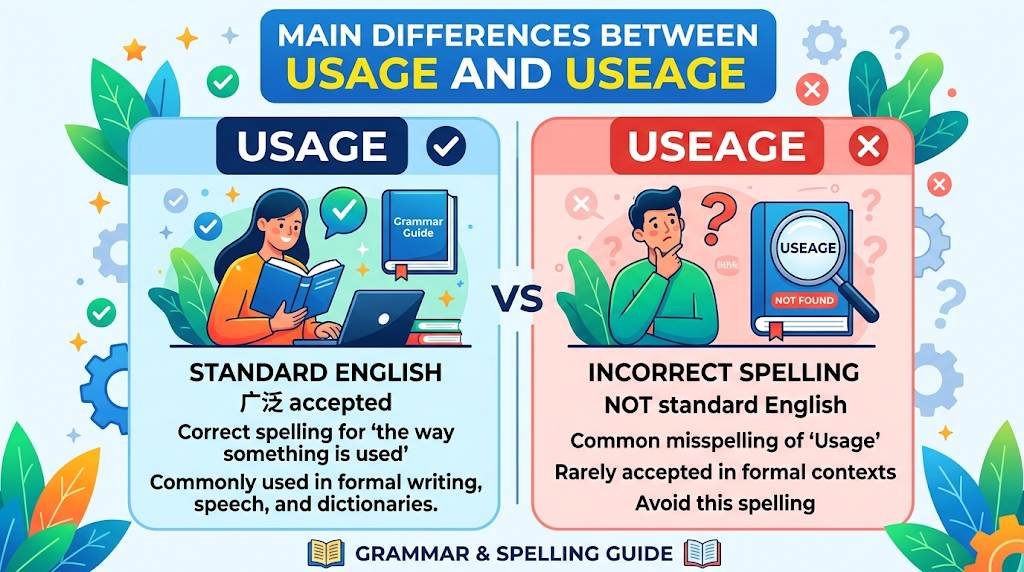
“Usage” is the correct spelling. “Useage” is a misspelling and does not appear as a standard word in major dictionaries.
The rule behind it is easy: when you add “-age” to “use,” the silent “e” drops away.
- ✅ use + age = usage
- ❌ useage
Comparison Overview
| Feature | Usage | Useage |
| Correct spelling? | Yes | No |
| Part of speech | Noun | None (misspelling) |
| In standard dictionaries? | Yes | No |
| Syllables | 2 (us·age) | 3 (use·a·ge, wrongly) |
| Accepted in US and UK English? | Yes | No |
| Spellcheck | Passes | Flagged |
Definition of Usage

What Does Usage Mean?
Usage has a few related meanings. Dictionaries usually group them like this:
- The way something is used. Example: the usage of a tool or a product.
- How much of something is used. Example: monthly electricity usage.
- The accepted way words and phrases are used in a language. Example: modern English usage.
- A customary practice or habit. Example: a local usage passed down for generations.
Usage as a Noun
“Usage” is a noun only. It names an action, an amount, or a custom, and it never works as a verb.
It can be countable or uncountable. The plural is “usages,” which you see mostly when people discuss several meanings or customs of a word.
- Uncountable: Heavy usage wore down the keyboard.
- Countable: The dictionary lists three usages of the term.
Common Contexts Where Usage Appears
You will meet this word in many places:
- Grammar and writing guides (usage notes, usage rules)
- Phone and internet plans (data usage, usage limits)
- Utility bills (water usage, energy usage)
- Software and apps (usage statistics, usage policy)
- Product manuals (usage instructions, recommended usage)
- Medicine and chemistry (drug usage, dosage and usage)
How to Pronounce Usage
Say it as YOO-sij. It has two syllables, and the stress falls on the first one.
- IPA: /ˈjuːsɪdʒ/
- Some speakers voice the middle sound and say YOO-zij. Dictionaries record both, so neither is an error.
Definition of Useage
Is Useage a Real English Word?
No. “Useage” is not a recognized English word. It is simply “usage” with a stray letter, and it carries no separate meaning.
Writers produce it because the base word is “use,” and the eye expects to see all three letters, u-s-e, before the suffix.
Why Is Useage Considered Incorrect?
English spelling usually drops a silent final “e” before a suffix that starts with a vowel. “Useage” breaks that habit.
Compare these:
| Base word | Add -age | Result |
| use | + age | usage |
| store | + age | storage |
| dose | + age | dosage |
Nobody writes “storeage” or “doseage,” so “useage” should not pass either. Spell checkers, editors, and style guides will mark it.
Main Differences Between Usage and Useage
Why Do People Confuse Usage and Useage?
There are three common reasons:
- The base word is visible. Writers want to keep “use” intact, so they leave the “e” in.
- Other words keep the “e.” “Mileage” and “likeable” hold on to theirs, so the rule feels inconsistent.
- Fast typing. The three letters “u-s-e” are a natural finger pattern, and the extra “e” slips in.
One more trap: the related word “usable” can also be written “useable.” Both forms are accepted for that word, so some writers assume “useage” must be fine too. It is not.
Usage vs Useage: Spelling and Meaning Compared
| Usage | Useage | |
| Spelling | u-s-a-g-e | u-s-e-a-g-e |
| Letters | 5 | 6 |
| Meaning | The way, amount, or custom of using | None; a mistake for “usage” |
| Where to use it | Everywhere | Nowhere (except quoting an error) |
Why Is Usage Spelled Without an Extra E?
The Spelling History of Usage
“Usage” came into English in the 1300s. It arrived through Anglo-French and Old French, where the word was already written usage, built on the Latin root usus, meaning “use” or “custom.”
English borrowed it with the French spelling intact. The word was never formed in English by gluing “-age” onto “use,” so it never had an “e” to keep. That is why the correct form looks the way it does.
How to Remember the Correct Spelling
Try one of these quick tricks:
- The “Say it” check. You say “YOO-sij.” There is no separate “ee” sound, so there is no need for an extra “e.”
- The “storage” test. If “storage” has no “e” before the “a,” neither does “usage.”
- The letter count. “Usage” has five letters, the same as “stage” and “image.” If your version has six, take another look.
- The “drop the e” rule. Whenever you add “-age” to “use,” lose the e.
Grammar Guide
How to Use Usage in Sentences
“Usage” often appears with a few predictable partners:
- usage of + noun: the usage of social media
- in usage: a term still in usage today
- usage + noun: usage report, usage policy, usage data
- adjective + usage: correct usage, heavy usage, daily usage
Is Usage a Noun or a Verb?
It is a noun. If you need an action word, switch to “use.”
- ❌ I usage this app every day.
- ✅ I use this app every day.
- ✅ My usage of this app has grown.
Common Grammar and Spelling Mistakes
Watch for these slips:
- Writing “useage” instead of “usage”
- Using “usage” as a verb
- Writing “an usage” (the correct form is “a usage,” because the word begins with a “y” sound)
- Using “usage” when the simpler “use” fits better
- Forgetting that “usage” is usually singular in general statements
Simple Rules to Remember
- The correct spelling is usage, never “useage.”
- “Usage” is a noun. “Use” can be a noun or a verb.
- Say a usage, not “an usage.”
- When in doubt about “usage” or “use,” read the sentence aloud and see if “use” sounds more natural.
Usage or Useage in a Sentence
Correct Usage Sentence Examples
- The usage of this font is limited to printed materials.
- Her phone usage dropped after she set a daily timer.
- Modern English usage allows “they” as a singular pronoun.
- The report tracks monthly water usage in each district.
- Careful usage of the tool will make it last longer.
Incorrect Useage Sentence Examples
| ❌ Incorrect | ✅ Correct |
| Check your monthly data useage. | Check your monthly data usage. |
| The useage of this word is rare. | The usage of this word is rare. |
| Heavy useage damaged the machine. | Heavy usage damaged the machine. |
| Read the useage instructions first. | Read the usage instructions first. |
Usage Examples in Everyday English
Usage in Academic Writing
Students and researchers use the word when they talk about language conventions or how often something occurs.
- The essay compares British and American usage of the word “fortnight.”
- Her study measures library usage among first-year students.
- Citation style guides include a usage section for abbreviations.
Usage in Technology and Data
This is the most common modern setting. “Usage” describes how much of a resource people consume.
- The dashboard shows CPU usage and memory usage in real time.
- Your plan includes unlimited data usage during off-peak hours.
- Teams review app usage metrics to improve the design.
Usage in Business and Communication
Companies use it in policies, contracts, and reports.
- The usage rights for this image expire in 12 months.
- Please follow the brand usage guidelines when you print the logo.
- Customer usage patterns helped the team set new pricing.
Usage in Everyday Conversations
In casual talk, people mention usage when they are describing habits or wear.
- “My laptop battery drains fast under heavy usage.”
- “That slang has gone out of usage in my town.”
- “Our electricity usage jumps every summer.”
Usage vs Use: What Is the Difference?
The two words overlap, and in many sentences either one works. But they are not perfect twins.
| Use | Usage | |
| Part of speech | Verb and noun | Noun only |
| Core idea | The act of using something | The way, manner, or amount of using; also language custom |
| Pronunciation | /juːz/ (verb), /juːs/ (noun) | /ˈjuːsɪdʒ/ |
| Typical tone | Simple and direct | Slightly more formal or technical |
When to Use Usage
Choose “usage” when you mean:
- A measured amount (energy usage, bandwidth usage)
- A pattern or manner of using something over time
- The accepted way words are used (English usage, usage note)
- An established custom or practice
When to Use Use
Choose “use” when you need a verb, or when you mean the plain act or purpose.
- I use a pencil for sketches. (verb)
- This tool has many uses. (noun, plural)
- What is the use of arguing? (noun)
A handy tip: if you can replace the word with “use” and the sentence still sounds natural, “use” is often the cleaner choice. “The use of plain language helps readers” is shorter than “The usage of plain language helps readers.”
Usage in American English vs British English
There is no spelling difference. Both American and British English spell the word usage, and both reject “useage.”
Pronunciation varies only slightly. Americans and Britons both say YOO-sij, and some speakers on each side say YOO-zij. Your choice will not affect how correct your writing is.
Origin and History of the Word Usage
The word goes back to the Latin usus, which came from the verb uti, “to use.” From there it passed into Old French as usage, meaning custom or practice, and then into Middle English, where it is recorded in the 14th century.
Early on, the word leaned toward “custom” and “habit.” Over time, it grew to cover the way people use language, and later the amount of a resource consumed, which is the sense we see in phone plans and software dashboards today.
Synonyms of Usage
Common Synonyms and Their Meanings
| Synonym | Meaning | Example |
| Use | The act of using | The use of gloves is required. |
| Utilization | Making practical use of something | Server utilization reached 80%. |
| Application | Putting something to a purpose | The application of this rule is simple. |
| Employment | Using something for a task | The employment of new tools saved time. |
| Consumption | Amount used up | Fuel consumption fell last year. |
| Custom | An established habit or tradition | It is the local custom to greet elders first. |
| Convention | An accepted way of doing things | Standard writing conventions help clarity. |
| Practice | Habitual or regular action | It is common practice in this trade. |
Pick the synonym that matches your meaning. “Consumption” fits resources, while “convention” fits language and etiquette.
Frequently Asked Questions
Is It Usage or Useage? Which Spelling Is Correct?
“Usage” is correct. “Useage” is a misspelling.
Why Is Usage Spelled Without an Extra E?
The silent “e” of “use” drops before the suffix “-age,” as it does in “storage” and “dosage.” The word also came from French already spelled usage.
What Does Usage Mean in English?
It means the way, manner, or amount in which something is used. It also refers to accepted language habits and customs.
How Do You Use the Word Usage Correctly in a Sentence?
Treat it as a noun: “Her data usage doubled this month.” For a verb, switch to “use.”
What Is the Difference Between Usage and Use?
“Use” can be a verb or noun and describes the plain act of using. “Usage” is a noun that stresses the manner, amount, or custom of using.
Is Useage Ever an Accepted Alternative Spelling of Usage?
No. Standard dictionaries do not list it, and editors treat it as an error.
Final Thoughts
“Usage” is the only correct spelling, and the extra “e” in “useage” is a habit from the base word “use.” Drop that “e,” just as you do in “storage” and “dosage,” and the problem disappears.
Remember that “usage” is a noun, that it takes “a” instead of “an,” and that “use” is often the simpler pick. With these small rules in mind, you can write the word with confidence in any report, email, or essay. You can also check incomplete or uncomplete and separate vs seperate for more pairs like this.


3 thoughts on “Usage Or Useage: What Is the Difference & Which Is Correct?”