

You type “humour,” and your spell checker flags it. You switch to “humor,” and a British friend raises an eyebrow. So which one is right?
Both are. This guide shows you which spelling fits your reader, how the word works in a sentence, and how to avoid the one version that is always wrong.
Quick Answer (Humour or Humor)
Humour (with a “u”) is correct in British English. Humor (without a “u”) is correct in American English. Both spellings mean the same thing, and both are right when used in the matching region.
The only spelling that is wrong everywhere is “humourous.” The adjective is always humorous.
Why People Confuse Humour and Humor
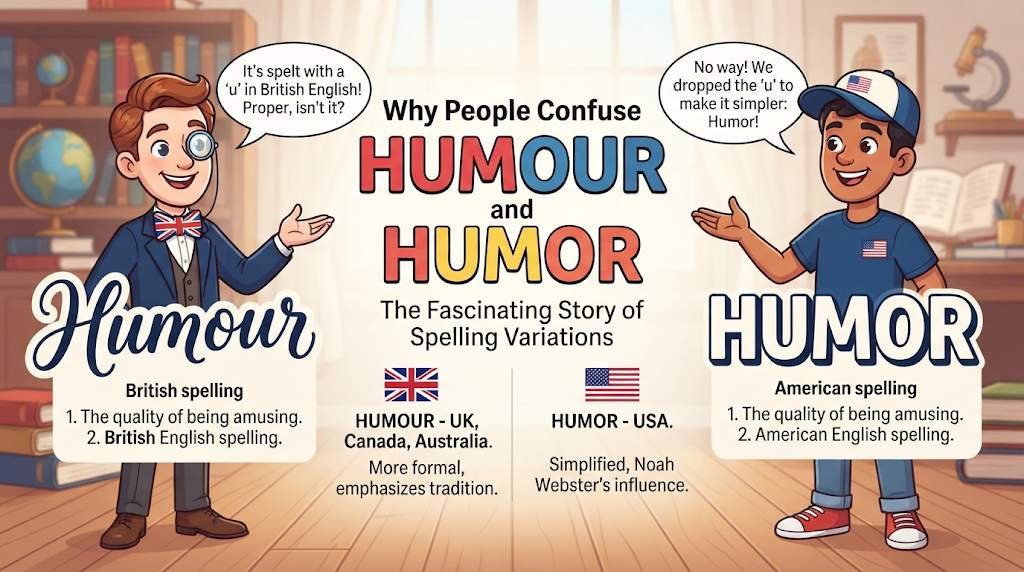
English has two major spelling systems, and they split on many words that end in -our or -or. You see the same pattern in colour/color, favour/favor, and neighbour/neighbor.
Most of us read both versions every day. We see British spelling in news sites, books and films, and American spelling in apps, software and social media. The brain gets used to both, so neither looks fully “wrong.”
Spell checkers add to the mix. If your device is set to US English, it underlines “humour.” Set it to UK English, and “humor” gets the red line.
Humour vs Humor: Key Differences at a Glance
| Feature | Humour | Humor |
| Spelling style | British English | American English |
| Meaning | Funniness, mood, to indulge | Funniness, mood, to indulge |
| Pronunciation | HYOO-mer | HYOO-mer |
| Used in | UK, Australia, New Zealand, India, South Africa, Canada | United States |
| Adjective | humorous | humorous |
| Past tense | humoured | humored |
| -ing form | humouring | humoring |
| Person who writes funny things | humourist | humorist |
The meaning never changes. Only the spelling does.
Meaning and Usage of Humour and Humor
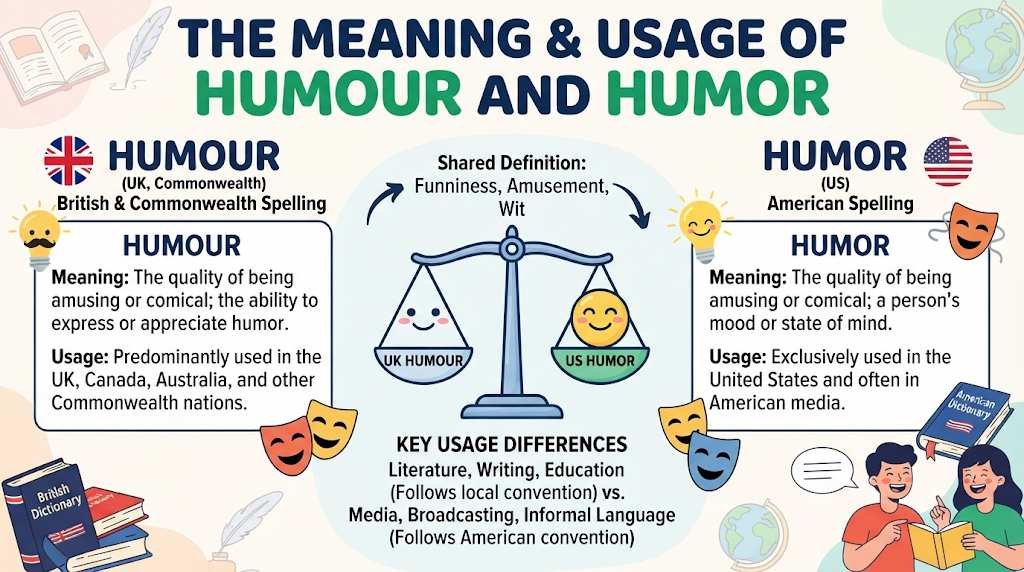
What Does Humour or Humor Mean?
The word has three common meanings:
- The quality of being funny. A joke, a witty remark or a comic scene has humour.
- A person’s mood. Someone can be in good humour or bad humour.
- To go along with someone. You humour a person by playing along with their idea or whim.
Humour or Humor as a Noun
Most of the time, you will use it as a noun. It names the funny quality in something, or a state of mind.
- The show’s dry humour kept the audience laughing.
- Her humor is sharp but never cruel.
- He arrived in foul humour and snapped at everyone.
The second meaning, “mood,” sounds old-fashioned today. You mostly meet it in set phrases like good-humoured and out of humour.
Humour or Humor as a Verb
As a verb, it means to indulge someone, often to keep them calm or happy. You do not have to agree with them. You just let them have their way.
- She humoured her grandfather and listened to the same story again.
- The teacher humored the child’s idea of building a rocket from cardboard.
Is There a Difference in Meaning?
No. Humour and humor are two spellings of one word. The definitions, the grammar and the sound are all the same.
The word humor also appears in medicine. Your eye holds vitreous humour (UK) or vitreous humor (US), the clear gel behind the lens. The spelling rule stays the same.
British English vs American English Spelling
When to Use Humour
Use humour when your audience follows British spelling rules. That includes readers in the UK and most Commonwealth countries. It is also the standard choice for UK exams, school essays and publications.
When to Use Humor
Use humor when you write for an American audience. This applies to US websites, business writing, school work and American brands. If you are unsure who will read your work, check who your main audience is first.
Is Humour or Humor Correct in Canada and Australia?
Canada and Australia both lean toward humour.
- Canada: Canadian spelling keeps the -our ending, so humour, colour and favour are standard. Canadian English also borrows American habits, such as -ize endings, so it is a blend.
- Australia: Australian English follows British norms for these words, so humour is correct.
- New Zealand, India and South Africa: All three generally use humour as well.
You may still see humor in Canada, since American media is everywhere. But for formal writing, humour is the safer pick there.
Which Spelling Should You Use?
Let your reader decide. A quick rule of thumb:
- Writing for the US? Choose humor.
- Writing for the UK, Canada, Australia, India, New Zealand or South Africa? Choose humour.
- Writing for a global audience? Pick one and stick with it. Match the spelling of your main market.
Which Spelling Is Better for Formal Writing?
Neither is better. What matters is that the spelling matches the style guide, institution or audience you are writing for.
Check the rules first. A UK university will expect humour. A US journal will expect humor. If no rule exists, follow the spelling used by most of your readers.
Why Consistency Matters in English Writing
Mixing both spellings in one text looks careless. A reader may wonder if you proofread at all.
Keep these in the same system too:
- humour → colour, favour, honour, neighbour, behaviour
- humor → color, favor, honor, neighbor, behavior
A grammar tool set to the right English variant can catch slips for you.
Humour or Humor in Everyday Phrases
I Like Your Humour or Humor
Both are right, depending on your region. The sentence is a simple compliment about someone’s funny side.
- British: I like your humour. It’s so dry.
- American: I like your humor. It’s so dry.
Sense of Humour or Sense of Humor
This is the most searched phrase of the bunch. It means the ability to enjoy and create funny things.
- UK, Canada, Australia: sense of humour
- US: sense of humor
You can say someone has a great, dry, dark or twisted sense of humour. You can also say they have no sense of humour at all.
Humour Me: Meaning and Examples
“Humour me” is a polite way to ask someone to go along with you, even if they feel unsure. It often comes before a small request.
- Humour me for five minutes and try the new route.
- Just humor me. Read the instructions once before you start.
The phrase can sound playful or slightly impatient. Tone decides which.
Humour or Humor Pronunciation
Both spellings sound the same. Say it as HYOO-mer.
Some speakers drop the “h” and say “YOO-mer,” especially in fast American speech. Both versions are accepted. The stress falls on the first syllable.
Humour or Humor Example Sentences
Examples Using Humour
- The author’s gentle humour made a heavy topic easy to read.
- Our manager has a wonderful sense of humour.
- After a long day, he was in no humour to talk.
- She humoured the toddler by pretending to drink the toy tea.
- The village fête was full of good-humoured chatter.
Examples Using Humor
- The comedian’s humor is full of everyday observations.
- A little humor can calm a tense meeting.
- My sister’s sense of humor runs a bit dark.
- He humored his dad and watched the old movie again.
- The ad worked because its humor felt honest.
Examples in Everyday Conversations
- “You laughed at that terrible joke?” “I was just humouring you!”
- “Try this app for a week, okay?” “Fine, I’ll humor you.”
- “Where’s your sense of humor?” “I left it at the airport.”
- “He’s in a good humour today.” “Great, let’s ask him now.”
Humorous or Humourous: Which Is Correct?
Humorous is correct. Humourous is never correct, not even in British English.
Why the odd rule? When you add -ous to the word, the “u” drops out. British writers keep the “u” in humour, but they remove it in humorous. The same thing happens in glamour → glamorous and vigour → vigorous.
| Word | UK | US |
| Funny (adjective) | humorous | humorous |
| Funny (adverb) | humorously | humorously |
| Wrong spelling | humourous | humourous |
Common Spelling Mistakes and Quick Fixes
| Mistake | Why it’s wrong | Fix |
| humourous | The “u” always drops before -ous | humorous |
| humorus | Missing an “o” | humorous |
| humour (in a US essay) | British spelling in US context | humor |
| humor (in a UK essay) | American spelling in UK context | humour |
| humourist (in US text) | British form | humorist |
| Mixing humour and color | Two systems in one text | humour and colour, or humor and color |
Quick memory trick: British English keeps the “u” in the noun, but “humorous” is the one word that always drops it.
Word Forms and Related Words
Noun Forms
- Humour / humor: the quality of being funny, or a mood
- Humourist / humorist: a person who writes or performs funny material
- Humourlessness / humorlessness: a lack of humour
Verb Forms: Humoured, Humored, Humouring, and Humoring
| Form | British | American |
| Base verb | humour | humor |
| Past tense | humoured | humored |
| -ing form | humouring | humoring |
| Third person | humours | humors |
Adjective: Humorous
Humorous is the same everywhere. It describes something that is amusing or comic.
Related adjectives include humourless / humorless (lacking humour) and good-humoured / good-humored (cheerful).
Related Words and Synonyms
If you want to avoid repeating the word, try:
- wit
- comedy
- levity
- banter
- jocularity
- drollery
- satire
- amusement
Each has a slightly different feel. Wit is clever. Levity is lighthearted. Satire mocks with a point.
Word Origin and History
The word dates back to the mid-1300s. It first meant a fluid or juice, and came from Old French and the Latin word umor, meaning “body fluid.”
Old medicine said the body held four humours: blood, phlegm, yellow bile and black bile. The balance between them was thought to shape a person’s health and temperament. That is how the word came to mean “mood,” and later, “funniness.”
The American spelling took off after Noah Webster pushed for simpler -or endings in the late 1700s and early 1800s. Britain kept the older -our form. Today, that split is the whole difference.
Frequently Asked Questions
Is it spelled humour or humor in English?
Both are correct. Humour is the British spelling, and humor is the American one.
What is the difference between humour and humor?
Only the spelling differs. The meaning, grammar and pronunciation are identical.
Is humour British English and humor American English?
Yes. Humour is used in British English, and humor in American English.
Which spelling of humour or humor should I use in formal writing?
Use the spelling that matches your audience or style guide. Then keep it consistent throughout.
Why do British and American English spell humour differently?
American spelling was simplified in the early days of the United States, with Noah Webster as a key voice. British English kept the older form.
Is humor or humour correct in Canada, Australia, and the UK?
Humour is standard in all three. Canada sometimes uses humor in casual writing because of US influence.
Final Thoughts
Humour and humor are the same word in two outfits. Pick the one that suits your reader, and use it every time. If you are writing for the UK, Canada or Australia, go with humour. For the US, go with humor.
And one last thing to remember: the adjective is always humorous. Skip the “u” there, and you will never get caught out. You can also read our guide on cosy or cozy and our breakdown of totalling or totaling for more pairs like this.