

Respond and response look almost the same, so it is easy to mix them up. But they do different jobs in a sentence. Respond is a verb. Response is a noun.
This guide shows you how each word works, when to use it, and which mistakes to avoid. You will also find real examples for emails, chats, and formal writing, so you can pick the right word every time.
Respond vs Response: Comparison Overview
Here is the short answer. Respond is something you do. Response is something you give or get.
| Respond | Response | |
| Part of speech | Verb | Noun |
| Core idea | The act of answering or reacting | The answer or reaction itself |
| Pronunciation | ri-SPOND | ri-SPONS |
| Example | I will respond tomorrow. | I will send my response tomorrow. |
| Related forms | responds, responded, responding | responses |
If you can put “a,” “the,” “your,” or “my” in front of the word, you need a response. If you can put “will,” “to,” or “can” in front of it, you need to respond.
Definition of Respond
What Does Respond Mean?
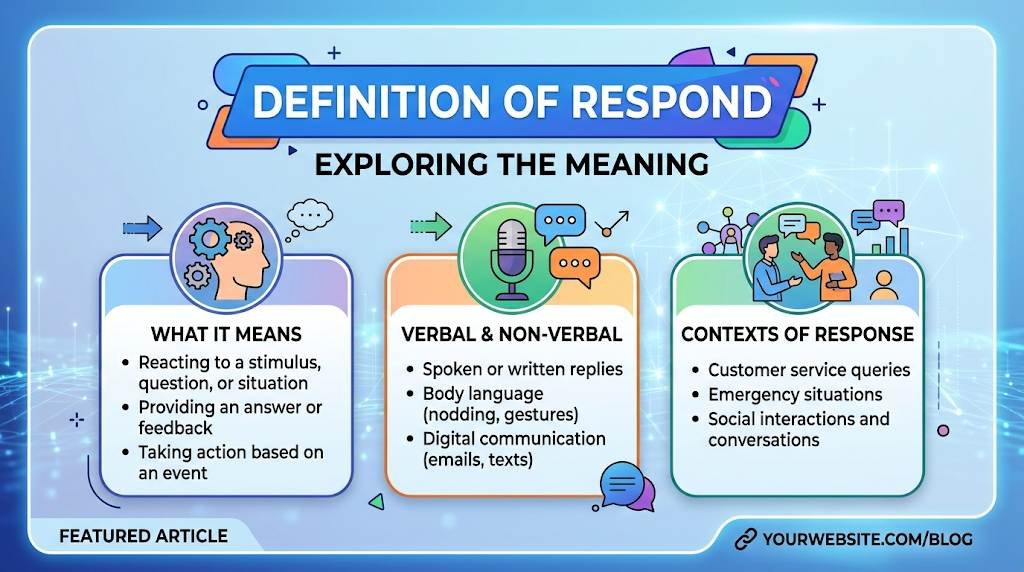
To respond means to say, write, or do something as an answer to a message, question, or event. It is an action word. Someone asks, and you respond.
The word also covers reactions that are not spoken. A patient can respond to treatment. A website can respond to a click. A team can respond to an emergency.
Most of the time, respond is followed by to and the thing being answered.
Respond Examples in Sentences
- She responded to the invitation within an hour.
- Please respond by Friday so we can confirm the booking.
- How did the crowd respond to the new song?
- The app responds quickly, even on slow networks.
- Rescue teams responded to the flood warning at dawn.
- He chose not to respond to the rumor.
Definition of Response
What Does Response Mean?
A response is the answer, reply, or reaction that comes from someone or something. It is a thing. You can send it, wait for it, read it, or rate it.
Response also appears in science, business, and tech. Think of an “immune response,” a “customer response,” or a “server response.”
Response Examples in Sentences
- Her response to the email was short and polite.
- We are still waiting for a response from the landlord.
- The survey got a strong response from young users.
- His quick response saved the project.
- The doctor noted a positive response to the new medicine.
- In response to your question, the answer is yes.
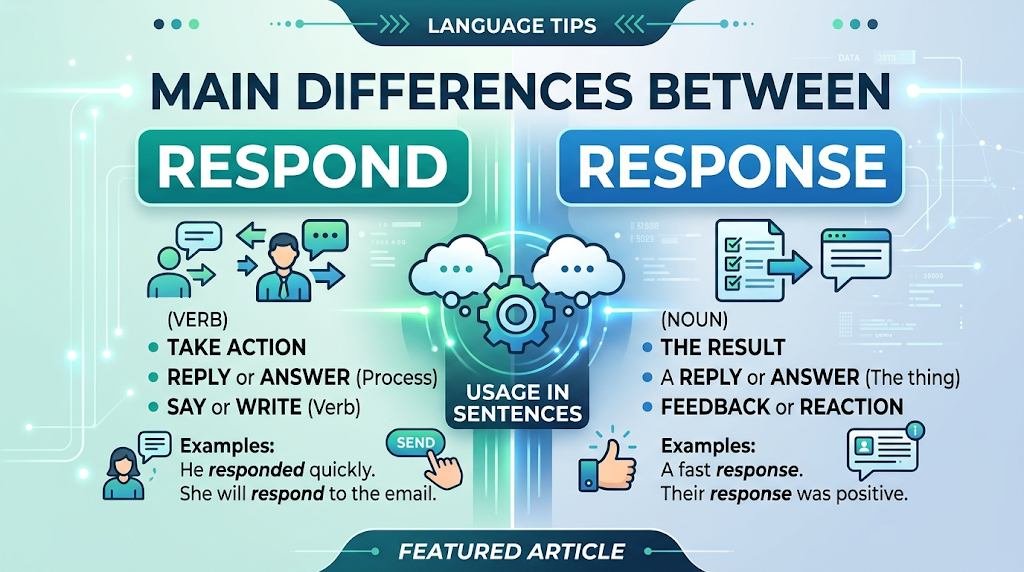
Main Differences Between Respond and Response
Comparison Table
| Feature | Respond | Response |
| Word type | Verb | Noun |
| Used as | An action | A thing or result |
| Common partners | respond to, respond by, respond with | in response to, a response from, a quick response |
| Take an article (a/the)? | No | Yes |
| Can it be pluralized? | No (but takes -s: responds) | Yes (responses) |
| Sample phrase | I will respond soon. | I got your response. |
Respond vs Response: Verb vs Noun
A verb shows action. A noun names a person, place, or thing. That single difference solves most mix-ups.
Try this test. Say the sentence aloud and ask: “Is this an action or a thing?”
- “Please ______ to this email.” This is an action, so use respond.
- “I did not get a ______.” This is a thing, so use response.
A simple memory trick: responD means Do something. ResponSE is Something you send or receive.
How Their Meanings Differ
The two words are close in meaning because they come from the same root. The gap is about focus.
- Respond focuses on the moment of answering. It asks, “What did you do?”
- Response focuses on what came out of it. It asks, “What was the answer?”
Notice how one idea can be written both ways:
- She responded angrily. (the action)
- Her response was angry. (the result)
Both sentences are correct. They just put the spotlight in different places.
Respond or Response in Different Situations
Thank You for Your Respond or Response: Which Is Correct?
The correct phrase is “Thank you for your response.”
After “thank you for,” you need a noun or an -ing word. “Response” is a noun, so it fits. “Respond” is a plain verb, so it does not.
- ✅ Thank you for your response.
- ✅ Thank you for responding.
- ❌ Thank you for your respond.
You will see “thank you for your respond” in forums and comments. It is a common error. Skip it in professional writing.
Respond or Response to an Email
Use respond when you talk about the action. Use response when you talk about the message itself.
- I will respond to your email this afternoon.
- Thanks for your quick response to my email.
- Please respond to this message by noon.
- I haven’t had a response yet.
Subject lines follow the same rule. “Response required” is correct. “Respond required” is not.
Respond or Response in Chat and Text Messages
Chats are casual, but grammar still helps. People often type “response” when they want the verb.
- ❌ Why don’t you response?
- ✅ Why don’t you respond?
- ✅ Sorry for the late response.
- ✅ I’ll respond when I’m home.
Short options also work well in chat: “reply,” “answer,” or “get back to you.” They are friendly and clear.
I Don’t Know How to Respond or Response
The correct sentence is “I don’t know how to respond.”
After “to,” English uses a base verb. “Respond” is the verb, so it fits here.
If you mean the noun, rephrase it: “I don’t know what response to give.” Both sentences are right. They just use different word types.
Please Respond or Response: Which Is Correct?
“Please respond” is correct. You are asking someone to do something, so you need a verb.
Use response when “please” is followed by a request that includes a noun:
- ✅ Please respond by Monday.
- ✅ Please send your response by Monday.
- ❌ Please response by Monday.
Respond to or Response to: What’s the Difference?
Both forms are correct, but they work differently.
- Respond to + noun: I need to respond to the complaint.
- Response to + noun: Her response to the complaint was calm.
You will also see the fixed phrase “in response to,” which means “as an answer to.” For example: In response to your request, we have updated the file.
Other useful patterns include:
- respond with (what you say or do): She responded with a smile.
- respond by (how you act): He responded by calling the manager.
- respond in (the form of the answer): Please respond in writing.
Grammar Guide: How to Use Respond and Response
How Respond Is Used in Sentences
Respond is an intransitive verb in most cases. That means it does not take a direct object. You respond to something, not respond to something.
- ✅ I responded to her message.
- ❌ I responded her message.
When you want a direct object, use another word. “Reply” and “answer” can take the object directly in many cases: I answered the question.
How Response Is Used in Sentences
Response is a noun, so it follows normal noun rules. It can follow an article (a, the), a possessive (my, your, their), or an adjective (quick, honest, written).
- a response
- your response
- an official response
- the response time
It can also be the subject or object of a sentence: The response surprised everyone. We loved the response.
Responds vs Responded vs Responding
| Form | When to use it | Example |
| respond | Base form, plural subjects, after “to” or “will” | They respond fast. |
| responds | Third person singular, present tense | She responds fast. |
| responded | Past tense and past participle | He responded yesterday. |
| responding | Ongoing action, or after “for,” “by,” “when” | Thanks for responding. |
Past Tense of Respond and Other Verb Forms
The past tense of respond is responded. It is a regular verb, so you just add -ed.
- Present: I respond
- Past: I responded
- Past participle: I have responded
- Present participle: I am responding
- Third person: She responds
There is no such form as “respond” for the past tense. Do not write “I respond yesterday.” Write “I responded yesterday.”
Response vs Responses: Singular and Plural
Response is singular. Responses is plural.
- We received one response so far.
- We received twelve responses so far.
“Responses” is common in surveys, forms, interviews, and research papers. In those cases, it often means a collection of answers.
Do not confuse “responses” with “responds.” One is a plural noun. The other is a verb: She responds to every comment, and the responses are thoughtful.
Common Grammar Mistakes to Avoid
- Using “respond” as a noun. ❌ I’m waiting for your respond. ✅ I’m waiting for your response.
- Using “response” as a verb. ❌ She will response soon. ✅ She will respond soon.
- Writing “responds” for the noun. ❌ I read your responds. ✅ I read your responses.
- Dropping “to.” ❌ I will respond your email. ✅ I will respond to your email.
- Writing “respond back.” The word “back” is redundant. ✅ I’ll respond tomorrow.
- Mixing “your” and “you’re.” ✅ Thanks for your response. ❌ Thanks for you’re response.
Simple Rules to Remember
- Need an action? Use respond.
- Need a thing? Use response.
- After “a,” “the,” “your,” or “my”? Use response.
- After “will,” “can,” “to,” or “should”? Use respond.
- Past tense? Use responded.
- More than one? Use responses.
When to Use Respond
Use respond when you describe someone doing the answering. It works for people, groups, machines, and the body.
- Replying to messages: I’ll respond once I’ve read the report.
- Reacting to events: Emergency crews responded within minutes.
- Medical and science contexts: Most patients respond well to the therapy.
- Tech and design: A responsive page responds to screen size.
- Formal requests: Applicants must respond before the deadline.
When to Use Response
Use response when you name the answer or reaction as an item. You can count it, describe it, send it, or measure it.
- Emails and letters: Thank you for your response.
- Customer service: Our average response time is two hours.
- Surveys: We collected 500 responses.
- Public statements: The company issued a response to the report.
- Science and health: The body showed a strong immune response.
How to Use Respond and Response in Professional Writing
In work emails, clarity beats fancy words. A few habits help.
- Open with “Thank you for your response” when someone has replied.
- Use “I will respond by [date]” to set a clear timeline.
- Say “in response to” when you link your message to an earlier one.
- Keep the verb and noun straight in subject lines: “Response needed by Friday.”
- Use “reply” or “get back to you” for a warmer tone.
For example: Thank you for your response. I will respond to the budget questions by Thursday. Both words appear, each in its proper role.
When NOT to Use Respond or Response
There are moments when neither word is the best pick.
- When you mean an emotional or instant reaction. Use react. “She reacted with shock” sounds more natural than “she responded with shock” in some cases.
- When you want a casual tone. “Reply,” “answer,” or “get back to me” often feel more human.
- When the question is simple. “Answer” is shorter and clearer: Please answer yes or no.
- When you use the wrong word class. Never use “respond” after “your” or “a.” Never use “response” after “will.”
- When “responsible” or “responsive” fits better. Those are different words. Responsive means quick to react. Responsible means accountable.
Respond vs Response: Quick Decision Guide
Use this table when you are in a hurry.
| If your sentence needs… | Use | Example |
| An action | respond | I’ll respond tonight. |
| A thing you can send or receive | response | I got your response. |
| A past action | responded | She responded early. |
| An ongoing action | responding | I’m responding now. |
| More than one answer | responses | All responses are in. |
| A fixed phrase meaning “as an answer to” | in response to | In response to your note… |
Quick check: replace the word with “answer.” If “answer” works as a noun, use response. If “answer” works as a verb, use respond.
Real-World Examples of Respond and Response
Everyday Conversation Examples
- “Did she respond to your text?” “Not yet. I’m still waiting for her response.”
- “How should I respond to that comment?” “Just keep your response short.”
- “My dog doesn’t respond to his name.” “That’s a normal response for a puppy.”
- “The coach responded calmly.” “Her response impressed the team.”
Professional Email Examples
- Hello Sam, thank you for your response. I will respond to your questions by Wednesday.
- We are writing in response to your inquiry about pricing.
- Please respond to this message to confirm your attendance.
- Your prompt response is greatly appreciated.
- If we do not receive a response by Friday, we will follow up by phone.
- Our support team usually responds within 24 hours.
Academic and Formal Writing Examples
- Participants responded to a short questionnaire about sleep habits.
- The study measured the cell response to heat stress.
- Researchers analyzed 300 survey responses from graduate students.
- The government responded to the report with new guidelines.
- The committee’s response was published in the annual review.
Respond vs Response: Side-by-Side Examples
| Using respond (verb) | Using response (noun) |
| The manager will respond by noon. | The manager’s response came by noon. |
| Customers responded warmly to the update. | The customer response was warm. |
| Plants respond to light. | A plant’s response to light is called phototropism. |
| Please respond to the survey. | Please submit your survey response. |
| He didn’t respond to my call. | I never got a response to my call. |
Frequently Asked Questions
What is the difference between respond and response?
Respond is a verb that means to answer or react. Response is a noun that means the answer or reaction itself.
Is respond a verb and response a noun?
Yes. Respond is always a verb. Response is always a noun.
When should I use respond or response in a sentence?
Use respond when you need an action word, like “I will respond.” Use a response when you need a thing, like “Thank you for your response.”
Is it correct to say respond to or response to?
Both are correct. Use “respond to” for the action and “response to” for the noun, as in “I will respond to you” and “my response to you.”
What is the correct way to use response in a sentence?
Treat it like any noun. Put it after words like a, the, your, or quick: “Your response was helpful.”
Can respond and response be used interchangeably?
No. They belong to different word types, so swapping them creates a grammar error. You can often rewrite a sentence to use either one, but the form must change.
Final Thoughts
The rule is easy to keep in mind. Respond is what you do, and response is what you give. Once you check whether your sentence needs an action or a thing, the right choice becomes clear.
Next time you write an email, text, or report, run the quick “answer” test or use the decision table above. A few seconds of care will make your writing sharper and more professional. For more pairs like this, see too many vs to many and fair vs fare.