

Is it “camouflage” or “camoflauge”? The word looks simple, yet it trips up writers, students and even careful typists. One misplaced letter and your spell checker lights up red.
This guide gives you the right spelling in seconds. You will also learn what the word means, how to say it, where it came from, and how to remember it for good.
Quick Answer (Camouflage or Camoflauge)
Camouflage is the only correct spelling. Camoflauge is a common misspelling.
The correct order of the end letters is o-u-f-l-a-g-e. The “u” sits right after the “o,” and the word ends in “-age,” like garage and mirage.
Why People Confuse Camouflage and Camoflauge
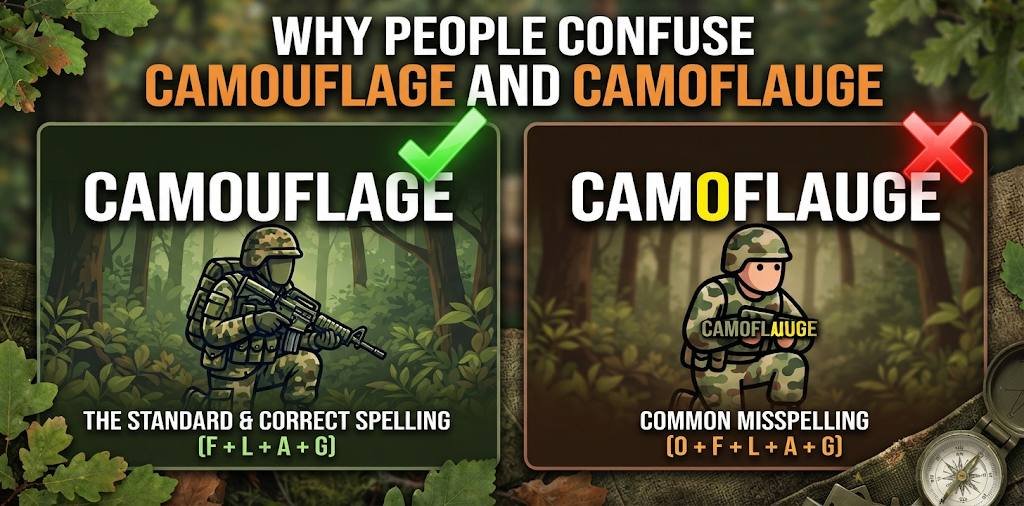
The word has a tricky mix of sounds. We say “KAM-uh-flahzh,” so the middle of the word sounds like “uh.” That sound does not show you which letters to write.
The ending adds more trouble. The “-age” at the end sounds like “-ahzh,” not like the “-age” in a cage or page. Many people guess, and some drop the “u” in the wrong place and write “flauge.”
English readers also see a few similar words, such as flaunt and fauna, which have “au” in them. The brain can pull that pattern into the wrong spot.
Camouflage vs Camoflauge: Key Differences at a Glance
| Feature | Camouflage | Camoflauge |
| Correct? | Yes | No |
| Letter pattern | c-a-m-o-u-f-l-a-g-e | c-a-m-o-f-l-au-g-e |
| Found in dictionaries | Yes | No |
| Origin | French camoufler | Not a real word |
| Safe for formal writing | Yes | Never |
There is no regional difference here. American, British, Canadian and Australian English all use the same spelling.
Why Is Camouflage the Correct Spelling?
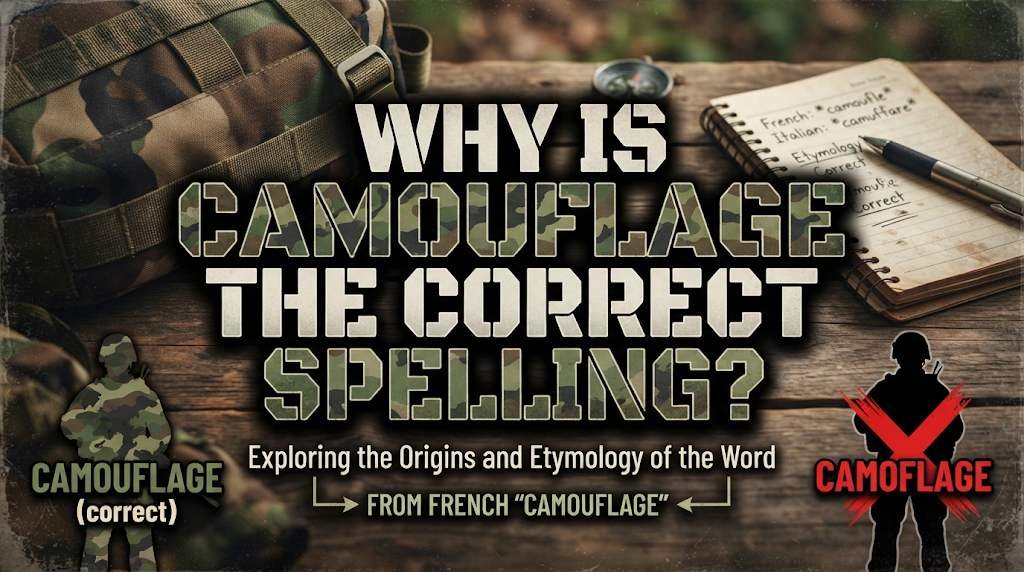
Because English borrowed the word from French and kept the French spelling. Dictionaries list camouflage as the standard form, and no major dictionary lists “camoflauge” as a variant.
Why Is Camoflauge Incorrect?
It breaks the word’s pattern. The real word has “ou” in the middle and “ag” near the end. “Camoflauge” swaps the “u” into the wrong place and creates a sequence (“lau”) that never appears in the original French word.
Spelling tools treat it as an error for this reason. If you see it in a draft, replace it.
Why Do People Misspell Camouflage?
Here are the main causes:
- Sound-based spelling. People write what they hear.
- Letter swapping. The “u” slides to the wrong spot.
- Short-form habit. Most of us say and type “camo,” so the long form is used less often.
- Foreign spelling rules. French spellings do not always match English sound rules.
Other wrong versions you may see include camoflage, camoflague, camouflague and camoufflage. None of them are right.
Meaning and Usage of Camouflage
What Does Camouflage Mean?
Camouflage means hiding something, or making it hard to see, by changing how it looks or by blending it into its surroundings. It can describe paint, nets, leaves, fur, feathers, clothing patterns or even behaviour.
Camouflage as a Noun
As a noun, camouflage is the disguise itself, or the act of disguising.
- Soldiers used branches as camouflage.
- The moth’s wings are perfect camouflage against tree bark.
- His joking tone was camouflage for how nervous he felt.
The noun is uncountable in most uses. You say “a lot of camouflage,” not “many camouflages,” though the plural exists.
Camouflage as a Verb
As a verb, it means to hide or disguise something.
- The crew camouflaged the tent with netting.
- Concealers can camouflage dark circles.
- The company tried to camouflage its losses with creative accounting.
Camouflage in Everyday Language
You will meet the word far outside the army and the wild. People use it in:
- Fashion: camouflage jackets, caps and “camo” prints
- Technology: test cars covered in swirly wraps before launch
- Makeup and home décor: hiding blemishes or a bulky cable box
- Figures of speech: a kind remark can be camouflage for a hidden motive
How to Pronounce Camouflage
Say it as KAM-uh-flahzh. The stress falls on the first syllable.
British and American Pronunciation
The two accents are very close. Some dictionaries also list a version ending in “-flahj,” and you may hear that in casual speech. Both are acceptable. The “g” is soft, like the “s” in measure.
How Many Syllables Are in Camouflage?
Three. Split it like this: cam-ou-flage.
Camouflage in Different Contexts
Animal Camouflage: What Does It Mean?
Animal camouflage means an animal’s colour, shape or pattern helps it avoid being seen or recognised. It helps animals dodge predators or sneak up on prey.
Common types include:
| Type | How it works | Example |
| Background matching | Colour blends with the surroundings | A white hare in snow |
| Disruptive patterning | Bold patterns break up the body outline | A leopard’s spotted coat |
| Countershading | Dark back, light belly | Many sharks and fish |
| Mimicry of objects | Body looks like a leaf or twig | Stick insects |
| Colour change | Skin changes to match the scene | Cuttlefish and octopuses |
What Does Camouflage Pants Mean?
Camouflage pants are trousers printed in a mottled, patchy pattern, usually green, brown, tan or grey. Many people call them camo pants. They began as military gear. Today they are a common style in streetwear, outdoor and hunting clothing.
Camouflage as a Way to Hide or Disguise Something
The word is not limited to colour and cloth. It also covers any trick that hides the truth or the real purpose.
- A cheerful mood can camouflage worry.
- Long sentences can camouflage a weak argument.
- Busy wallpaper can camouflage scuffed walls.
What Does the Camouflage Joke Mean?
The “camouflage joke” is not one single gag. It is a family of jokes built on a simple idea: something is so well hidden that you cannot find it.
You will see it as a blank image with a caption like “Camouflage level: expert.” Another version shows a photo of a cat or bird hiding in plain sight and asks you to find it. Some jokes also poke fun at camo worn in places where it does not blend in at all.
Why Is It Called Camouflage and Not Disguise?
A disguise changes how a person or thing looks, often to fake an identity. Camouflage is narrower. It aims to make something blend in or become hard to notice.
That is why the word fits so well in jokes about invisible things. It also helps that the term came from French slang, so it has a playful ring to many English ears.
How the Camouflage Joke Became a Meme
Image-sharing sites made it easy to post “hidden” things, from empty frames to well-hidden animals. People copied the format and added captions. I could not find a single first post that started it, so it is best to see it as a format that grew over time, not one origin.
Synonyms for Camouflage
Camouflage vs Concealment
Concealment is the act of keeping something out of sight, by any method. You can conceal a gift in a drawer. That is not camouflage, since the drawer does nothing to change how the gift looks. Camouflage hides by blending in.
Camouflage vs Disguise
Disguise changes appearance so a person or object looks like something else. A fake beard is a disguise. A green net over a truck is camouflage. The two overlap, but camouflage is about fitting into the setting.
Other Words Similar to Camouflage
- cover
- mask
- screen
- cloak
- veil
- front
- facade
- guise
- blend in (phrase)
- conceal, hide, obscure (verbs)
Camouflage Example Sentences
Examples of Camouflage as a Noun
- The hunter’s jacket was green camouflage from collar to cuff.
- Sand-coloured feathers give the bird natural camouflage.
- Her jokes were camouflage for a very shy personality.
- Paint and netting provided good camouflage for the vehicle.
Examples of Camouflage as a Verb
- The octopus camouflages itself against the rocks.
- He camouflaged the gap in the fence with a few plants.
- The photographer camouflaged her hide with branches.
- A bold scarf can camouflage a plain jacket.
Examples in Everyday Conversations
- “Where’s the remote?” “It’s the same colour as the sofa. Total camouflage.”
- “Did you see that gecko?” “No, it was camouflaged on the wall.”
- “Nice pants!” “Thanks, they’re camo, but I still stand out.”
- “Why is the new phone covered in tape?” “It’s camouflage for the design.”
Word Forms and Dictionary Details
Camouflage, Camouflages, and Camouflaged
| Form | Part of speech | Example |
| camouflage | noun, verb, adjective | a camouflage net |
| camouflages | noun (plural), verb (3rd person) | She camouflages her nerves. |
| camouflaged | verb (past), adjective | a camouflaged bunker |
Camouflaging: Meaning and Usage
Camouflaging is the -ing form of the verb. It can describe an action in progress or work as a noun.
- The lizard is camouflaging itself on the bark.
- Camouflaging a large building takes careful planning.
Note that the final “e” is dropped before “-ing.” So it is camouflaging, not “camouflageing.”
Word Origin and History
The word comes from the French camoufler, a Paris slang term that meant “to disguise.” Some dictionaries link it to the French camouflet, a puff of smoke, and to the Italian camuffare, “to disguise.” Experts still debate the exact roots.
The word became widely used in English around 1917, during the First World War, when armies began hiding guns, ships and trains. France set up one of the first dedicated camouflage units in 1915. Today the term covers nature, fashion, design and everyday speech.
Common Spelling Mistakes and Quick Fixes
| Wrong spelling | Fix |
| camoflauge | camouflage |
| camoflage | camouflage |
| camoflague | camouflage |
| camouflague | camouflage |
| camoufflage | camouflage |
| camofulage | camouflage |
| camouflageing | camouflaging |
A Simple Trick to Remember the Correct Spelling
Break the word into three chunks: CAM + OU + FLAGE.
Then remember two things:
- The “u” always sits right after the “o” (ou).
- The ending matches gar-age and mir-age. There is no “u” near the end.
Say it slowly a few times and type it once from memory. That usually locks it in.
Frequently Asked Questions
Is it spelled camouflage or camoflauge?
It is spelled camouflage. “Camoflauge” is a misspelling.
What does camouflage mean, and how is it used in a sentence?
Camouflage means hiding something by making it blend in. Example: “The frog’s green skin is perfect camouflage.”
Why do people commonly misspell camouflage as camoflauge?
The word is French in origin, and its sounds do not match its spelling. People write the “u” in the wrong place.
How do you pronounce the word camouflage correctly?
Say KAM-uh-flahzh, with the stress on the first syllable.
What is the difference between camouflage, concealment, and disguise?
Camouflage hides by blending in. Concealment is any act of hiding, and disguise changes how something looks.
What are the different types of animal camouflage, and why is it used?
Main types include background matching, disruptive patterns, countershading, mimicry and colour change. Animals use them to avoid predators or catch prey.
Final Thoughts
The right spelling is camouflage, with “ou” in the middle and “-age” at the end. Once you split it into cam-ou-flage, it becomes much easier to write.
Now you also know what the word means, how it sounds and where it came from. Use it with confidence, whether you are writing about nature, fashion or a clever disguise. You can also read our guide on eyeing vs eying and our breakdown of weiner or wiener for more pairs like this.