

You type a quick message: “I’m comming over in ten minutes.” Something looks off, but you can’t say why. The spelling you want is coming, with a single M.
This guide shows why one M is enough, where the double-M habit comes from, and how to avoid the mistake for good. You will also get clear examples and a short word-form chart.
Quick Answer: Coming or Comming ?
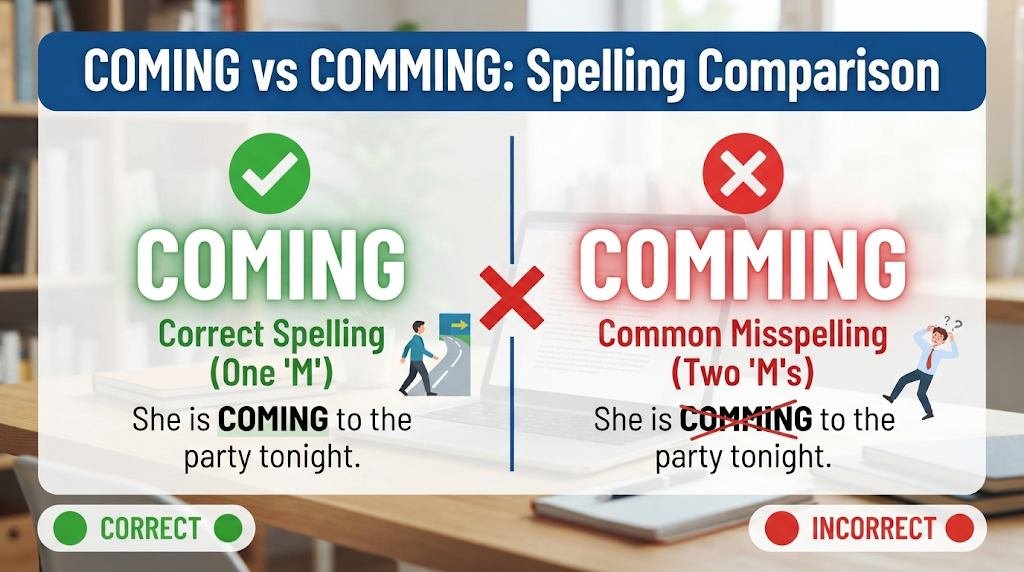
Coming is the correct spelling. Comming is a misspelling.
Coming is the -ing form of the verb come. You drop the silent E from come and add -ing. The M never doubles.
- Correct: “She is coming to the meeting.”
- Incorrect: “She is comming to the meeting.”
Coming vs Comming: Spelling Comparison
| Feature | Coming | Comming |
| Correct spelling? | Yes | No |
| Number of Ms | One | Two |
| Letters | 6 | 7 |
| Built from | come + -ing | Not a valid form of any word |
| Accepted in dictionaries? | Yes | No (an old, obsolete variant at best) |
| Example | “The bus is coming.” | “The bus is comming.” (wrong) |
Why Do People Confuse Coming and Comming?
The mix-up is not random. It comes from a real spelling rule that works for many other words, just not this one.
Confusion With Double-Consonant Rules
English often doubles a final consonant before -ing. Think of run and running, stop and stopping, or sit and sitting. After years of seeing this pattern, it is easy to apply it everywhere.
Come also has a short vowel sound, much like run or sun. So the ear says “double it.” The eye has seen “-mm-” in words like summer, hammer, and comment, and the double M feels natural.
Why the Letter M Is Not Doubled
The doubling rule only applies to certain words. It works when a word ends in a single vowel followed by a single consonant, such as run (u + n).
Come does not end in a consonant. It ends in a silent E. That changes the whole rule, so the M stays single.
Why Is Coming the Correct Spelling?
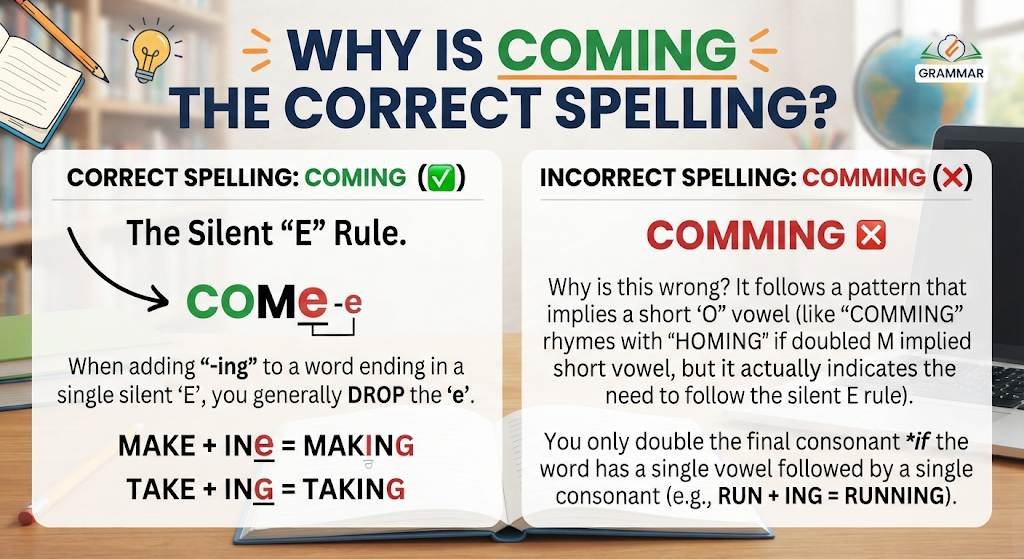
Spelling this word right comes down to one rule about silent E.
The Rule for Adding -ing to Words Ending in Silent E
When a word ends in a silent E, drop the E before adding -ing. Do not double anything.
| Base Word | Add -ing | Result |
| come | come + ing | coming |
| make | make + ing | making |
| write | write + ing | writing |
| hope | hope + ing | hoping |
| leave | leave + ing | leaving |
Come + -ing = Coming
Here it is step by step:
- Start with come.
- Remove the silent e to get com.
- Add -ing to get coming.
The result has one M, one O, and no extra letters.
Coming vs Running and Swimming
Running and swimming look like close cousins, but they follow a different rule. Compare them side by side.
| Word | Ending Pattern | What Happens | Result |
| run | vowel + consonant | Double the final letter | running |
| swim | vowel + consonant | Double the final letter | swimming |
| come | vowel + consonant + silent e | Drop the e | coming |
| hope | vowel + consonant + silent e | Drop the e | hoping |
If the base word ends in E, think “drop, don’t double.”
What Does Coming Mean?
Coming can play three different roles in a sentence. Each one has its own feel.
Coming as a Verb (Present Participle)
This is the most common use. As the present participle of come, it describes action in progress or a planned future event.
- The train is coming around the bend.
- They are coming to dinner on Friday.
- Is anyone else coming with us?
Coming as a Noun
As a noun, coming names an arrival or the act of showing up. It appears in a few set phrases.
- The coming of spring brought warmer evenings.
- The town was full of comings and goings.
- Many people wait for the Second Coming in religious teaching.
Coming as an Adjective
As an adjective, coming means “approaching” or “next.” It sits before a noun.
- Please plan around the coming holiday.
- She is working hard for the coming exams.
- He is an up-and-coming chef in the city.
Is Comming Ever a Correct Word?
No. In modern English, comming is not a word and has no meaning. Older texts sometimes show it as a past spelling variant, but it is considered obsolete today.
You may spot it in a person’s name or a brand title. Those are special cases. For ordinary writing, there is no right time to use it.
Comming as a Common Spelling Mistake
This error is easy to make because it looks almost right. Fast typing, a missed autocorrect, or a habit from the doubling rule can all cause it.
Search engines and spell checkers flag it, but they don’t catch every instance. A quick proofread solves it.
Coming vs Comming Examples in Everyday English
Reading the correct form in real sentences builds the habit faster than memorizing rules.
Coming in Daily Conversations
- “Are you coming to the game tonight?”
- “My cousin is coming over after lunch.”
- “Dinner is almost ready, so keep coming this way.”
Coming in School and Workplace Writing
- The professor said new grading rules are coming next semester.
- A schedule update is coming from the HR team on Monday.
- Thank you for coming to the project review.
Coming in Questions and Statements
| Type | Sentence |
| Question | “Who is coming to the workshop?” |
| Question | “When are the guests coming?” |
| Statement | “The new manager is coming on Tuesday.” |
| Statement | “Better weather is coming this weekend.” |
Coming in Formal and Informal Sentences
| Tone | Sentence |
| Formal | “The committee is coming to a decision by Friday.” |
| Formal | “We appreciate you coming to the briefing.” |
| Informal | “I’m coming, give me two minutes!” |
| Informal | “Is Sam coming or what?” |
The spelling stays the same in every tone. Only the style around it changes.
What Does Coming Soon Mean?
Coming soon means something will be available or will happen in the near future. It builds anticipation without giving an exact date.
Coming Soon in Everyday English
In casual talk, people use it to hint at something that is on the way.
- “Summer break is coming soon.”
- “My new apartment is coming soon, I just need the keys.”
Coming Soon in Announcements and Advertising
Businesses use this phrase on signs, websites, and social media posts. It is a short way to promote a product, show, or store opening.
- A bakery places a “Coming Soon” banner on its new shop window.
- A film studio shares a trailer with “Coming Soon to theaters.”
- An app page shows “Dark mode: coming soon.”
Misspelling it as “comming soon” looks careless on a public sign, so always double-check the spelling.
Common Spelling Mistakes Related to Coming
Three errors show up again and again. Knowing them helps you catch them in your own work.
Comming vs Coming
This is the double-M mistake, and the most frequent of the three.
- Wrong: He is comming tomorrow.
- Right: He is coming tomorrow.
Comeing vs Coming
Here the writer keeps the silent E and adds -ing. The E has to go.
- Wrong: They are comeing home soon.
- Right: They are coming home soon.
Applying the Wrong Consonant-Doubling Rule
Some writers over-apply the run/running rule to words that end in silent E. The same slip happens with other words.
| Wrong | Right |
| hopping (when you mean hoping) | hoping |
| makking | making |
| writting | writing |
| comming | coming |
Note that hopping is a real word, but it means “jumping.” Doubling the P changes the meaning of hoping completely.
Coming: Word Forms, Synonyms, and Related Words
Come is an irregular verb. Its forms are worth knowing, since they are some of the most used in English.
Base Form: Come
The simple, dictionary form. Use it with I, you, we, they, and after to or will.
- “They come here every summer.”
- “I will come early.”
Past Tense: Came
The simple past is came. It describes a finished action.
- “She came to the party late.”
- “The package came yesterday.”
Past Participle: Come
The past participle is the same as the base form. Use it with has, have, or had.
- “He has come a long way.”
- “We had come to a stop.”
Present Participle: Coming
This is the -ing form. Use it with am, is, are, was, or were.
- “I am coming now.”
- “They were coming home when it rained.”
| Form | Word | Example |
| Base | come | “Please come in.” |
| Third person | comes | “She comes by every Sunday.” |
| Past | came | “He came back late.” |
| Past participle | come | “It has come to this.” |
| Present participle | coming | “I’m coming!” |
Synonyms and Similar Words
Depending on the sentence, you can swap coming for one of these.
| Meaning | Synonyms |
| Arriving | arriving, approaching, nearing, showing up |
| Next, in the future | upcoming, forthcoming, impending, future |
| Happening soon | imminent, on the way, around the corner |
| Rising in success | emerging, promising, up-and-coming |
Frequently Asked Questions
Is It Coming or Comming, and Which Spelling Is Correct?
Coming is correct. Comming is a spelling mistake.
Why Is Coming Spelled With One M Instead of Two?
The base word come ends in a silent E, which is dropped before -ing. The M is not doubled because the doubling rule applies to words ending in a consonant.
Is Comming a Real Word or a Common Spelling Mistake?
It is not a real word in modern English. It is a common typo and spelling error for coming.
How Do You Use Coming in a Sentence?
Use it as a verb after am, is, or are: “My sister is coming tomorrow.” It can also be a noun (“the coming of winter”) or an adjective (“the coming week”).
What Is the Spelling Rule for Adding -ing to the Word Come?
Drop the silent E, then add -ing. That gives come → coming.
What Is the Difference Between Come, Coming, and Came?
Come is the base form, coming is the -ing form for ongoing or planned actions, and came is the simple past tense.
Final Thoughts
The answer to the coming vs comming question is simple. Coming is the only correct spelling, and it follows the silent E rule: drop the E, add -ing. The doubled M in comming comes from a rule that does not apply here.
Keep the pattern in mind, and you can spell coming, making, writing, and hoping with ease. Before you hit send or publish, take a quick glance at any “-ing” word, and you will not be caught out again. The same doubling question appears in putting vs puting, and the drop-the-E rule behind it is the one in suing vs sueing.


1 thought on “Coming vs Comming: Which Is Correct? Meaning, Spelling & Examples (2026)”