

You are typing an email to a supplier, and you stop. Is it “vender” or “vendor”? Both look fine, and the answer is not as simple as “one is wrong.”
Here is the short version. One spelling is standard, one is a rare variant, and one is a Spanish verb. This guide sorts all three out with clear examples.
Quick Answer
Vendor is the correct, standard spelling in English. It means a person or company that sells goods or services.
Vender is a rare variant spelling. Merriam-Webster lists it, but it is much less common, and it appears mainly in The New Yorker’s house style. In Spanish, vender is a verb that means “to sell.”
Why People Confuse Vender and Vendor
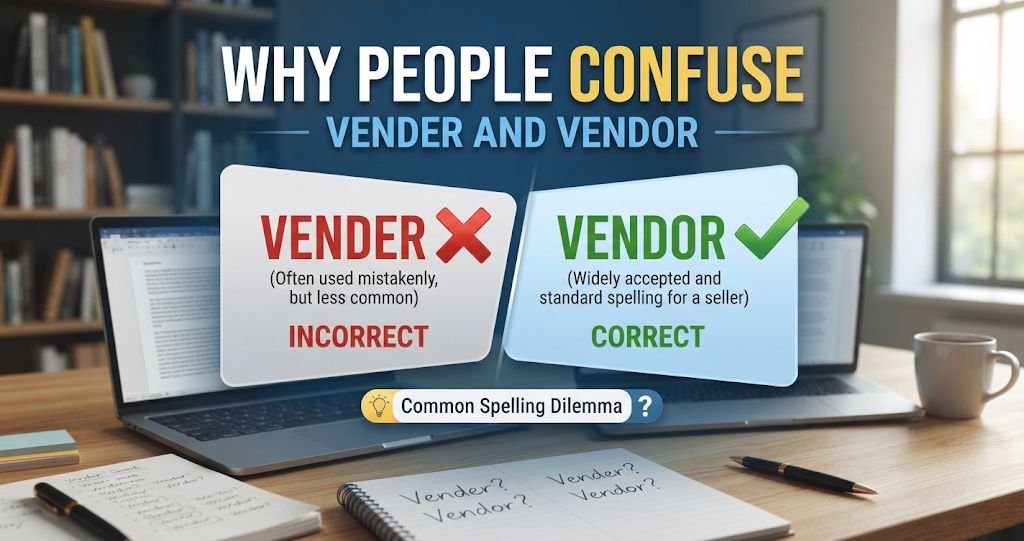
Both words sound almost the same in English. The last syllable is unstressed, so the ear cannot tell “-er” from “-or.”
The grammar adds to the mix. Most English words that name a person doing something end in “-er,” like painter, baker and seller. So “vender” feels logical: vend + er.
Then there is the Spanish link. Many people meet “vender” first as a Spanish verb. That makes the spelling look familiar in an English sentence too.
Vender vs Vendor: Key Differences at a Glance
| Feature | Vendor | Vender |
| Standard in English | Yes | No |
| Listed in dictionaries | Yes, as the main entry | Yes, as a less common variant |
| Meaning in English | A seller | A seller (same meaning) |
| Meaning in Spanish | Not a Spanish word | “To sell” (verb) |
| Typical use | Business, retail, legal, tech | The New Yorker, older texts |
| Safe for formal writing | Yes | Only if a style guide asks for it |
Are Vender and Vendor the Same Word?
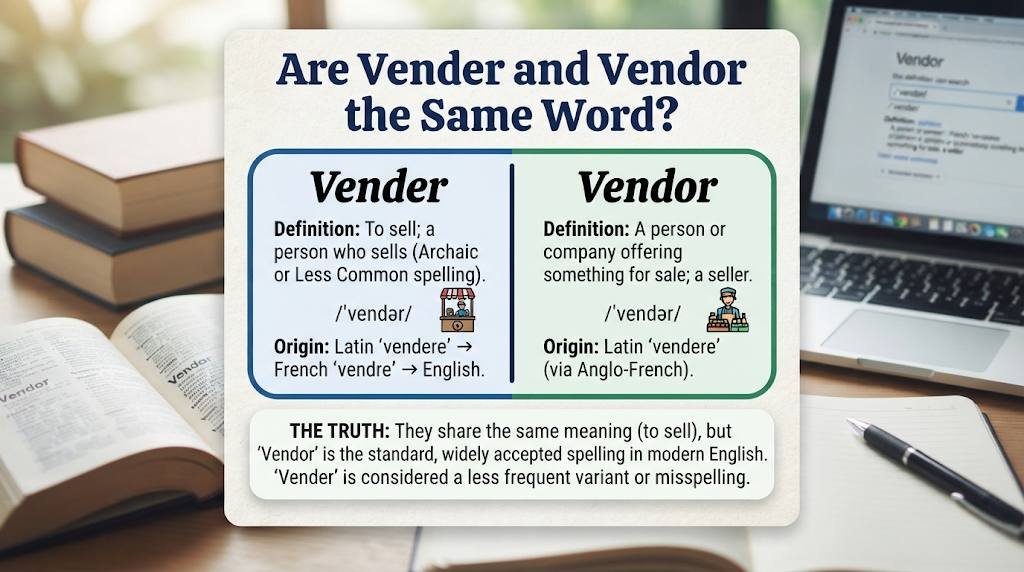
In English, yes. They are two spellings of the same noun with the same meaning. One is mainstream, and the other is a minor variant.
Is Vender a Real Word in English?
Yes, but barely. Merriam-Webster lists vender as a “less common” variant of vendor. Its legal entry also shows it as a variant.
That does not make it a good choice. Many spelling guides label it a mistake or an outdated form. If a reader sees “vender,” they will probably think it is a typo.
Why Is Vendor the More Common Spelling?
Three reasons stand out:
- History. The word came into English from Anglo-French, and the first known English use of vendor dates to 1594.
- Legal and business habits. Many legal terms use the “-or” ending for the person who gives or sells, such as grantor, lessor and mortgagor. Vendor fits that group.
- Sheer usage. One analysis of a large American English text collection found that vendors appeared more than 100 times as often as vender once The New Yorker was set aside.
Vender or Vendor in American and British English
Which Spelling Is Used in American English?
Vendor. It is the standard in American dictionaries, news writing, business and law. You will see “street vendor,” “food vendor” and “software vendor” everywhere.
Which Spelling Is Used in British English?
Vendor as well. I found no dictionary support for the idea that “vender” is a British spelling. A few low-quality sites claim it, but major dictionaries and real usage point to vendors on both sides of the Atlantic.
So unlike words such as colour/color, this is not a UK vs US split.
Is Vender an Accepted Alternative Spelling?
Technically, yes. Merriam-Webster records it. In practice, most editors would change it to vendor.
Use vender only if a style guide tells you to. Otherwise, choose a vendor and move on.
Why Does The New Yorker Use Vender Instead of Vendor?
If you have read the magazine, you may have noticed “venders” and thought it was a typo. It is not. It is a deliberate choice.
The New Yorker’s Editorial Spelling Preference
The magazine has a famously strict house style. It also uses other unusual spellings, such as “coöperate” with a diaeresis, “focussed,” and “marvellous.”
Writers on usage often explain the “vender” choice by pointing to the general “-er” rule for people who do an action. It follows a similar logic to adviser vs advisor. In both cases, the “-er” form is the older one, and “-or” became more common over time.
Should You Use Vender in Your Own Writing?
Probably not. Here is a quick guide:
| Situation | Best choice |
| Business emails, reports, contracts | vendor |
| School and university essays | vendor |
| Websites and blog posts | vendor |
| Writing for The New Yorker | vender (house style) |
| Quoting a text that uses “vender” | keep the original spelling |
What Does Vendor Mean in English?
A vendor is a person or business that sells something. The “something” can be a physical product, food, software or a service.
Vendor as a Noun
Vendor is a noun. It is a countable word, so you can have one vendor or many vendors.
- The vendor delivered the chairs on Friday.
- We compared three vendors before choosing one.
Common Types of Vendors
| Type | What they sell | Example |
| Street vendor | Snacks, drinks, small goods | A man selling roasted corn |
| Food vendor | Meals at events and markets | A taco stand at a festival |
| Market vendor | Crafts, produce, clothes | A stall at a farmers’ market |
| Software vendor | Apps and IT systems | A company selling accounting software |
| Hardware vendor | Devices and equipment | A laptop maker |
| Service vendor | Cleaning, security, catering | A catering company |
Vendor in Business and Everyday English
In everyday talk, a vendor is often a small seller you meet in person. In business, it is a company that supplies goods or services to another company.
Large firms keep lists of approved vendors, pay them through purchase orders and invoices, and review them for quality and price. That is why phrases like vendor management and vendor onboarding are so common in offices.
What Does Vender Mean in Spanish?
In Spanish, vender is a verb that means “to sell.” It is pronounced roughly “ben-DER,” with the stress on the last syllable.
Both the Spanish vender and the English vendor trace back to the Latin verb vendere, “to sell.”
Vender as a Spanish Verb
Vender is a regular “-er” verb. Here is the present tense:
| Person | Spanish | English |
| yo | vendo | I sell |
| tú | vendes | you sell |
| él / ella | vende | he / she sells |
| nosotros | vendemos | we sell |
| ellos / ellas | venden | they sell |
The seller is a vendedor (or vendedora). The past participle is vendido, and the -ing form is vendiendo.
Vender vs Vendor: English and Spanish Meanings
| English | Spanish | |
| vendor | A seller (noun) | Not used |
| vender | A rare spelling of vendor (noun) | To sell (verb) |
| vendedor | Not used | A seller (noun) |
So the Spanish word for the person is “vendedor,” while “vender” is the action. This is a handy point if you translate between the two languages.
Examples of Vender in Spanish Sentences
- Quiero vender mi bicicleta. (I want to sell my bike.)
- Ella vende frutas en el mercado. (She sells fruit at the market.)
- Vendimos todas las entradas. (We sold all the tickets.)
- Se vende casa. (House for sale.)
- Voy a vender mi coche el mes que viene. (I’m going to sell my car next month.)
Vendor in Business and Reselling
Vendor vs Reseller: What’s the Difference?
A vendor is the company that makes or supplies a product. A reseller buys that product from the vendor and sells it on to customers, often adding support, setup or bundles.
For example, a software company is the vendor. A local IT shop that sells and installs that software is the reseller. In casual speech the terms blur, so check the context.
What Is a Vendor Code?
A vendor code is a unique number or ID a company gives each approved vendor in its records. It helps the finance and purchasing teams match invoices, orders and payments to the right supplier.
Common Vendor Terms and Phrases
- Vendor management: tracking and reviewing suppliers
- Third-party vendor: an outside company that provides a service
- Vendor lock-in: being stuck with one provider because switching is costly
- Vendor-neutral: not tied to one company’s products
- Approved vendor list: companies cleared to supply a business
- Vendor agreement: a contract between a buyer and a seller
Synonyms for Vendor and Vender
Vendor vs Seller
Seller is the plain, general word. Vendor often sounds a bit more formal or business-like, and often points to a regular or professional seller.
Vendor vs Supplier
The two are often used as if they mean the same. A supplier usually provides materials or goods to another business, often in bulk. A vendor can sell to either a business or the public.
Vendor vs Vendee
A vendee is the buyer, mainly in legal language. The vendor sells, and the vendee buys. You will see both terms in property and sales contracts.
Other Words for Vendor
- seller
- supplier
- merchant
- trader
- retailer
- dealer
- hawker
- peddler
- stallholder
How to Pronounce Vendor and Vender
Vendor Pronunciation
Say VEN-der. The stress is on the first syllable. In some legal uses, you may hear ven-DOR, with the stress on the second syllable.
Vender Pronunciation
In English, vender sounds the same: VEN-der. You cannot hear the spelling difference when someone speaks.
In Spanish, it is ben-DER, and the “v” sounds like a soft “b.”
Vender or Vendor Example Sentences
Examples Using Vendor
- The coffee vendor opens at six every morning.
- Our IT vendor will fix the server tonight.
- Please send the invoice to the vendor by Monday.
- Each vendor at the fair needs a permit.
Examples Using Vender
These show the variant spelling and the Spanish verb:
- The magazine printed “venders” in its house style. (English variant)
- Ella quiere vender su casa. (Spanish: She wants to sell her house.)
- No podemos vender más entradas. (Spanish: We can’t sell any more tickets.)
Examples in Business and Everyday Conversations
- “Who is our main vendor for packaging?” “It’s the same one as last year.”
- “Can I pay the vendor in cash?” “Most stalls here take cards too.”
- “Did the vendor confirm the delivery date?” “Not yet, I’ll chase them.”
- “Which vendor made this app?” “A small firm in Austin.”
Word Forms and Dictionary Details
Vendor and Vender Plural Forms
The plural is vendors. If you use the variant, it is venders.
| Singular | Plural |
| vendor | vendors |
| vender (variant) | venders |
| vendee | vendees |
Do not add an apostrophe. “The vendor’s stall” shows ownership. “The vendors are here” is the plural.
The Verb Vend: Meaning and Usage
Vend is a verb that means “to sell,” especially small items or things sold through a machine or on the street. It also appears in law.
- The kiosk vends hot snacks and drinks.
- Vending machines accept coins and cards.
Related forms include vending, vended and vendible (able to be sold).
Word Origin and History
Vendor came into English from Anglo-French vendur or vendour, which came from the verb vendre, “to sell.” That verb goes back to Latin vendere. The first known English use of vendor is from 1594.
The “-er” version is older. Some usage discussions note that vendor gradually took over from vender, much as advisor has been gaining on adviser.
Common Spelling Mistakes and Quick Fixes
| Mistake | Why it’s an issue | Fix |
| vender (in business writing) | Rare variant, looks like a typo | vendor |
| vendar | Wrong vowel | vendor |
| vendors’ (for plural only) | Apostrophe not needed | vendors |
| vendee for seller | Vendee means buyer | vendor |
| vendedor in English text | Spanish word for seller | vendor |
How to Remember the Spelling of Vendor
Link it to its legal partner. Vendor / vendee and lessor / lessee all use “-or” for the person who sells or gives, and “-ee” for the person who receives. If you can spell vendee, you can spell vendor.
A second trick: pair it with other business words that end in “-or,” such as distributor, contractor and investor. Each names a party in a deal.
Frequently Asked Questions
Is it spelled vender or vendor, and which spelling is correct?
Vendor is the standard and correct spelling. Vender is a rare variant.
Is vender a real English word or an outdated spelling of vendor?
It is listed as a less common variant, but most writers treat it as outdated or a typo. Use vendors.
What does vender mean in Spanish?
In Spanish, vender is a verb that means “to sell.”
Why does The New Yorker spell vendor as vender?
It is part of the magazine’s long-standing house style. Other publications do not follow it.
What is the difference between a vendor, seller, and supplier?
A seller is the general term. A vendor is a seller, often in a business setting, and a supplier usually provides goods to other businesses.
What is the plural of vendor, and how do you spell it correctly?
The plural is vendors, with no apostrophe.
Final Thoughts
Use vendors in almost every case. It is the standard spelling in American and British English, and it is what readers expect in business, news and everyday writing.
Keep vender for two situations only: the Spanish verb that means “to sell,” or a house style like The New Yorker’s that requires it. Once you know that, the choice is easy. You can also read our guide on totalling or totaling and our breakdown of labelling or labeling for more pairs like this.