

You add up a bill, glance at your sentence, and freeze. Is it totalling with two Ls, or totaling with one? Spell-checkers don’t always agree, and that makes it harder.
The short version is that both are right, depending on where you write. This guide explains why, shows when to use each, and clears up the car-crash meaning too.
Quick Answer (Totalling or Totaling)
Totaling (one L) is the American English spelling. Totalling (two Ls) is the British English spelling.
Both mean the same thing: adding numbers together, reaching a sum, or, in slang, destroying a car. The past tense follows the same split: totaled in the US and totalled in the UK.
| American English | British English | |
| Present participle | totaling | totalling |
| Past tense | totaled | totalled |
| Base verb | total | total |
Pick one style and use it for the whole piece.
Why People Confuse Totalling and Totaling
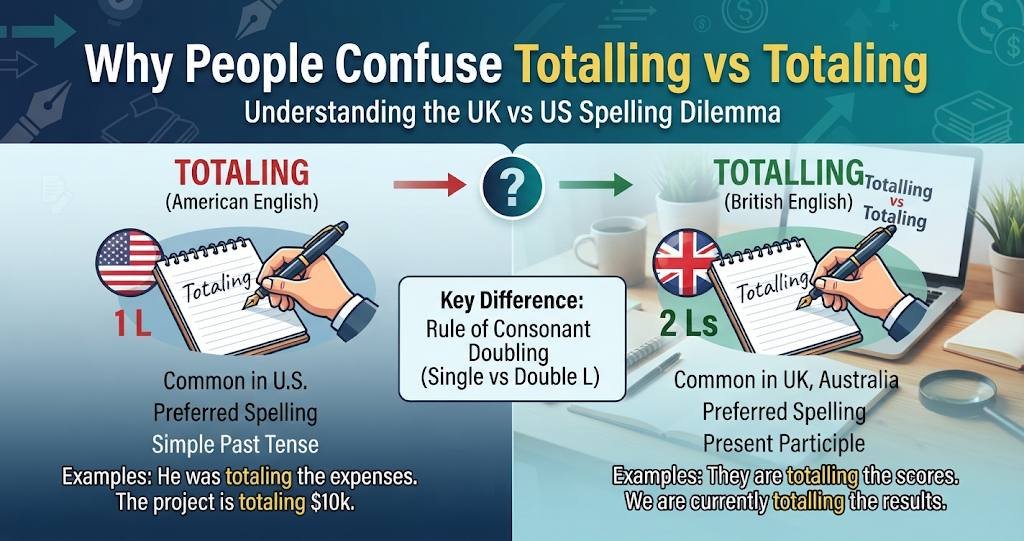
English has two major spelling systems, and they split on a handful of verbs. Writers see both versions online every day, so each one starts to look right.
Spell-check tools add to the confusion. They often default to US English, so a British writer sees a red line under totalling even though it is correct in their style.
Then there is the logic problem. The base word is total, so adding -ing seems like it should give totaling. The extra L feels random if nobody has explained the rule.
Totalling vs Totaling: Key Differences at a Glance
| Feature | Totalling | Totaling |
| Number of Ls | Two | One |
| Region | UK, Ireland, and most Commonwealth countries | United States |
| Meaning | Same | Same |
| Part of speech | Verb form (-ing) | Verb form (-ing) |
| Past tense | Totalled | Totaled |
| Formality | Standard in UK writing | Standard in US writing |
The only real difference is spelling. The meaning, grammar and pronunciation stay the same.
Meaning and Usage of Totalling and Totaling
What Does Totalling Mean?
Totalling is the British form of the -ing verb. It describes adding things up, or coming to a certain sum.
- “The invoices are totalling more than we expected.”
- “She spent the evening totalling the shop’s receipts.”
What Does Totaling Mean?
Totaling is the American form of the same verb. It does the same job in a US sentence.
- “The repair costs are totaling nearly a thousand dollars.”
- “He is totaling the scores from each round.”
Do Totalling and Totaling Have the Same Meaning?
Yes. There is no difference in meaning, tone or grammar. The only thing that changes is the regional spelling.
Think of it like colour and color. Readers in either place will understand you, but a local reader may notice if your spelling doesn’t match their style.
What Does It Mean to Total a Car?
To “total” a car is slang for wrecking it so badly that it is not worth repairing. It comes from the idea of a “total loss.”
Insurers decide this by comparing repair costs with the car’s value. The exact cutoff differs by insurer and by place. In the UK, people more often say a car was written off.
- “He totaled his truck on an icy road.”
- “She totalled her van, but she walked away unhurt.”
Why Does Totalling Have Two Ls in British English?
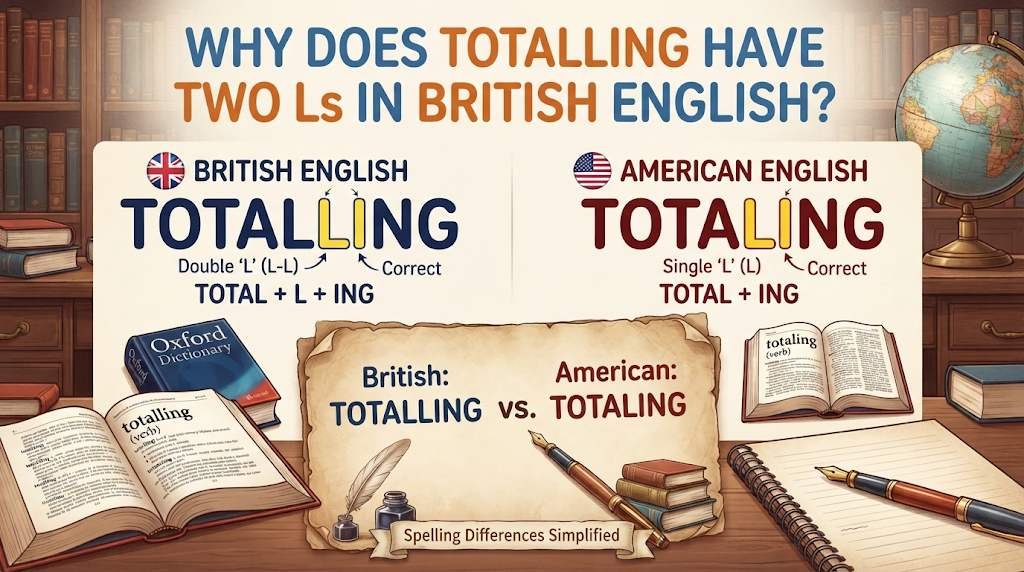
The British English Spelling Convention
British English tends to double a final L when adding an ending such as -ed or -ing to a verb. This applies even when the stress is not on the last syllable.
That is why you see:
- travel → travelling
- cancel → cancelling
- label → labelling
- total → totalling
The American English Spelling Convention
American English usually doubles a final consonant only when the last syllable is stressed. In total, the stress falls on the first syllable (TO-tal), so the L stays single.
The same logic gives traveling, canceling and labeling in the US. Noah Webster’s early spelling reforms in the 1800s helped set this simpler pattern in American writing.
| Base word | British | American |
| total | totalling | totaling |
| travel | travelling | traveling |
| cancel | cancelling | canceling |
| model | modelling | modeling |
| signal | signalling | signaling |
Totalling or Totaling: Which Spelling Should You Use?
When to Use Totalling in British English
Use totalling if you write for readers in the UK, Ireland, or other places that follow British conventions. Australia and New Zealand also lean this way, and Canadian writing often accepts it as well.
This matters for UK business emails, local news, school work and government copy.
When to Use Totaling in American English
Use totaling if your audience is in the United States. It also suits US companies, American publications and anything following a US style guide.
Which Spelling Is Better for Formal Writing?
Neither is better. Formal writing depends on consistency and audience, not on one form being fancier.
A UK university essay should use totalling. A US research paper should use totaling. Check the style guide or the instructions you were given, and follow them.
Should You Mix British and American Spellings?
No. Mixing looks careless and can make readers doubt your editing.
Here is a quick check. If you write colour, organisation and totalling, you are in British style. If you write color, organization and totaling, you are in American style. Keep every word in the same group.
Totalling or Totaling in Different Contexts
Totalling or Totaling in Business and Accounting
In finance, the word means summing up figures. A UK accountant might be totalling a column of expenses, while a US bookkeeper is totaling the same column.
Reports often use the noun instead: “The total came to £4,200” or “The total came to $4,200.”
Totalling or Totaling in Personal Finance
Everyday money talk uses it for bills, savings and grocery receipts.
- UK: “Our monthly bills are totalling more than £900.”
- US: “Our monthly bills are totaling more than $900.”
Totalling or Totaling in Education
Teachers use it for marks, grades and points. Students also use it when they check their own scores.
- “The marks for the three papers are totalling 212.”
- “The points from all the quizzes are totaling 95.”
Totalling or Totaling in Sports
Sports writers use it for goals, runs, points and medals across a season.
- UK: “He ended the season with goals totalling 28.”
- US: “She finished the season with points totaling 612.”
Totalling or Totaling in Car Insurance
Here the word often means declaring a car a total loss. It is common in US claims talk.
- “The adjuster is totaling the car after the flood.”
- “Our insurer is totalling the vehicle after the collision.”
UK insurers more often use terms like write-off in formal letters, so check your policy language.
Totalled or Totaled: Which Spelling Is Correct?
What Does Totalled Mean?
Totalled is the British past tense and past participle. It means added up, or, in slang, wrecked beyond repair.
- “The bill totalled £62.”
- “Their car was totalled in the crash.”
What Does Totaled Mean?
Totaled is the American version of the same form.
- “The bill totaled $62.”
- “Their car was totaled in the crash.”
How to Spell Total in the Past Tense
Follow your regional style. Here is a quick guide.
- Writing for the UK, Ireland, Australia or New Zealand: totalled.
- Writing for the US: totaled.
- Writing for Canada: check your style guide, since both appear.
- Writing for a global audience: pick one style and apply it everywhere.
Totalling or Totaling: Pronunciation
Both are pronounced the same: TOH-tuh-ling. The double L in British spelling does not change the sound.
The stress falls on the first syllable. The past tense is TOH-tuld.
So you can use either spelling when speaking, because no one can hear the difference.
Totalling or Totaling in a Sentence
British English Example Sentences
- “The charity’s donations are totalling £15,000 this month.”
- “He has been totalling till every night since Monday.”
- “The extra costs totalled almost a quarter of the budget.”
- “She is totalling up the marks before the meeting.”
American English Example Sentences
- “The charity’s donations are totaling $15,000 this month.”
- “He has been totaling the register every night since Monday.”
- “The extra costs totaled almost a quarter of the budget.”
- “She is totaling the scores before the meeting.”
Examples Using Totalling an Amount
- “We’re totalling the receipts to see what we owe.” (UK)
- “I’m totaling the receipts to see what we owe.” (US)
- “Adding up the donations and totalling them took an hour.”
- “After totaling the fees, the final amount was clear.”
Synonyms and Related Words
Synonyms for Totalling and Totaling
| Meaning | Words |
| Adding up | summing, adding, tallying, counting, tabulating |
| Reaching a figure | amounting to, coming to, running to, adding up to |
| Wrecking (slang) | destroying, writing off, demolishing, wrecking |
Other Forms of the Word Total
| Form | UK | US |
| Base verb | total | total |
| Third person | totals | totals |
| Present participle | totalling | totaling |
| Past tense | totalled | totaled |
| Noun | total | total |
| Adjective | total | total |
| Adverb | totally | totally |
You may also see totalise (UK) and totalize (US), but they are rarer and have a more technical meaning, such as combining into a whole or a betting system.
Common Phrases Containing Total
- Grand total
- Sub-total
- Running total
- Total loss
- Total cost
- In total
- Total up
- Total recall
- Totalled out
- Complete and total
Common Mistakes (and Quick Fixes)
Mistake #1: Assuming One Spelling Is Incorrect
Neither one is a mistake. They belong to different regions. Fix: Match your spelling to your audience.
Mistake #2: Mixing British and American Spellings
Writing “totalling” next to “color” confuses the style. Fix: Use a single variant, and set your editor’s language to match.
Mistake #3: Thinking the Meaning Changes
Some writers think the two-L version means something different. It does not. Fix: Remember that spelling shifts by region, not by meaning.
Mistake #4: Confusing Totalled and Totaled
People use totaled in a UK document or totalled in a US one. Fix: Use the same L rule across all forms: totalling and totalled, or totaling and totaled.
Mistake #5: Applying Spelling Rules Without Checking Exceptions
The doubling rule has exceptions, so don’t apply it blindly. For example, parallel becomes paralleled in both styles, and worship has both worshipped and worshiped. Fix: When unsure, check a trusted dictionary.
Dictionary-Style Word Details
Part of Speech
Total works as a verb, a noun and an adjective. Totalling and totaling are the -ing forms of the verb, so they can act as a verb form or as a gerund.
Verb Meaning and Usage
As a verb, total means:
- To add up numbers: “Please total the column.”
- To amount to: “The cost totals £300.”
- To wreck something completely (slang): “He totaled the motorcycle.”
Noun Meaning and Usage
As a noun, total means the whole amount or sum.
- “The total was higher than I thought.”
- “A running total keeps track as items are added.”
The adjective total means complete: “a total surprise.”
Word History
Total came into English from the French word total, which grew from Latin totus, meaning “whole” or “all.” The verb sense of adding up developed later, and the slang use for wrecking a car emerged in 20th-century American English.
Frequently Asked Questions
Is It Totalling or Totaling, and Which Spelling Is Correct?
Both are correct. Use totalling in British English and totaling in American English.
What Is the Difference Between Totalling and Totaling in British and American English?
There is no difference in meaning. Totalling has two Ls in British spelling, and totaling has one in American spelling.
Why Does British English Use Totalling With Two Ls While American English Uses Totaling With One L?
British English usually doubles a final L before -ing or -ed. American English only doubles a consonant when the last syllable is stressed, which is not the case in total.
Is Totalling or Totaling Correct in Formal and Academic Writing?
Both are correct in formal writing. Choose the one that matches your audience or style guide, and stay consistent.
What Is the Correct Spelling of Totalled or Totaled in Past Tense?
Use totalled for British English and totaled for American English.
Do You Spell It Totalling or Totaling When Calculating a Final Amount or Sum?
It depends on your region. Use totalling in the UK and totaling in the US, since the meaning is the same.
Final Thoughts
Totalling and totaling are two spellings of one verb. The two-L form is British, the one-L form is American, and the meaning never changes.
Choose the style that fits your readers, and keep every related word in the same style. Check your editor’s language setting, and you will rarely get this one wrong.
You can also read our guide on traveled vs travelled and our breakdown of labelling or labeling for more pairs like this.


1 thought on “Totalling or Totaling: Which Is Correct? Meaning, Spelling & Examples (2026)”