

You may have typed a message and paused on this phrase. Does it need a space, or can you squeeze it into one word? It’s a small detail, but it shows up in emails, texts, and essays every day.
This guide settles the question for good. You’ll get the correct spelling, the meaning, grammar rules, and plenty of examples you can use right away.
Of Course or Ofcourse: Quick Answer
“Of course” is correct. “Ofcourse” is a spelling error. The phrase is always written as two separate words in standard English, in both American and British writing.
| Spelling | Correct? | Verdict |
| Of course | ✅ Yes | Standard spelling |
| Ofcourse | ❌ No | Common typo, avoid it |
Correct: Of course, I’ll send the report by noon. Incorrect: Ofcourse, I’ll send the report by noon.
Comparison Overview (Of Course or Ofcourse)
Here is a side-by-side look at the three look-alikes people mix up most often.
| Feature | Of course | Ofcourse | Off course |
| Correct in standard English | Yes | No | Yes (different meaning) |
| Number of words | Two | One (invalid) | Two |
| Part of speech | Adverbial phrase | None | Adverb or adjective phrase |
| Meaning | Naturally, certainly, obviously | No meaning | Away from the intended path |
| Example | Of course you can join us. | Ofcourse you can join us. | The boat drifted off course. |
What Does “Of Course” Mean?
Definition and Meaning of Of Course
“Of course” is an adverbial phrase. It means naturally, certainly, or as expected. You use it to agree, to give permission, or to point out something that is obvious.
The phrase has been in English since the 1540s. It started as “of the ordinary course,” meaning something that follows the normal order of things. That origin still explains the modern sense: it signals that something is expected or goes without saying.
How to Use Of Course in a Sentence
“Of course” does three main jobs:
- To agree or say yes: “Can you cover my shift?” “Of course.”
- To grant permission: Of course you may borrow my notes.
- To state the obvious: Of course the store is closed on a public holiday.
Tone matters. Said warmly, it sounds generous. Said flatly, it can suggest the question was silly. Context and delivery decide which one the reader hears.
What Does “Yes, of Course” Mean?
“Yes, of course” is a stronger, friendlier way to say yes. The word “yes” gives the answer, and “of course” adds that you agree readily and without hesitation.
“Would you mind waiting a moment?” “Yes, of course. Take your time.”
Be careful with context. If someone asks, “Do you mind if I sit here?” then “Of course not” is the natural reply, not “Of course.” The wording of the question changes what you need to say.
Is “Ofcourse” a Correct Word?
Why Ofcourse Is Incorrect
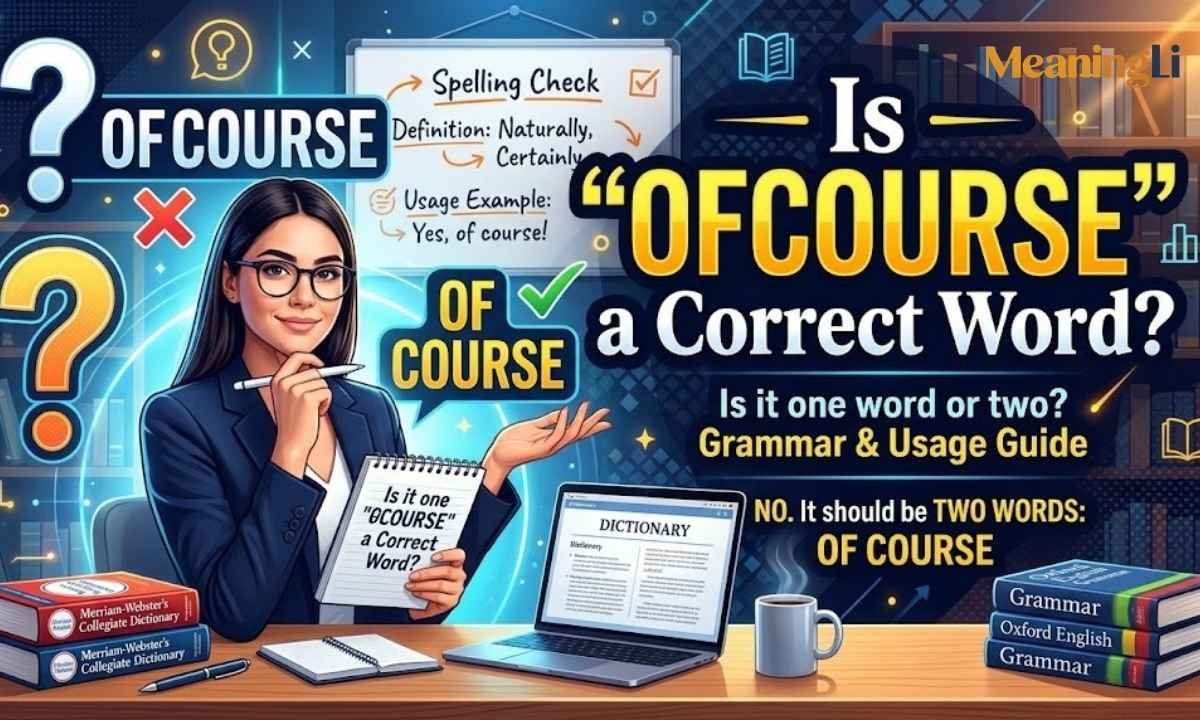
No. “Ofcourse” is not a word in any standard dictionary or style guide. “Of course” is made of the preposition of and the noun course, and together they form a fixed phrase. Fixed phrases like this stay as separate words, just as “in fact” and “at least” do.
Spell checkers will flag “ofcourse” with a red underline, and editors will correct it. In professional writing, the error can make a polished message look careless.
Why People Commonly Misspell Of Course
The mistake is easy to understand. Several habits cause it:
- Fast typing: The space bar gets skipped when you type quickly, especially on phones.
- Speech patterns: In spoken English the phrase runs together as one sound, so it feels like one word.
- Look-alike compounds: Real one-word terms such as “offhand” and “outcome” make a merged spelling seem plausible.
- Autocorrect gaps: Some messaging apps leave the error alone.
A quick fix is to read the phrase back slowly. If you can hear two beats, “of” and “course,” write two words.
Of Course or Ofcourse: Main Differences
Spelling and Grammar Differences
The differences are simple, and a short list covers them:
- “Of course” is a valid two-word adverbial phrase.
- “Ofcourse” is an invalid one-word spelling that breaks the standard form.
- Grammar rules (commas, placement, tone) apply only to “of course.”
Of Course or Ofcourse in British and American English
There is no regional split here. Both American and British English use “of course” as two words. Neither variety accepts “ofcourse.”
| Variety | Accepted spelling | Accepts “ofcourse”? |
| American English | of course | No |
| British English | of course | No |
| Australian / Canadian English | of course | No |
The only differences you may notice are habits of punctuation and tone. British writers often add commas more freely, while American writers tend to use fewer.
Of Course vs. Off Course: What Is the Difference?
These two sound nearly identical, but they mean different things.
- Of course means naturally or certainly.
- Off course means away from the intended path or plan.
Of course: Of course I remember your birthday. Off course: The storm pushed the ship off course.
Memory trick: “off course” has a double f because the thing has moved off its path. If you mean “naturally,” you need the single f.
Grammar Rules for Using Of Course
Should You Use a Comma After Of Course?
It depends on where the phrase sits in the sentence.
| Position | Rule | Example |
| Start of sentence | Comma after | Of course, we can reschedule. |
| Middle of sentence | Commas on both sides | The team, of course, will attend. |
| End of sentence | Comma before | We’ll be there, of course. |
| Standalone reply | No comma needed | “Will you help?” “Of course!” |
| After “yes” or “but” | “Yes, of course” takes a comma; “but of course” usually doesn’t | But of course you’re welcome. |
Commas mark a pause. If you wouldn’t pause when speaking, you can often leave the comma out, especially in a short, tight sentence like Of course I will.
Can Of Course Start or End a Sentence?
Yes, to both. It’s flexible.
- Starting: Of course, the meeting starts at nine.
- Ending: You’ll need a ticket, of course.
- Standing alone: Of course.
Starting a sentence with “of course” feels natural in speech and informal writing. Ending with it works well when you’re adding a small, obvious extra detail.
Common Of Course Grammar Mistakes
Watch for these slip-ups:
- Writing it as one word: “ofcourse” instead of “of course.”
- Mixing it up with “off course”: The plan went of course should be off course.
- Missing commas in the middle of a sentence: The manager of course approved it reads better with commas around the phrase.
- Overusing it: Repeating “of course” can sound patronizing or filler-heavy.
- Misjudging tone in formal emails: It can imply the other person should have known the answer.
Of Course Examples in Sentences
Of Course in Everyday Conversations
- “Can I borrow your charger?” “Of course!”
- Of course I’ll pick you up from the airport.
- You’ll want an umbrella, of course.
- “Did you save me a seat?” “Of course I did.”
- Of course she said yes. They’ve been planning this for months.
Of Course in Formal and Professional Writing
- Of course, we would be glad to arrange a follow-up call.
- The committee will, of course, review every application.
- Of course, any changes must be approved in writing.
- We will, of course, keep your details confidential.
In professional writing, use it sparingly and with a warm tone. When it replaces a real explanation, a clearer phrase usually works better.
Yes, Of Course: Example Sentences
- “Are you free Thursday?” “Yes, of course.”
- Yes, of course, I can explain the process.
- “Could you send it again?” “Yes, of course. One moment.”
- Yes, of course you can bring a guest.
Incorrect Ofcourse Examples and Their Corrections
| ❌ Incorrect | ✅ Correct |
| Ofcourse I’ll be there. | Of course I’ll be there. |
| Yes, ofcourse I can help. | Yes, of course I can help. |
| Ofcourse, the invoice is attached. | Of course, the invoice is attached. |
| We ofcourse accept cards. | We, of course, accept cards. |
| The pilot went, of course. | The pilot went off course. |
Synonyms and Alternatives to Of Course
“Of course” is useful, but repeating it can make writing feel flat. These alternatives let you adjust tone and keep your message fresh.
Formal Alternatives to Of Course
| Alternative | Example |
| Certainly | Certainly, I can prepare that summary. |
| Absolutely | Absolutely, the files will be ready today. |
| Naturally | Naturally, we will cover the shipping cost. |
| Without question | Without question, the deadline can be extended. |
| By all means | By all means, please join the discussion. |
| Undoubtedly | Undoubtedly, the results support the plan. |
| Indeed | Indeed, the policy applies to all staff. |
Informal Alternatives to Of Course
| Alternative | Example |
| Sure | Sure, I’ll grab you a coffee. |
| You bet | You bet, I’ll be there at six. |
| No problem | No problem, happy to help. |
| Definitely | Definitely, count me in. |
| For sure | For sure, let’s meet up Friday. |
| Totally | Totally, that sounds great. |
| Obviously | Obviously, we’ll wait for you. |
Pick the option that matches your audience. “Certainly” suits a client email, while “you bet” suits a chat with a friend.
Frequently Asked Questions
Is it of course or ofcourse? Which spelling is correct?
“Of course” is correct and should always be written as two words. “Ofcourse” is a common misspelling that no dictionary accepts.
What does “of course” mean in English, and when should you use it?
It means “naturally” or “certainly.” Use it to agree, give permission, or point out something obvious.
Why is “ofcourse” incorrect, and is it ever accepted as one word?
“Ofcourse” is incorrect because “of course” is a fixed phrase made of two separate words. No standard style guide accepts it as one word.
How do you use “of course” in a sentence? Give examples.
Place it at the start, middle, or end of a sentence, or use it alone as a reply. For example: Of course, I’ll help, or “Can you come?” “Of course!”
Is “of course” formal or informal, and is it appropriate for professional writing?
It is neutral, so it works in both casual and professional writing. In formal messages, use it sparingly, since it can sound dismissive if the point isn’t truly obvious.
What are some common alternatives to “of course,” and when should you use them?
Use “certainly,” “absolutely,” or “naturally” in formal writing. Use “sure,” “you bet,” or “no problem” in casual conversation.
Final Thoughts
The answer is simple: “of course” is always two words. “Ofcourse” is a typo, and no variety of English accepts it. Remember the “two beats” trick, and you’ll get it right every time.
Beyond spelling, a few habits make your writing stronger. Use commas where you’d naturally pause, keep “off course” for things that have wandered from their path, and vary your wording with the alternatives above. Small choices like these make your writing look polished and trustworthy.
Keep exploring with these commonly confused words: Happy Holiday or Happy Holidays, To Fast or Too Fast, and Soo vs So.


4 thoughts on “Of Course or Ofcourse: Which Is Correct? Meaning, Difference & Examples (2026)”