

You have probably typed “soo excited” in a text and “so excited” in an email without thinking twice. But is there a real difference between “soo” and “so”, or is one simply a typo?
Here is the short answer: “so” is the standard word, and “soo” is an informal, stretched-out spelling used to add feeling. This guide explains what each one means, where each belongs, and how to avoid awkward mistakes.
What Is the Difference Between “Soo” and “So”?
“So” is the correct, dictionary-approved word. “Soo” is a casual spelling of “so” that writers use to sound more expressive. The meaning stays the same. Only the tone changes.
Think of “soo” as the written version of drawing out a word when you talk. When you say “That was sooo good,” your voice stretches the vowel. Typing extra “o”s copies that sound on screen.
| Feature | So | Soo |
| Standard English | Yes | No |
| Found in dictionaries | Yes | No (as a casual spelling) |
| Tone | Neutral | Playful, emotional |
| Best for | Emails, essays, reports, daily writing | Texts, chats, captions, comments |
What Does “So” Mean?
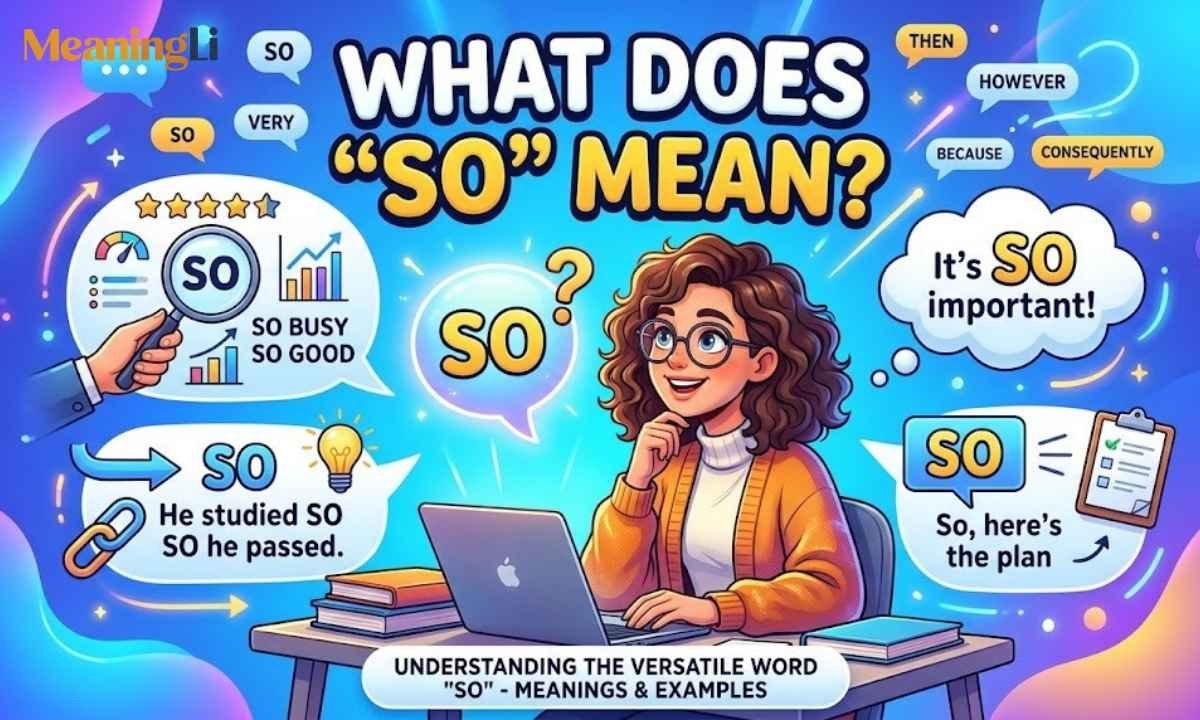
“So” is one of the most flexible words in English. It can work as an adverb, a conjunction, or an intensifier, and it appears in dozens of fixed phrases. The meaning depends on how the word is used in the sentence.
“So” as an Adverb
As an adverb, “so” describes how, how much, or in what way something happens. It often means “to such a degree” or “in this way.”
- The soup is so hot that I can’t taste it.
- Hold the frame just so.
- “Is the shop open on Sundays?” “I believe so.”
In the last example, “so” stands in for a whole idea, which saves you from repeating it.
“So” as a Conjunction
As a conjunction, “so” connects two clauses and shows a result or a purpose.
Result:
- The train was late, so we missed the first act.
- She forgot her charger, so her phone died.
Purpose (often “so that”):
- I set three alarms so I wouldn’t oversleep.
- He spoke slowly so that everyone could follow.
A quick test: if you can replace “so” with “therefore” or “as a result,” it is showing a result.
“So” as an Intensifier
An intensifier makes an adjective or adverb stronger. “So” is a very common one, especially in speech.
- This playlist is so relaxing.
- You are so kind to help.
- The movie ended so suddenly.
Compared with “very,” “so” usually sounds warmer and more personal. “I’m very glad” sounds polite. “I’m so glad” sounds like you mean it.
Common Expressions With “So”
Many everyday phrases rely on “so.” Learning them helps you sound natural.
| Expression | Meaning | Example |
| So far | Until now | So far, the plan is working. |
| So what? | Why does it matter? | We lost a point. So what? We still won. |
| So be it | Fine, let it happen | If they say no, so be it. |
| And so on | Continuing the same pattern | Pack shirts, socks, and so on. |
| So-so | Average, not great | The pizza was so-so. |
| Or so | Approximately | It took an hour or so. |
| So to speak | In a manner of speaking | He is, so to speak, the team’s engine. |
| So much for | That plan has failed | So much for a quiet weekend. |
What Does “Soo” Mean in Texting?
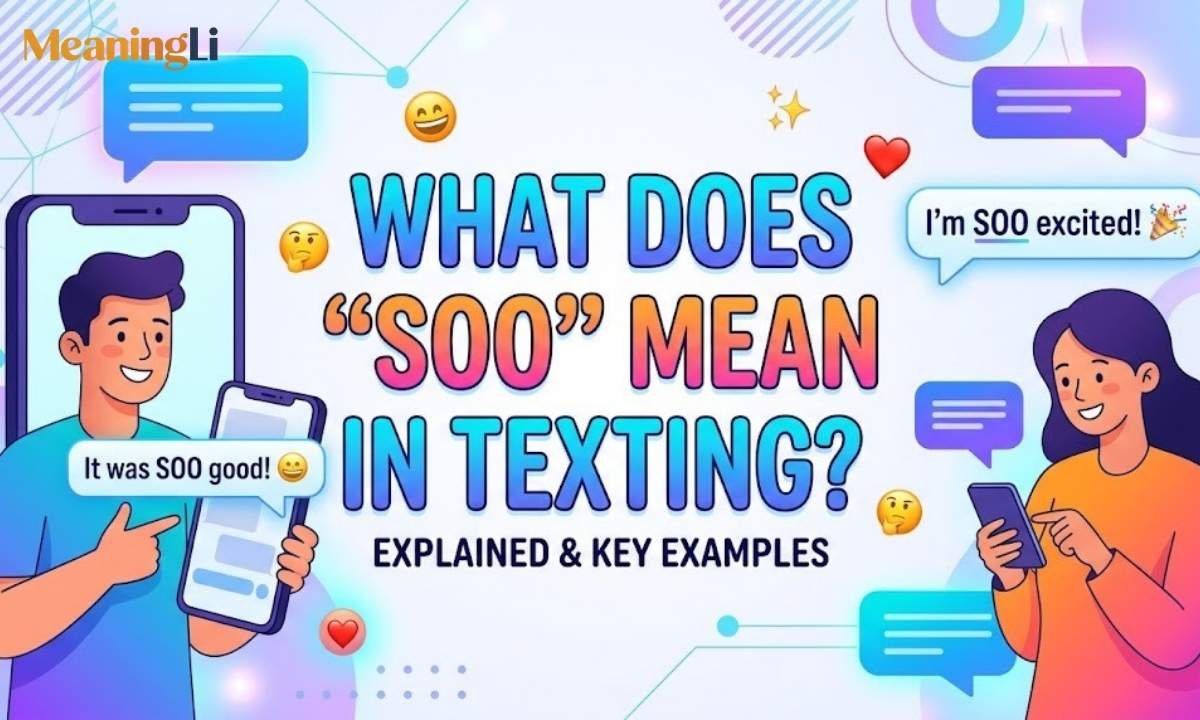
In texting, “soo” means exactly what “so” means: very, really, or extremely. The extra “o” signals that the feeling is stronger than usual. It does not add a new definition.
For example, “I’m tired” is plain. “I’m soo tired” tells the reader you are properly exhausted.
Why Do People Write “Soo” Instead of “So”?
There are a few simple reasons:
- To copy speech. People stretch words out loud, so they stretch them in writing too.
- To show emotion. Text has no tone of voice. Extra letters fill that gap.
- To sound friendly. “Soo cute” feels more casual than “so cute.”
- To stand out. On busy feeds, a stretched word catches the eye.
- Habit. After seeing it everywhere, many people type it without thinking.
Linguists call this habit word lengthening or elongation. It is a well-studied feature of online writing, and it usually adds emphasis or personality rather than meaning.
Is “Soo” a Real Word?
Not in the formal sense. Standard dictionaries list “so,” not “soo,” as the word to use. “Soo” is best described as an informal spelling.
There is one catch. “Soo” also exists as a proper noun. In the Great Lakes region, “the Soo” is a nickname for the Sault Ste. Marie locks and area. “Soo” is also a common name in Korea, as in many given names. These uses have nothing to do with the intensifier, and context makes them easy to spot.
What Does “Soo” Mean on Social Media?
On social platforms, “soo” works as an emphasis marker in captions, comments, and replies. You will see it in lines like:
- Soo proud of this team.
- This view is soo pretty.
- Monday came soo fast.
Some people go further with “sooo” or “soooo.” More letters usually mean more feeling, though there is no official scale. Brands and creators often use it to sound relatable, so it is common in informal marketing too.
“Soo” vs. “So”: Comparison Table
| Point of Comparison | So | Soo |
| Meaning | Very, therefore, in this way | Very (with extra emphasis) |
| Word type | Adverb, conjunction, intensifier | Informal variant of “so” |
| Accepted in dictionaries | Yes | No |
| Tone | Neutral to warm | Casual, excited, playful |
| Used in formal writing | Yes | No |
| Used in texts and chats | Yes | Yes |
| Can show result or purpose | Yes | No, rarely used this way |
| Example | It was so cold, so we stayed in. | It was soo cold today! |
“Soo” vs. “So” Grammar Rules
The grammar rules belong to “so.” “Soo” simply borrows them, so the same sentence patterns apply. The only real question is whether the setting allows a casual spelling.
Standard Spelling vs. Informal Spelling
Standard spelling is the form found in dictionaries and style guides. It is what teachers, editors, and employers expect. For this word, that is “so.”
Informal spelling bends the rules for effect. It is fine in relaxed settings where the reader knows you are being casual. It is risky in professional ones, where it may look careless.
A simple guide:
- Writing to a boss, client, teacher, or stranger? Use so.
- Writing to a friend, family member, or your followers? Soo is fine.
Does Adding Extra “O”s Change the Meaning?
No. Extra “o”s change the mood, not the meaning. “So,” “soo,” “sooo,” and “soooo” all point to the same idea. The longer versions simply sound louder and more exciting.
One caution: don’t overdo it. A string of ten “o”s can look exaggerated or even sarcastic, depending on the reader.
“So Pretty” or “Soo Pretty”: Which Is Correct?
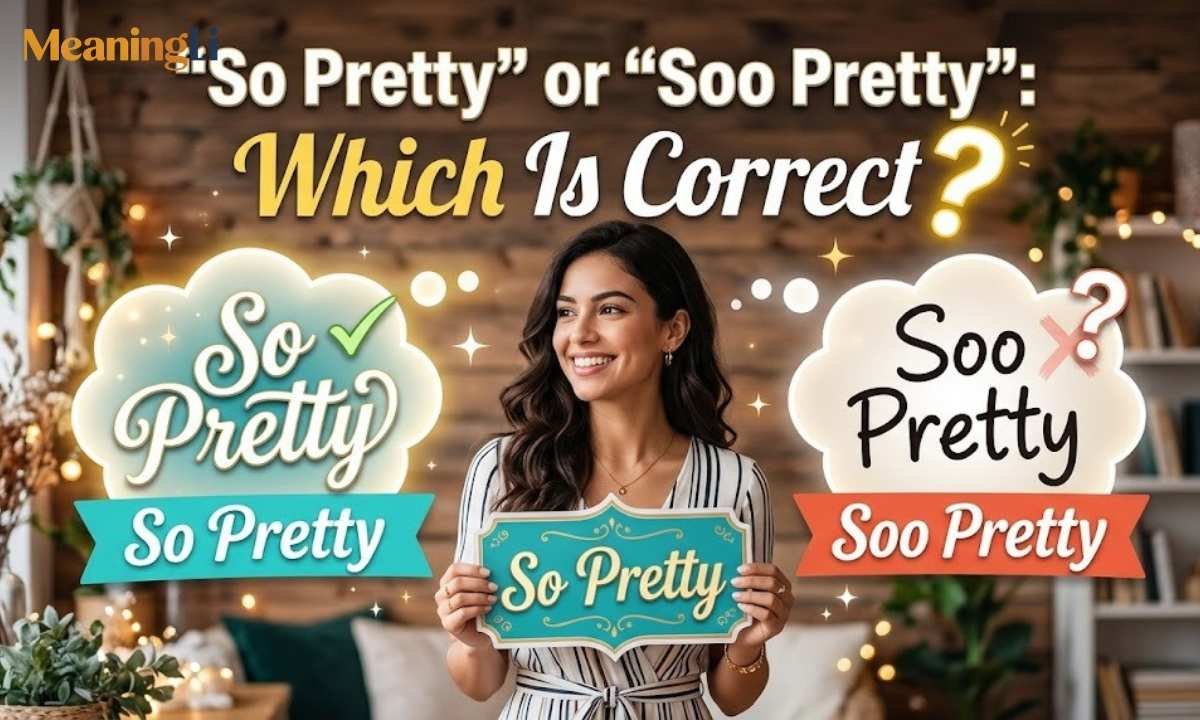
“So pretty” is the correct standard form. “Soo pretty” is acceptable only in casual chats and social posts. Both express the same admiration, but only the first suits all situations.
Examples of “So Pretty” and “Soo Pretty”
| Standard (“So”) | Informal (“Soo”) |
| The garden looks so pretty in spring. | Your garden looks soo pretty! |
| Her handwriting is so pretty. | Omg her handwriting is soo pretty |
| The cake was so pretty that nobody wanted to cut it. | That cake is soo pretty, can’t cut it 😍 |
“Soo” vs. “So” in a Sentence
Seeing both words in real sentences makes the difference clear.
Examples Using “So”
- The meeting ran long, so we skipped lunch.
- I am so grateful for your advice.
- Speak clearly so that the back row can hear you.
- She trained daily, and so she improved quickly.
- “Will it rain?” “I hope not,” or “I think so.”
Examples Using “Soo”
- I’m soo ready for the weekend.
- This song is soo catchy 🎶
- That exam was soo hard, I needed a nap.
- Thank you soo much for the gift!
- He was soo funny at dinner.
Common Sentence Mistakes
| Incorrect | Why It’s Wrong | Correct |
| Dear Sir, I am soo pleased to join your firm. | Too casual for a formal letter | Dear Sir, I am so pleased to join your firm. |
| The results were soo significant (research paper) | “Soo” is not acceptable in academic writing | The results were highly significant. |
| It rained, soo we left. | “Soo” cannot join clauses | It rained, so we left. |
| I like it to. (meaning “too”) | Wrong word | I like it too. |
“So” vs. “Too” vs. “Soo”: Key Differences
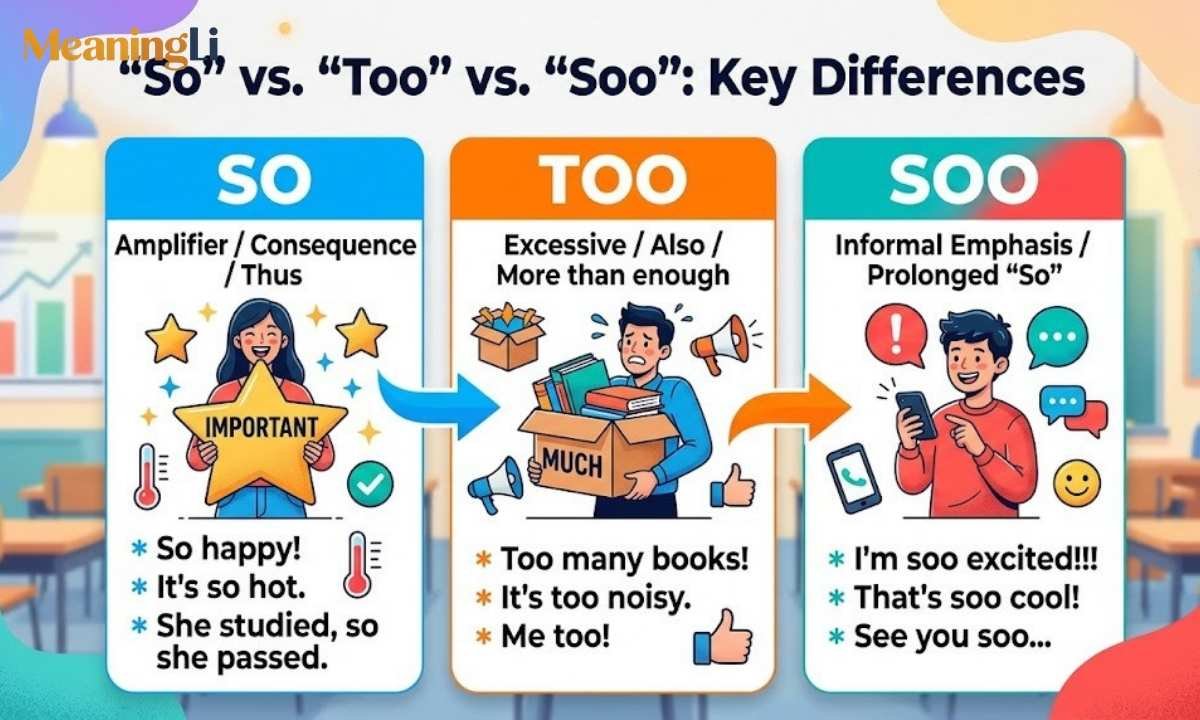
These words look and sound alike, so they get mixed up. Here is how they differ.
| Word | Meaning | Example |
| So | Very; therefore; in this way | I was so tired that I fell asleep early. |
| Too | Excessively; also | The tea is too hot. I want some too. |
| Soo | Informal, stretched form of “so” | I’m soo tired today. |
Key difference: “so” strengthens a quality (so tired), while “too” suggests there is more than needed (too tired to drive). “Soo” is just “so” with extra flavor.
A handy memory trick: “too” has an extra “o” because it means extra or more than enough. “So” keeps one “o” in formal writing.
When Should You Use “So” or “Soo”?
Choose based on your reader, your platform, and your purpose.
When to Use “So” in Standard English
Use “so” when the writing needs to look polished and trustworthy:
- Emails to managers, clients, or teachers
- Resumes, cover letters, and applications
- Essays, reports, and academic work
- Blog posts, articles, and website copy
- Business messages and announcements
- Any message where you are unsure of the tone
When to Use “Soo” in Informal Messages
“Soo” fits when you are speaking in a friendly, relaxed voice:
- Texts and chats with friends
- Comments and captions on social media
- Casual replies in group messages
- Fun posts where personality matters
If you are ever unsure, go with “so.” It is never wrong, while “soo” sometimes is.
Common Mistakes to Avoid
Keep an eye out for these slip-ups:
- Using “soo” in professional writing. It can make a message look careless.
- Mixing up “so” and “too.” Write “too hot,” not “so hot” when you mean excessively hot.
- Writing “soo” to connect clauses. Use “so” for results (I was late, so I ran).
- Overstretching the word. “Soooooooo” can be read as sarcasm.
- Using intensifiers too often. If everything is “so amazing,” nothing stands out.
- Forgetting the comma. When “so” joins two full clauses, a comma usually comes before it.
- Confusing the proper noun. “The Soo” (the Great Lakes locks) and “Soo” (a name) are different from the intensifier.
Frequently Asked Questions
What is the difference between “soo” and “so” in English?
“So” is the standard word, while “soo” is an informal spelling that adds emphasis. Both carry the same meaning.
Is “soo” a correct spelling, or should I always use “so”?
“Soo” is not a standard spelling, so use “so” in most writing. Keep “soo” for casual messages with friends.
What does “soo” mean in texting and social media?
It means “very” or “really,” just stretched for effect. The extra “o” signals stronger excitement, affection, or frustration.
Why do people write “soo” instead of “so” in messages?
People do it to copy how they talk and to show emotion that plain text can’t carry. It also makes messages feel friendlier.
When should I use “so” instead of “soo” in a sentence?
Use “so” in any formal, professional, or academic context, and whenever the word joins clauses to show a result. When in doubt, choose “so.”
Is “soo” grammatically correct in formal writing, emails, or academic work?
No. Formal writing calls for standard spelling, so stick with “so” in emails, essays, and reports.
Final Thoughts
“So” and “soo” share one meaning, but they do not share one setting. “So” is the dependable, dictionary-approved choice for everything from business emails to school essays, while “soo” is a friendly, expressive shortcut for casual chats.
Pick the form that fits your reader. If you want to show real excitement in a text, “soo” works. If you want to look clear, professional, and credible, write “so” and let your word choice carry the emotion instead.
Continue with these commonly confused words: To Fast or Too Fast, Storys vs Stories, and What Happen or What Happened.


2 thoughts on ““Soo” vs “So”: Meaning, Differences & Correct Usage (2026)”