

Drier or dryer? Both words sound the same, so it is easy to pick the wrong spelling. The good news is that the rule is simple once you know what each word does in a sentence.
In this guide, you will learn what each word means, why they are spelled differently, and how to use them without second-guessing. You will also find real examples, common mistakes, and a quick FAQ.
Quick Answer: Drier or Dryer?
Use “drier” when you mean “more dry.” Use “dryer” when you mean a machine that dries things.
- Drier is an adjective. It compares dryness: The desert is drier than the coast.
- Dryer is a noun. It names a device: Put the towels in the dryer.
Fast test: Replace the word with “more dry.” If the sentence still works, write drier. If you mean an appliance, write a dryer.
Why People Confuse Drier and Dryer
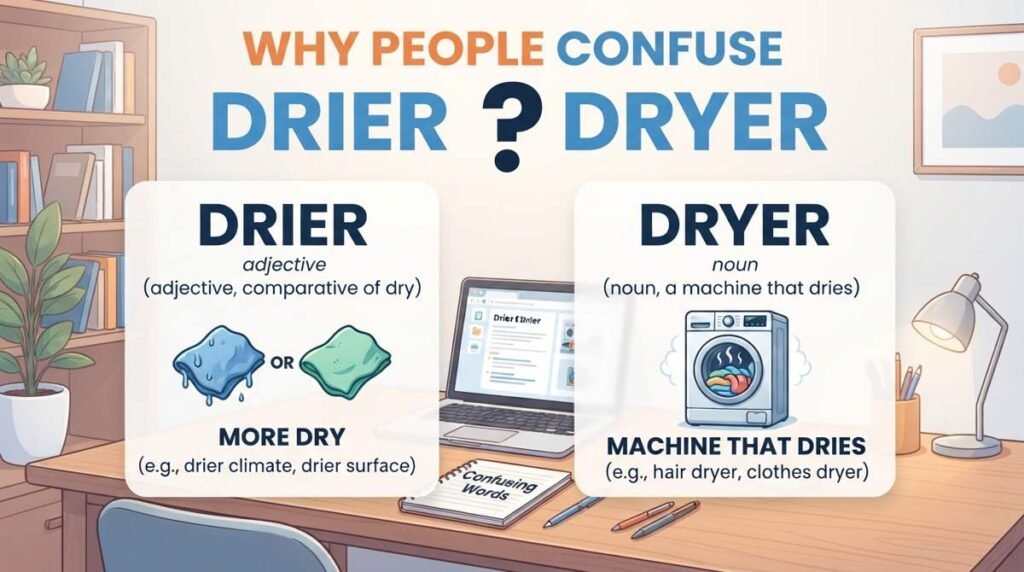
The two words are homophones. They sound exactly alike, so your ear cannot help you. Only the spelling gives the meaning away.
The confusion also has a history behind it. Both words come from “dry” plus the ending -er, and for a long time writers used the spellings loosely. Over time, English settled on one spelling for each job.
Meaning overlaps too. A dryer makes things drier. That close link makes the two words easy to swap by accident.
Drier vs Dryer: Key Differences at a Glance
| Feature | Drier | Dryer |
| Part of speech | Adjective (comparative form of dry) | Noun |
| Basic meaning | More dry; less wet | A machine or device that dries |
| Describes | Weather, skin, wine, food, soil, air | Clothes dryer, hair dryer, hand dryer |
| Used with “than” | Yes (drier than) | No |
| Can take “a/the” before it | Rarely | Yes (a dryer, the dryer) |
| Opposite | Wetter, damper | None |
| Example | The air feels drier today. | The dryer is full of laundry. |
Meaning and Usage Difference
What Does Drier Mean?
Drier is the comparative form of the adjective dry. It tells you that one thing has less moisture than another, or less than it had before.
You use it to compare two things or two moments in time. The chain goes: dry, drier, driest.
- A drier climate has less rainfall.
- Her skin feels drier in winter.
- I like my wine drier, with less sugar.
What Does Dryer Mean?
Dryer is a noun. It is something that removes moisture, most often an appliance. You can count it, point to it, and plug it in.
Common kinds include:
- Clothes dryer (also called a tumble dryer in British English)
- Hair dryer or blow dryer
- Hand dryer in public restrooms
- Spin dryer
- Air dryer, such as the one used in compressed-air systems
Can Drier Also Mean a Drying Machine?
Yes, but only as an older or less common variant. Major dictionaries such as Merriam-Webster list drier as a variant spelling of the noun, and they also record a use for a substance that speeds up drying in paints, oils, and inks.
So you may see “clothes drier” in older books or some British writing. It is not wrong in the dictionary sense. It is simply not the standard choice today.
If you want the safe, modern spelling for the appliance, use a dryer.
Why Is Drier Spelled With an I?
The Spelling Rule for Words Ending in Y
When a word ends in a consonant plus y, you usually change the y to i before adding -er or -est. That is why it becomes drier.
You can see the same pattern in many everyday words:
| Base word | Comparative | Superlative |
| dry | drier | driest |
| happy | happier | happiest |
| busy | busier | busiest |
| heavy | heavier | heaviest |
| easy | easier | easiest |
Dry, Drier, and Driest
Here is how the three forms work in real sentences:
- Dry: The towel is dry.
- Drier: This towel is drier than that one.
- Driest: This is the driest towel in the pile.
The noun dryer keeps the y because it is a different kind of word. It names the thing that does the drying, so the spelling stays closer to the verb dry. That small difference is what keeps the two words apart.
Drier or Dryer: Which One Should You Use?
Ask one question: Am I describing a quality, or naming a thing? Quality means drier. It means dryer.
Drier Than or Dryer Than
Always write drier than. The word then signals a comparison, and comparisons need the adjective.
- Correct: This summer was drier than last summer.
- Incorrect: This summer was dryer than last summer.
Drier or Dryer Weather
Weather is a quality, so the answer is drier weather. You will also see drier air, drier climate, and drier season.
- Forecasters expect drier weather by the weekend.
Drier or Dryer for Hair
Two different words can appear in one hair sentence, and both can be right:
- Your hair feels drier after bleaching. (adjective)
- Use a hair dryer on a low setting. (noun)
The tool is a hair dryer (some people write hairdryer as one word). The result on your hair is drier.
Drier or Dryer for a Washing Machine
A washing machine washes. It does not dry. The appliance that dries is the dryer. People usually say “washer and dryer” for the pair.
A machine that does both jobs is called a washer-dryer or a combo unit.
Air Drier or Air Dryer
If you mean the device, write air dryer. Think of the air dryers in workshops or hand dryers in restrooms.
If you mean the air feels less humid, you write that the air is drier. For example: “The air is drier inside the house in winter.”
Drier vs Dryer: Tone, Context, and Formality
Neither word is slang or too casual. Both are plain, neutral English, so they fit emails, school essays, product pages, and news articles.
What matters more is consistency and region.
- American English: dryer for the appliance is the standard spelling.
- British English: tumble dryer and spin dryer are common. Some British dictionaries list drier as an accepted variant for the machine.
- Formal and academic writing: Stick to the standard split. Drier describes. Dryer names a device.
- Product copy and SEO pages: Use dryer for the appliance, since that is how people search for it.
Whatever you choose, keep it the same through the whole piece.
When One Choice Sounds Wrong
Some sentences make the wrong spelling stand out right away. If a sentence reads strangely, check these signals:
- “Than” follows the word. It must be drier.
- “A” or “the” comes before the word and it is an object. It is probably dryer.
- The word describes a noun, like “drier skin”. Use drier.
- You can add “machine” after it. Use dryer.
Read these two lines aloud, and the problem shows:
- “I put my wet jacket in the drier than the rack.” (Does not work.)
- “I put my wet jacket in the dryer, so it will be drier soon.” (Works.)
Common Mistakes (and Quick Fixes)
| Mistake | Why it is wrong | Fix |
| The soil is dryer than last week. | Comparing, so an adjective is needed. | The soil is drier than last week. |
| I need a new clothes drier. | Standard spelling for the appliance is dryer. | I need a new clothes dryer. |
| My hair is dryer after swimming. | Describes hair, not a machine. | My hair is drier after swimming. |
| Use the dryer air today. | Mixed up the adjective and noun. | Use the drier air today, or the dryer machine. |
| An dryer broke. | Dryer begins with a consonant sound. | A dryer broke. |
| The wine is more drier. | Double comparison. | The wine is drier. |
Drier or Dryer: Everyday Examples
Examples of Drier in Sentences
- The northern side of the valley is drier than the south.
- Add a splash of milk if the dough feels drier than it should.
- My skin gets drier every December.
- Is it just me, or is this cake drier than yesterday’s?
- We hope for a drier week so the roof repair can finish.
- The cold air inside the office made my eyes feel drier.
- After the wind, the grass was far drier than before.
Examples of Dryer in Sentences
- The dryer stopped mid-cycle again.
- Please clean the lint filter in the dryer after every load.
- She packed a travel hair dryer for the trip.
- The restaurant replaced its paper towels with a hand dryer.
- A heat pump dryer uses less energy than an older vented model.
- Move the dryer a few inches from the wall for better airflow.
- The shop fitted a new air dryer on the compressor.
Drier or Dryer: Dictionary-Style Word Details
Part of Speech
| Word | Part of speech | Plural / forms |
| Drier | Adjective (comparative of dry) | dry → drier → driest |
| Dryer | Noun | dryer → dryers |
| Drier (variant) | Noun (older or less common spelling of dryer) | drier → driers |
Synonyms
Synonyms for drier (adjective): more arid, less moist, less damp, more parched, more dehydrated, thirstier (for land), crisper (for food)
Opposites of drier: wetter, damper, moister, soggier
Words close to dryer (noun): drying machine, tumble dryer, blow dryer, hand dryer, dehydrator, dehumidifier (for air)
Example Sentences
- Drier: Cacti thrive in drier soil.
- Dryer: I forgot my socks in the dryer again.
Word History
Dry is a very old English word, found in writing from before the 12th century. Adding -er gave English two jobs for one ending: a comparative (“more dry”) and an agent noun (“something that dries”).
Merriam-Webster dates the noun drier to 1528. Over the following centuries, usage drifted toward drier for the adjective and dryer for the machine, and most modern writing follows that split.
Common Phrases Containing Drier and Dryer
With drier:
- drier climate
- drier than expected
- drier skin
- drier air
- a drier wine
- drier conditions
With dryer:
- clothes dryer
- tumble dryer
- hair dryer / blow dryer
- hand dryer
- dryer sheet
- dryer vent
- dryer lint
- washer and dryer
Frequently Asked Questions
What Is the Difference Between Drier and Dryer?
Drier is an adjective meaning “more dry.” Dryer is a noun for a machine that dries things, like a clothes dryer or hair dryer.
Is It Spelled Drier or Dryer When Describing Something With Less Moisture?
Use drier. It is the comparative form of dry, so it describes anything with less moisture, such as air, skin, or soil.
Does Dryer Always Mean a Machine Used to Dry Clothes?
No. Dryer can be any device that dries, including a hair dryer, hand dryer, or industrial air dryer. A clothes dryer is just the most common one.
Can Drier and Dryer Be Used Interchangeably in a Sentence?
Not in modern standard writing. Use drier to compare dryness and dryer for a device, although some dictionaries still list drier as a variant of the noun.
How Do You Use Drier and Dryer Correctly in Everyday Writing?
Ask whether you are describing or naming. If “more dry” fits, write drier; if you mean a machine, write dryer.
What Is the Comparative Form of Dry, and Why Is It Spelled Drier Instead of Dryer?
The comparative of dry is drier. English changes a final y to i after a consonant before adding -er, just like happy becomes happier.
Final Thoughts
The rule comes down to one idea: drier describes, dryer is a thing. If you are comparing moisture levels, write drier. If you are talking about an appliance, write dryer.
Keep the “more dry” test in your pocket for quick checks. With a little practice, the right spelling will feel automatic in emails, essays, and product pages alike. You can also read our guide on eyeing vs eying and our breakdown of humour or humor for more pairs like this.