

You typed the word, paused, and wondered if it should start with “en” or “in.” You are not alone. This pair trips up students, bloggers and professional writers alike.
Here is the quick answer: both spellings exist, but ingrained is the standard choice. This guide explains the meaning, the history, and exactly when each spelling makes sense.
Engrained vs. Ingrained: Which Is Correct?
Ingrained is the correct and preferred spelling. Engrained is a recognized but much rarer variant of the same word.
Major dictionaries such as Merriam-Webster and Oxford list engrained as a less common form of ingrained. They do not treat it as a different word with a different meaning. If you want your writing to look polished and avoid reader doubt, pick ingrained every time.
Quick rule: Use ingrained. Treat engrained as an acceptable but uncommon alternative.
What Is the Difference Between Ingrained and Engrained?
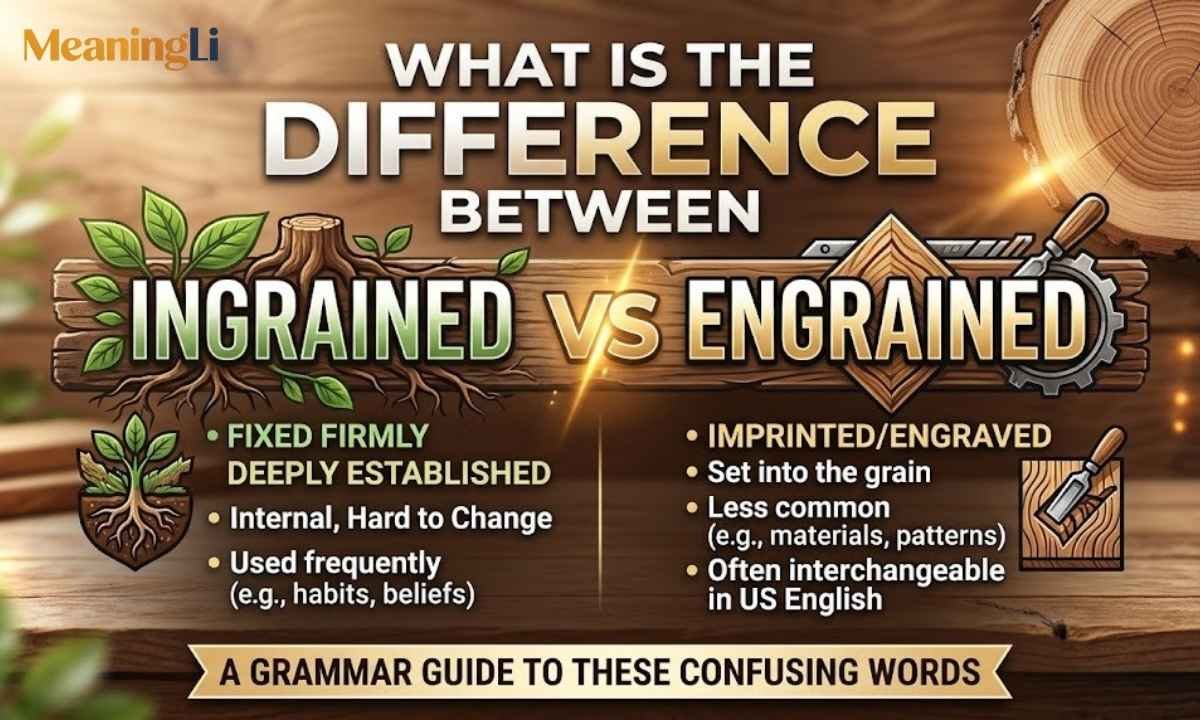
The difference is mostly about spelling frequency, not meaning. Both words describe something that is fixed deeply and is hard to remove or change.
Some websites claim engrained refers to physical marks and ingrained to ideas. Dictionaries do not back up that split. In practice, writers use either spelling for both physical and mental situations, though ingrained dominates.
Ingrained vs. Engrained Comparison Table
| Feature | Ingrained | Engrained |
| Status | Standard, preferred spelling | Accepted variant |
| Meaning | Deeply fixed, firmly established | Same as ingrained |
| Frequency | Very common | Rare |
| Verb form | Ingrain | Engrain |
| Best for | Formal, academic, professional writing | Informal writing, if used at all |
| Regional use | Standard in US, UK and worldwide | Seen more often in American English |
| Risk of looking like an error | Low | Moderate |
Which Spelling Is More Common?
Ingrained wins by a wide margin in books, news articles and everyday writing. Usage trend charts show engrained appearing only a small fraction as often.
Engrained does show up more in American English than in British English. Even so, American writers and editors still prefer ingrained.
Are Ingrained and Engrained Interchangeable?
Yes, in meaning they are interchangeable. You can swap one for the other without changing what the sentence says.
In practice, though, switching to engrained can distract readers or trigger a spell-check flag. That is why most style guides and editors recommend sticking with ingrained.
What Does Ingrained Mean?
Ingrained describes a habit, belief, attitude or mark that is so deeply rooted it is very difficult to change or remove. It can be used for both abstract things and physical ones.
Definition of Ingrained
Ingrained (adjective): firmly established; deeply rooted in a person, group or material.
The related verb is ingrain, which means to fix something deeply or permanently. The word traces back to the old practice of dyeing cloth “in grain,” meaning the color soaked into the fibers and would not wash out. That image still explains the word today: something ingrained is part of the very fabric.
Ingrained can describe:
- Habits and routines
- Beliefs and values
- Cultural traditions
- Fears and attitudes
- Dirt or stains pressed into a surface
Examples of Ingrained in Sentences
- Saying “thank you” has been ingrained in her since childhood.
- The mechanic scrubbed hard, but the grease stayed ingrained in his knuckles.
- Punctuality is deeply ingrained in the company’s culture.
- His distrust of banks was ingrained long before he earned his first salary.
- Years of practice made the piano scales feel ingrained in her fingers.
- Old doubts about public speaking were still ingrained, even after the course.
What Does Deeply Ingrained Mean?
Deeply ingrained means something is rooted so firmly that changing it takes serious effort. The word “deeply” adds emphasis, though ingrained alone already implies depth.
Typical examples include deeply ingrained habits, deeply ingrained prejudice and deeply ingrained traditions. The phrase works well when you want to stress how stubborn something is.
What Does Engrained Mean?

Engrained carries exactly the same meaning as ingrained. It is simply the less popular spelling, often caused by how the word sounds when spoken.
Is Engrained a Real Word?
Yes, engrained is a real word. Merriam-Webster and Oxford list it as a variant spelling.
However, it is not the main entry. If a reader or editor sees it, they may assume it is a typo, even though it is technically acceptable.
Examples of Engrained in Sentences
- Early rising became engrained in him after years of farm work.
- The oil was engrained in the workbench after decades of use.
- Respect for teachers is engrained in their family.
- That melody is so engrained in my memory that I hum it without noticing.
Each sentence would read just as well, and look more standard, with ingrained.
Ingrained vs. Engrained Examples
Seeing both words side by side makes the choice clearer.
Examples in Everyday English
| Situation | Preferred (Ingrained) | Variant (Engrained) |
| Habit | Checking his phone is an ingrained habit. | Checking his phone is an engrained habit. |
| Culture | Hospitality is ingrained in the region. | Hospitality is engrained in the region. |
| Physical mark | Ink was ingrained in the paper. | Ink was engrained in the paper. |
| Belief | Her faith is deeply ingrained. | Her faith is deeply engrained. |
Common Phrases With Ingrained
- Deeply ingrained habit
- Ingrained behavior
- Ingrained belief
- Ingrained prejudice
- Ingrained tradition
- Ingrained in the culture
- Ingrained in memory
- Ingrained from childhood
- Ingrained dirt
- Ingrained attitude
Synonyms for Ingrained and Engrained
Because both spellings share one meaning, they also share synonyms. Choose the one that fits your tone and context.
| Synonym | Best used for |
| Deep-rooted | Beliefs, traditions |
| Deep-seated | Fears, emotions, attitudes |
| Entrenched | Systems, habits, opinions |
| Embedded | Physical objects, ideas |
| Inherent | Natural, built-in qualities |
| Fixed | General, simple contexts |
| Established | Formal writing |
| Inbred | Traits from birth or upbringing |
| Ground-in | Dirt, stains |
| Firmly set | Casual writing |
Tip: Mixing in a few synonyms keeps your writing fresh and avoids repeating the same word.
When Should You Use Ingrained or Engrained?
When to Use Ingrained
Use ingrained in almost every situation. It is the safer, more recognized choice.
Choose ingrained when you are writing:
- Academic papers and essays
- Business emails and reports
- Blog posts and articles
- Resumes and cover letters
- Anything an editor, teacher or client will review
When Engrained Is Acceptable
Engrained is acceptable when you are following a source that already uses it, such as quoting a text, or when an organization’s style guide allows it. It is also fine in casual writing if you are consistent.
Even then, the safest move is to use ingrained. Consistency matters: never mix both spellings in the same document.
Ingrained vs. Engraved: What Is the Difference?
People also confuse ingrained with engraved, but these are different words with different meanings.
| Word | Meaning | Example |
| Ingrained | Deeply rooted, hard to change | Honesty was ingrained in him. |
| Engraved | Carved or cut into a hard surface | His name was engraved on the trophy. |
Easy memory trick: Engraved involves a tool cutting into metal, stone or glass. Ingrained involves something sinking deep into a person, group or material until it stays.
Note that engrained (with an “n” before “grained”) is not the same as engraved, even though they look alike.
Frequently Asked Questions
What is the difference between engrained and ingrained?
There is no real difference in meaning. Ingrained is the standard spelling, while engrained is a rarer variant.
Is engrained or ingrained the correct spelling?
Both are recorded in dictionaries, but ingrained is the correct, preferred spelling for most writing.
Does engrained mean the same thing as ingrained?
Yes. Both mean deeply fixed or firmly established, whether describing habits, beliefs or stains.
How do you use ingrained in a sentence?
Use it to describe something deeply rooted, for example: “Recycling is an ingrained habit in our household.”
Is engrained a real word in English?
Yes, it is a real but uncommon variant of ingrained, listed in major dictionaries.
When should you use ingrained instead of engrained?
Use ingrained in nearly all cases, especially in formal, professional or published writing, because readers recognize it instantly.
Final Thoughts
Engrained and ingrained mean the same thing, but ingrained is the clear winner. It is the spelling dictionaries favor, editors expect and readers recognize without a second thought.
Next time you reach for this word, go with ingrained and keep your spelling consistent. Pair it with a strong synonym when needed, and you will write with confidence.
More commonly confused words: Mold vs Mould, Spoilt vs Spoiled, and Smelled or Smelt.


1 thought on “Engrained vs Ingrained: Which Is Correct? Meaning, Difference & Examples (2026)”