

You are about to write “She is ___ the last slice of cake,” and you stop. Is it eyeing or eying? Both look odd when you stare at them long enough.
Here is the good news. Both spellings are real, and they mean the same thing. This guide shows which one to pick, why the confusion exists, and how to use the word naturally.
Quick Answer (Eyeing vs Eying)
Both are correct. Eyeing and eying are two spellings of the present participle of the verb eye, which means to look at something closely or to consider it.
Eyeing is the more common spelling and the safer default. Eying is an accepted variant that you will see less often.
- “He is eyeing the last cookie.”
- “He is eying the last cookie.”
Both sentences are correct. Pick one and stay consistent.
Why People Confuse Eyeing and Eying
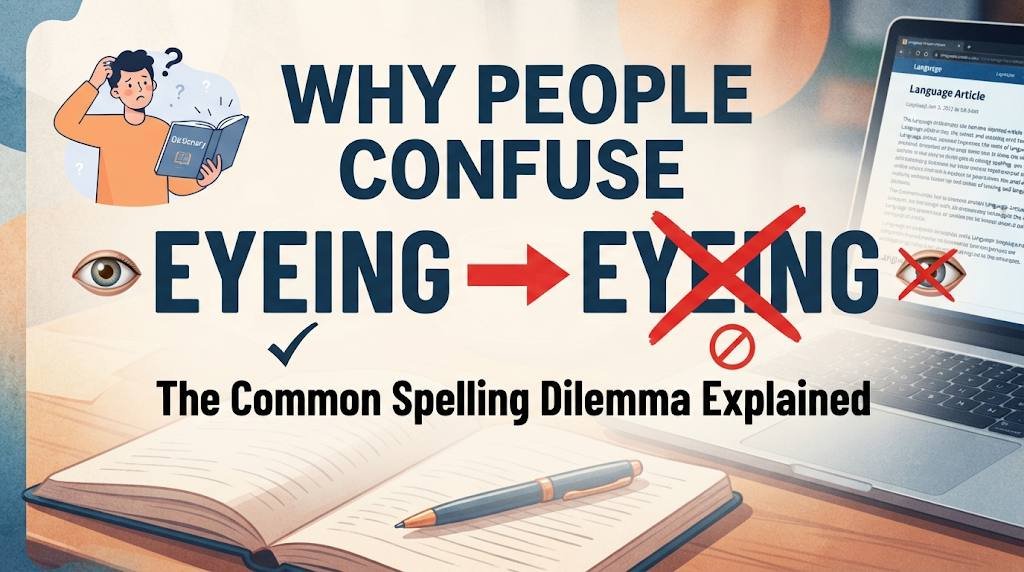
English has a spelling rule for verbs that end in a silent e. You usually drop the e before -ing, as in make → making and hope → hoping. By that rule, eye → eying looks logical.
But eying looks cramped on the page. Three letters in a row, y, i and n, make some readers pause. Writers also see eyeing in news headlines every day, so it feels familiar.
Add the fact that dictionaries list both, and it is easy to see why people are unsure.
Eyeing vs Eying: Key Differences at a Glance
| Feature | Eyeing | Eying |
| Status | Standard, most common | Accepted variant |
| Meaning | Looking at or considering | Looking at or considering |
| Part of speech | Present participle of eye | Present participle of eye |
| Frequency in news and books | Very high | Lower |
| Pronunciation | EYE-ing | EYE-ing |
| Best for | Most writing | Style guides that prefer it |
The meaning, grammar and sound are identical. Only the spelling differs.
Are Eyeing and Eying the Same Word?
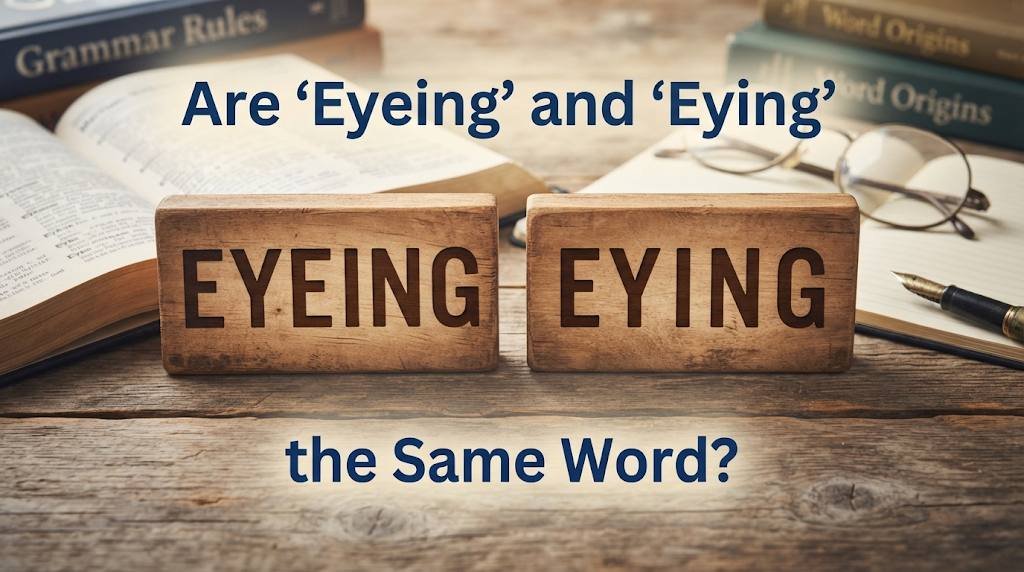
Yes. They are two spellings of one form, not two different words. Major dictionaries such as Merriam-Webster and Dictionary.com list them together under the verb eye.
What Does Eyeing Mean?
Eyeing means looking at something or someone carefully. It can also mean thinking about it as a possible goal or choice.
- “The cat is eyeing the goldfish bowl.”
- “The company is eyeing a move into new markets.”
What Does Eying Mean?
Eying has the same meaning. It describes the same act of watching closely or considering.
- “The cat is eying the goldfish bowl.”
- “The company is eying a move into new markets.”
Do Both Spellings Have the Same Meaning?
Yes, always. There is no formal, casual, positive or negative difference between them.
The tone comes from the sentence. “She was eyeing him suspiciously” sounds wary. “She was eyeing the dessert menu” sounds hungry. The spelling does not change either.
Eyeing vs Eying in American and British English
Which Spelling Is Preferred in American English?
Eyeing is the usual choice in American writing. It appears far more in US news, books and business copy.
Eying is still accepted and appears in some American publications. It is just the less common form.
Which Spelling Is Used in British English?
British writers also use eyeing most of the time. Eying is accepted there too.
You may see claims online that British English “uses eying” while American English “uses eyeing.” That is not a reliable rule. Major dictionaries do not present it as a regional split.
Is There a Strict US vs UK Spelling Difference?
No. Unlike pairs such as color and colour, or totaled and totalled, this is not a clean regional divide.
| Pair | Type of difference |
| color / colour | Strict US vs UK |
| totaled / totalled | Mostly US vs UK |
| eyeing / eying | Not regional, just common vs less common |
Which Spelling Should You Use?
When to Use Eyeing
Use eyeing in almost every case. It is the dominant form, it reads smoothly, and it will not draw a second look from editors or readers.
It is the safest choice for blogs, news, business writing, school work and social media.
When to Use Eying
Use eying only if a style guide, publisher or editor asks for it. You can also use it if you prefer the “drop the silent e” pattern.
If you do, use it every time in the same document.
Which Spelling Is Better for Formal Writing?
Neither is more formal. Both are acceptable in formal and academic writing.
Still, eyeing is the lower-risk option. It matches what most readers see, so it rarely looks like a typo.
What Do Oxford and Other Dictionaries Say?
Dictionaries treat both as valid. Merriam-Webster lists the forms as eyed; eyeing or eying, and it gives eyeing first. Dictionary.com also records both under the present participle.
Oxford and Cambridge references accept both too, so check the exact entry in the dictionary your school or employer uses.
What Does AP Style Recommend?
News writers often ask this one. The AP Stylebook generally defaults to Webster’s New World College Dictionary for spelling, and that kind of reference favors the more common form.
I could not confirm AP’s exact entry for this word. If you write for a newsroom, check your current stylebook directly.
Should You Mix the Two Spellings?
No. Mixing them in one article looks sloppy. Choose one form and apply it to every use in that piece.
Eyeing in Different Contexts
Eyeing Someone: Meaning and Examples
When you eye a person, you look at them with attention. The feeling depends on the situation: suspicion, curiosity, interest or caution.
- “The bouncer was eyeing the group near the door.”
- “She kept eyeing the new neighbor across the fence.”
Eyeing Something: Meaning and Examples
When you eye an object, you look at it closely or think about getting it.
- “He’s eyeing a used bike on the marketplace.”
- “The kids are eyeing the cake on the counter.”
Eyeing Up: Meaning and Usage
Eyeing up is more common in British English. It means looking someone or something over carefully, often to judge it. It can also mean checking out someone in a flirtatious way.
- “He was eyeing up the competition before the race.”
- “The firm is eyeing up a takeover.”
In casual use, this phrase can sound a bit cheeky, so context matters.
Side-Eyeing: Meaning and Usage
Side-eye is a sideways look that shows doubt, judgment or disapproval. As a verb, the -ing form is side-eyeing.
- “She was side-eyeing him after that bold claim.”
- “I’m side-eyeing my phone for dying again.”
Note that this is a different expression from plain eyeing. It carries a clear attitude of skepticism.
Eyeing a Goal, Job, or Opportunity
In business and news writing, eyeing often means planning or considering something big.
- “The startup is eyeing an IPO next year.”
- “She’s eyeing a promotion to team lead.”
- “The club is eyeing a young striker for the winter window.”
Eyeing Something or Eyeing On Something: Which Is Correct?
Eyeing something is correct. Eye is a transitive verb here, so it takes a direct object without a preposition.
- Correct: “He is eyeing the last seat.”
- Incorrect: “He is eyeing on the last seat.”
If you want a phrase with a preposition, use has his eye on: “He has his eye on the last seat.”
Common Mistakes (and Quick Fixes)
Mistake #1: Assuming Eying Is Always Incorrect
Some people mark eying as a typo. It is not. Fix: Treat it as a valid but less common variant.
Mistake #2: Assuming the Two Spellings Have Different Meanings
They do not. Fix: Choose by style and audience, not by meaning.
Mistake #3: Assuming a Strict Regional Difference
This is not a clean US vs UK split. Fix: Default to eyeing everywhere, unless a guide says otherwise.
Mistake #4: Using On Unnecessarily After Eyeing
Eyeing on is a common slip. Fix: Drop the preposition: “eyeing the prize,” not “eyeing on the prize.”
Mistake #5: Confusing Eyeing With Side-Eyeing
Side-eyeing signals doubt or disapproval. Plain eyeing can be neutral. Fix: Use side-eyeing only when you mean a skeptical look.
Eyeing vs Eying: Everyday Examples
Examples Using Eyeing
- “I’m eyeing those boots, but they’re on sale next week.”
- “The hawk was eyeing the field mouse from above.”
- “Investors are eyeing the new product launch.”
- “Mia has been eyeing the corner office for months.”
Examples Using Eying
- “He was eying the exit the whole meeting.”
- “The shop owner is eying the weather before opening the patio.”
- “They’re eying a trip to Lisbon this spring.”
- “Dad kept eying the last slice of pizza.”
Examples in American English
- “The team is eyeing a playoff spot.”
- “She’s eyeing a house near the lake.”
- “We’ve been eyeing that new taco place downtown.”
Examples in British English
- “The council is eyeing up a new bus route.”
- “He was eyeing up the cheese counter at the market.”
- “The club is eyeing a summer signing.”
Dictionary-Style Word Details
Part of Speech
Eyeing and eying are the present participle of the verb eye. They work in progressive tenses (“is eyeing”), as modifiers (“an eyeing glance,” though this is rare) and as gerunds (“Eyeing the door won’t help”).
Meaning and Definition
As a transitive verb, eye means:
- To look at closely or carefully.
- To watch or study with attention.
- To think about or consider as a possibility.
- To make an eye in something, as in “to eye a needle.” This sense is technical and rare.
Pronunciation
Both spellings are pronounced EYE-ing. The sound is /ˈaɪ.ɪŋ/, with two syllables.
The spelling difference is invisible in speech.
Synonyms and Related Words
| Sense | Words |
| Looking | watching, studying, observing, scanning |
| Looking hard | gazing, staring, ogling, scrutinizing |
| Considering | contemplating, weighing, considering, targeting |
| Judging a person | sizing up, checking out |
Word History
Eye comes from the Old English word ēage. The verb sense, meaning to look at, developed over the centuries as people used the noun as an action word.
The -ing spelling choice is a later issue. Writers kept the e in eyeing partly for clarity, much like dyeing keeps its e to avoid clashing with dying.
Common Phrases Containing Eyeing
- Eyeing the prize
- Eyeing the exits
- Eyeing up the competition
- Eyeing a promotion
- Eyeing the clock
- Eyeing a deal
- Eyeing an opportunity
- Eyeing with suspicion
Frequently Asked Questions
Is It Eyeing or Eying, and Which Spelling Is Correct in American English?
Both are correct, and eyeing is the more common American spelling. Eying is an accepted variant.
What Is the Difference Between Eyeing and Eying?
There is no difference in meaning. Eyeing is simply the more common spelling.
Why Is Eyeing Spelled With an E After the Y?
The base verb eye ends in an e. Keeping it gives a clearer look and avoids a cramped y-i-n cluster.
Is Eying an Accepted Spelling, or Is It Considered a Misspelling?
It is accepted. Major dictionaries list it as a valid variant of eyeing.
What Does Eyeing Someone or Something Mean, and How Do You Use It in a Sentence?
It means looking at them closely or considering them. For example: “She is eyeing the new laptop.”
What Is the Past Tense of Eye, and How Do You Use Eyed in a Sentence?
The past tense is eyed. For example: “He eyed the map and chose a route.”
Final Thoughts
Eyeing and eying are two spellings of the same verb form, and both are right. Eyeing is the common and safest choice, while eying is an accepted variant.
Use eyeing by default, and switch only if your style guide asks you to. Keep your choice consistent, and skip the extra on after it.
You can also read our guide on suing vs sueing and our breakdown of coming vs comming for more pairs like this.


1 thought on “Eyeing vs Eying: Which Is Correct? Spelling, Meaning & Examples (2026)”