

You type “sueing” and a red line appears under it. Or maybe it doesn’t, and you wonder if you got it right. Many writers stop at this exact word, because the extra E looks like it belongs.
This guide settles it fast. You will see the right spelling, the rule behind it, and plenty of examples. You will also learn how to avoid the mix-ups that go with this word.
Quick Answer: Suing or Sueing?
Suing is the correct spelling. Sueing is always wrong.
“Suing” is the present participle of the verb sue. It means taking legal action against a person, company, or organization. Every major dictionary lists suing and none lists sueing.
- ✅ The tenants are suing their landlord.
- ❌ The tenants are sueing their landlord.
Why Is Suing the Correct Spelling?
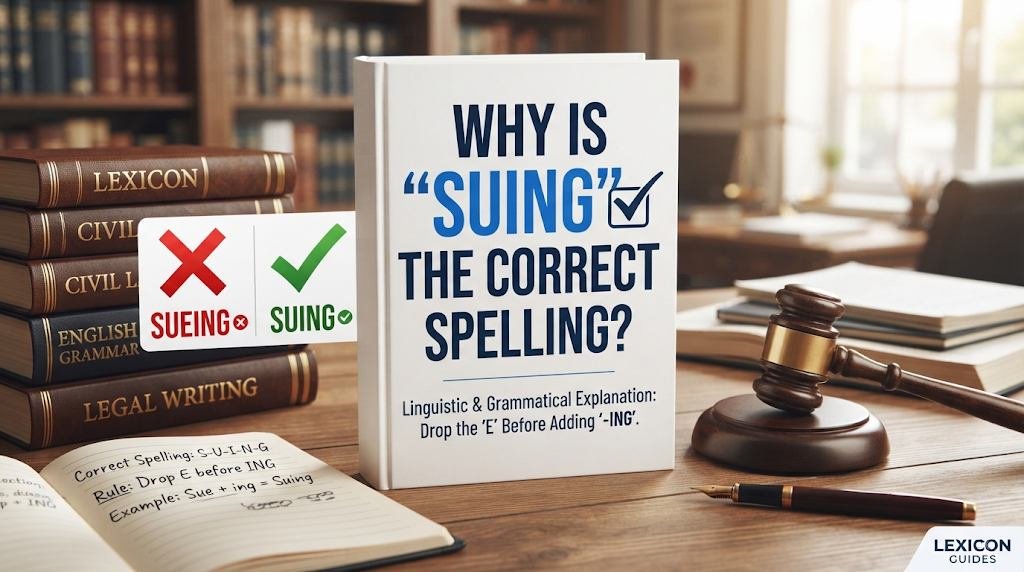
The answer comes down to one small spelling rule. Once you know it, you can fix a whole group of words, not just this one.
The Silent E Rule Explained
When a word ends in a silent e, you usually drop that e before adding -ing. The e does not make a sound, so it has no job to do once the ending arrives.
Think of make → making or hope → hoping. Nobody writes “makeing” or “hopeing.” The same logic applies to sue.
Why Sue Becomes Suing
Sue ends in a silent e. The u already carries the long “oo” sound. When you add -ing, the e drops away, and you get su + ing = suing.
If you kept the e, you would get three vowels in a row (u-e-i). English rarely spells words that way, and it looks clumsy on the page.
Other Words That Follow the Same Rule
Many verbs ending in -ue behave the same way. Look at the pattern:
| Base verb | Correct -ing form | Wrong form |
| sue | suing | sueing |
| argue | arguing | argueing |
| rescue | rescuing | rescueing |
| continue | continuing | continueing |
| issue | issuing | issueing |
| pursue | pursuing | pursueing |
| subdue | subduing | subdueing |
One note: queue is a rare case. Both queuing and queueing are accepted, so don’t use it as proof that sueing is fine.
Suing vs Sueing: Key Differences at a Glance
| Feature | Suing | Sueing |
| Correct spelling? | Yes | No |
| In dictionaries? | Yes | No |
| Part of speech | Verb form (present participle) | Not a real word |
| Meaning | Taking legal action against someone | None |
| Example | She is suing the airline. | She is sueing the airline. |
Meaning and Usage of Suing

What Does Suing Mean?
Suing means starting a civil case against someone in court. The goal is usually money, or a court order that forces someone to do (or stop doing) something.
Dictionaries also record an older meaning of sue: to plead or ask for something, as in “sue for peace.” You will mostly meet this in historical or formal writing.
How Is Suing Used in a Sentence?
You can use suing in two main ways.
As a verb in a continuous tense:
- A customer is suing the restaurant after a food-safety scare.
- They were suing each other for years over the same fence.
As a gerund (a verb acting like a noun):
- Suing a big company can take a long time.
- He is worried about being sued, not about suing.
Is Sueing Ever Correct?
No. Not in American English, not in British English, and not in legal writing. Standard dictionaries do not list it as a variant.
There is one small catch. Someone could write a person’s name followed by -ing by accident, such as a name like “Sue.” Even then, the natural form is “Sue’s” or “Sue is,” not “Sueing.”
Why People Confuse Suing and Sueing
The mistake is easy to make, and it has a few causes:
- Visual habit. Writers see Sue and want to keep it whole when adding an ending.
- Sound mapping. “Soo-ing” has two clear syllables, so people feel each should have its own letters.
- Exceptions in memory. Words like seeing, being, and dyeing keep their e, so the rule feels shaky.
- Autocorrect gaps. Some tools miss the error in fast typing.
Those keep-the-E words are different, though. Seeing and being keep the e because dropping it would change the sound or cause confusion. Dyeing keeps it so it won’t be mistaken for dying.
Forms of the Verb Sue
Sue is a regular verb. It has four forms you will use all the time.
Sue – Base Form
Use sue for the plain verb, after to, and with I, you, we, and they.
- I will sue if they don’t refund me.
- They plan to sue the manufacturer.
Sues – Third-Person Singular
Add -s for he, she, and it in the present tense.
- She sues whenever a contract is broken.
- The firm sues only as a last step.
Sued – Past Tense and Past Participle
Add -d. This form covers both the simple past and perfect tenses.
- He sued the contractor last spring.
- The company has been sued twice this year.
Suing – Present Participle and Gerund
Drop the e, then add -ing.
- They are suing for unpaid wages.
- Suing can be costly and slow.
| Form | Spelling | Example |
| Base | sue | I may sue. |
| 3rd person singular | sues | He sues often. |
| Past / past participle | sued | They sued last year. |
| Present participle / gerund | suing | We are suing. |
How to Use Sue in a Sentence
The word sue works with a few clear patterns. Learn these and your grammar stays clean.
Sue Someone or an Organization
The person or group being taken to court comes right after the verb. No preposition is needed.
- She decided to sue her former employer.
- Residents are suing the city council.
Sue Someone for Something
Used to name the reason or the loss.
- He is suing the shop for negligence.
- The band sued the label for unpaid royalties.
Sue Over Something
Use over to point to the dispute itself.
- Two neighbors are suing over a shared driveway.
- The brands sued over a similar logo.
Sue for Damages or Compensation
Use sue for when you name what you want to receive.
- She is suing for damages after the crash.
- The family is suing for compensation for medical bills.
Suing vs Sewing: What’s the Difference?
These two look different, but spell-checkers and fast typists mix them up because they sound close in some accents.
| Word | Meaning | Example |
| Suing | Taking legal action | He is suing his insurer. |
| Sewing | Joining fabric with a needle and thread | She is sewing a dress. |
Quick test: if a court is involved, use suing. If thread is involved, use sewing.
Suing Pronunciation
Suing has two syllables and is pronounced SOO-ing (/ˈsuːɪŋ/).
The first syllable rhymes with “too,” and the second is a soft “ing.” Sewing, by contrast, sounds like “SOH-ing,” so the two words differ in the first syllable.
Synonyms of Suing
Looking for another way to say it? These options work in different settings.
- Taking legal action
- Filing a lawsuit
- Bringing a case against
- Taking someone to court
- Pursuing a claim
- Seeking damages
- Litigating
Not all of these match perfectly. Litigating is broader and covers the whole process, while seeking damages focuses on the money. Pick the one that fits your sentence.
Common Spelling and Grammar Mistakes
Writing Sueing Instead of Suing
This is the big one. Drop the e every time.
- ❌ They are sueing the bank.
- ✅ They are suing the bank.
Confusing Suing With Sewing
- ❌ The tailor is suing a jacket.
- ✅ The tailor is sewing a jacket.
Using Sued Instead of Suing
Match the verb form to the tense. After is, are, was, or were, use suing.
- ❌ He is sued the company.
- ✅ He is suing the company.
- ✅ He was sued by the company.
Incorrect Prepositions After Sue
Skip against and at directly after sue. You sue someone; you file a lawsuit against someone.
- ❌ She is suing against her landlord.
- ✅ She is suing her landlord.
- ✅ She filed a lawsuit against her landlord.
Also, lawsuit is a noun, not a verb. Don’t write “they will lawsuit the supplier.”
Suing vs Sueing: Correct and Incorrect Examples
Examples of Suing in Different Sentences
- The author is suing the publisher over missing payments.
- Are you suing them, or just threatening to?
- Her lawyer advised against suing before trying mediation.
- Three shop owners are suing the developer together.
- Suing a friend can damage the friendship for good.
Examples of Other Forms of Sue
- Sue: If the deal falls through, we will sue.
- Sues: The union sues when safety rules are ignored.
- Sued: The musician sued her old manager in 2024.
- Been sued: The brand has been sued more than once.
Incorrect vs Correct Spelling Examples
| Incorrect | Correct |
| Sueing the company | Suing the company |
| He is sueing for damages | He is suing for damages |
| After sueing, they settled | After suing, they settled |
| Thinking of sueing my landlord | Thinking of suing my landlord |
Suing: Grammar, Word Origin and Dictionary Details
Part of Speech
Suing is the present participle of the verb sue. It can act as part of a continuous verb (“is suing”), as a gerund (a noun-like form), or as a participle describing a noun (“the suing party”).
Sue itself works as both a transitive verb (sue the company) and an intransitive verb (sue for peace).
Word History
Sue came into English through Anglo-French suer, which grew from Old French sivre, meaning “to follow.” That in turn goes back to Latin sequi, “to follow.”
The legal sense makes sense in that light: you “follow” a claim through the courts until it is settled. The first known English use dates to the 14th century. The same root family gives us words such as suit, lawsuit, and pursue.
Common Phrases and Expressions
| Phrase | Meaning |
| Sue for damages | Ask a court for money to cover harm or loss |
| Threaten to sue | Warn someone you may take legal action |
| Sue for peace | Ask an enemy to end a conflict (formal) |
| Grounds to sue | A valid legal reason to bring a case |
| Sue over (something) | Take legal action about a specific dispute |
How to Remember Suing vs Sueing
Here are a few tricks that stick.
- Drop the E, like make → making. If “makeing” looks wrong, so does “sueing.”
- Count the vowels. Three in a row (u-e-i) is a red flag in English.
- Say it out loud. “SOO-ing” has no sound for a second e, so the letter has no work to do.
- Group the family. Link suing with arguing, rescuing, and pursuing in your mind.
- Do a last check. Before you hit send, search your draft for “sueing.” One quick find-and-replace fixes it.
Frequently Asked Questions
Is it suing or sueing, and which spelling is correct?
Suing is correct. Sueing is a common misspelling and does not appear in standard dictionaries.
Why is suing spelled with one E instead of two?
Sue has one e to start with, and it drops when -ing is added. The silent final e is removed, leaving suing.
What does suing mean in English, and how is it used in a sentence?
Suing means taking legal action against someone, usually to get money or a court order. Example: “The tenant is suing the landlord for unsafe repairs.”
What is the spelling rule for dropping the E when adding -ing to sue?
If a word ends in a silent e, drop it before adding -ing. So sue becomes suing, just like arguing becomes arguing.
Is sueing ever considered a correct spelling in American or British English?
No. Both American and British English use suing, and neither accepts sueing as a variant.
What is the difference between sue, sued, and suing, with examples?
Sue is the base form (“I will sue”), sued is the past (“He sued last year”), and suing is the -ing form (“They are suing now”).
Final Thoughts
The spelling is simple once you know the rule: suing is right, and sueing is not. Drop the silent e before -ing, the same way you do with make, hope, and argue.
Keep the four forms in mind: sue, sues, sued, and suing. Pair them with the right preposition, and you can write about legal action with confidence, whether it’s an email, an essay, or a news piece. The same drop-the-E pattern appears in referred vs refered, and doubling rules like traveled vs travelled trip up writers just as often.


2 thoughts on “Suing vs Sueing: Which Spelling Is Correct? Meaning, Differences & Examples (2026)”