

You are writing an email about a new policy, and you stop. Does it “take effect” or “take affect”? The two words look alike, and spell check will not always save you.
Here is the good news. Only one version is correct, and a simple rule makes it easy to remember. This guide explains the answer, the grammar behind it and plenty of examples you can borrow.
Quick Answer: Take Effect or Take Affect?
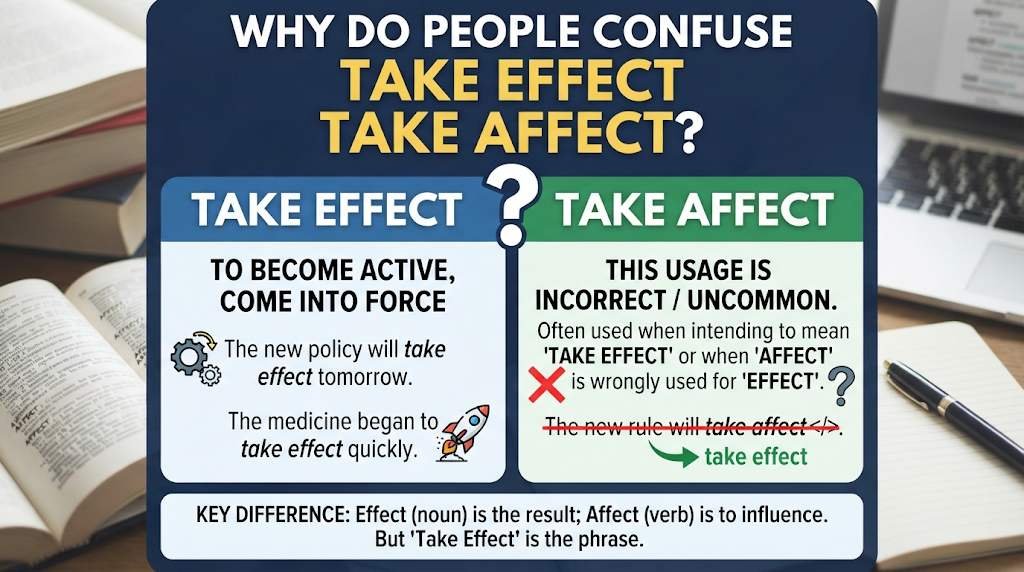
“Take effect” is correct. It means to begin working, to start applying or to start producing results.
“Take affect” is a mistake. In this phrase, “effect” is a noun, and “take” needs a noun after it. “Affect” is mainly a verb, so it does not fit.
- ✅ The new rule will take effect on Monday.
- ❌ The new rule will take affect on Monday.
Why Do People Confuse Take Effect and Take Affect ?
Three things cause nearly all of the confusion.
Similar Pronunciation and Spelling
Most people say both words almost the same way. The first sound is a short “uh” or “ih,” so the ear cannot tell “affect” from “effect.” Both words also share the same letters except the first one. A single typed letter makes the difference.
The Difference Between Affect and Effect
Both words are real, and both relate to change. That is the trap. Writers pick the one that “feels” right, but the feeling is often wrong. In general, affect is a verb (to influence) and effect is a noun (a result).
Why Take Affect Is Usually Incorrect
“Take affect” fails because “take” needs something to take. You can take a nap, a bus or a result. You cannot take an action word. The idiom “take effect” has been fixed in English for a long time, and no standard usage guide accepts “take affect.”
The one catch: “affect” does exist as a noun in psychology, meaning a visible display of emotion. But that rare sense has nothing to do with the idiom, so “take affect” is still wrong in everyday writing.
Take Effect vs Take Affect: Key Differences at a Glance
| Feature | Take effect | Take affect |
| Correct? | Yes | No |
| Meaning | Start working or become active | No standard meaning |
| Word type after “take” | Noun (effect) | Verb (affect) |
| Used for | Laws, medicine, rules, changes | Nothing, it is an error |
| Example | “The law takes effect in May.” | “The law takes affect in May.” |
What Does Take Effect Mean?
Take Effect Meaning in Everyday English
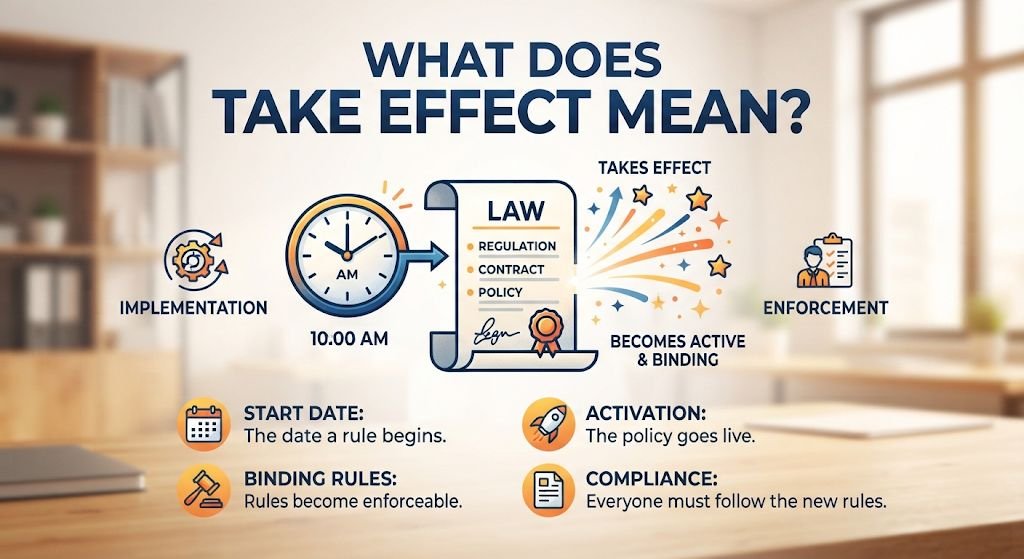
To take effect means to begin to work or to become active. A change that was planned or announced has now started. It can describe something official, like a law, or something physical, like a medicine.
When a Rule or Policy Takes Effect
Rules, policies and laws do not always start the day they are announced. They take effect on a set date. Reporters and employers use this phrase all the time.
- The new parking rules take effect on the first of the month.
- The dress code policy will take effect after the holidays.
When Medicine or Treatment Takes Effect
When a medicine takes effect, the body starts to respond to it. This is the sense most people use in daily life.
- The painkiller should take effect within an hour.
- It may take a few days for the allergy tablet to take effect.
When a Contract or Decision Takes Effect
Contracts, agreements and decisions also take effect. The date is often written in the document.
- The lease takes effect once both parties sign.
- The manager’s decision takes effect immediately.
Takes Effect, Took Effect, or Has Taken Effect?
The phrase changes with the tense. The word “effect” stays the same.
| Tense | Form | Example |
| Present | take / takes effect | The rule takes effect today. |
| Past | took effect | The rule took effect last week. |
| Present perfect | has / have taken effect | The rule has taken effect. |
| Future | will take effect | The rule will take effect soon. |
| -ing form | taking effect | The medicine is taking effect. |
Why Is Take Effect Correct?
The Grammar Behind Take Effect
“Take effect” is a verb plus noun idiom. The verb “take” is followed by the noun “effect,” meaning a result. In many ways it works like “take place” or “take shape.”
Why Effect Is Used After Take
An idiom is a fixed phrase. English settled on “effect” here because the phrase is about a result arriving. A change “takes” its effect when the result begins.
Why Take Affect Is Incorrect in Standard English
If you try “take affect,” you are placing a verb where a noun belongs. Style guides, dictionaries and usage guides all list “take effect” as the proper expression. A quick test: swap in the word “result.” “The law will take result” is odd, but it shows that a noun fits the slot.
Take Effect or Take Affect in Different Sentences
These are the sentence patterns that cause the most trouble.
This Change Will Take Effect or Affect
The correct choice is to take effect.
- ✅ This change will take effect on Friday.
- ❌ This change will take affect on Friday.
When Will This Take Effect or Affect?
The correct choice is to take effect.
- ✅ When will this take effect?
- ❌ When will this take affect?
I Have That Effect or Affect on Someone
The correct choice is to have that effect. You “have an effect on” a person, because “have” needs a noun.
- ✅ I seem to have that effect on people.
- ❌ I seem to have that affect on people.
I Tend to Have That Effect or Affect
Again, the effect is right. The noun follows “have.”
- ✅ Coffee tends to have that effect on me.
- ✅ Coffee tends to affect me that way. (Here “affect” works as a verb.)
Side Effect or Side Affect?
The correct choice is side effect, meaning an extra, often unwanted, result of a medicine.
- ✅ A common side effect is drowsiness.
- ❌ A common side affect is drowsiness.
Cause and Effect or Cause and Affect?
The correct choice is cause and effect. The result is the effect.
- ✅ The study looked at cause and effect.
- ❌ The study looked at cause and affect.
Affect vs Effect: Meaning and Grammar Differences
Affect as a Verb
Affect most often means to influence or change something.
- The delay will affect our schedule.
- Cold weather can affect your mood.
It can also mean to pretend or show off a trait: “He affected a British accent.”
Effect as a Noun
Effect most often means a result or outcome.
- The effect of the storm was a power cut.
- The speech had a strong effect on the crowd.
Effect as a Verb
Less commonly, effect is a verb that means to bring about or cause. It is formal.
- The company hopes to effect real change.
- She effected a smooth handover.
Affect as a Noun
Affect is also a noun in psychology, meaning the outward display of emotion. You will see it in clinical writing.
- The patient’s affect was flat during the interview.
Affected vs Effected: What’s the Difference?
| Word | Meaning | Example |
| Affected | Influenced, or pretended | The flood affected thousands of homes. |
| Effected | Brought about | The team effected a major policy change. |
If you are unsure, “affected” is far more common. Most of the time, it is the word you want.
How to Remember Affect vs Effect
- A is for Action: Affect is the verb, the action.
- E is for End result: Effect is the noun, the outcome.
- Try RAVEN: Remember, Affect is a Verb, Effect is a Noun.
- Use the swap test: If you can replace the word with “influence,” use affect. If you can replace it with “result,” use the effect.
Take Effect vs Similar Expressions
Take Effect vs Come Into Effect
These two mean nearly the same thing. “Come into effect” sounds a little more formal and is often used in legal or official writing, especially in British English.
- The regulations come into effect in July.
- The regulations take effect in July.
Take Effect vs Go Into Effect
“Go into effect” is also correct and is common in American English, especially in news. It means the same as “take effect.”
- The new tax goes into effect next year.
Take Effect vs Become Effective
“Become effective” is a formal version. You may find it in contracts and policies.
- The agreement becomes effective on signing.
All four phrases are correct. Choose the one that fits your tone.
Common Mistakes (and Quick Fixes)
Writing Take Affect Instead of Take Effect
This is the most common slip. Always use take effect. If you see “take affect” in a draft, change it.
Confusing Affect With Effect
Ask yourself if you need an action or a result. An action needs affect. A result needs effect.
Using Effect When You Mean Influence
Writers sometimes write “This will effect our results” when they mean “influence.” In that case, the correct word is affect: “This will affect our results.”
Forgetting the Correct Verb Form
The verb is “take,” not “taken,” unless you use a helper. Write “will take effect” (not “will take effect”) and “has taken effect” (not “has taken effect”).
| Mistake | Fix |
| The policy will taken effect. | The policy will take effect. |
| The rule has took effect. | The rule has taken effect. |
| The law takes affect today. | The law takes effect today. |
| It will effect your pay. | It will affect your pay. |
Everyday Examples of Take Effect and Affect
Examples About Rules and Policies
- The updated refund policy takes effect on the first day of next month.
- The ban will take effect once the council approves it.
- Because of the new schedule, travel times will affect everyone’s plans.
Examples About Medicine and Health
- The nasal spray took effect almost at once.
- Give the tablet time to take effect before you drive.
- Poor sleep can affect your focus.
Examples About Work and Education
- The new grading system takes effect this semester.
- The remote work plan will take effect after the trial period.
- Changes to the deadline may affect your project.
Examples in Everyday Conversations
- “When does my new phone plan take effect?”
- “I turned off the notifications, but nothing has taken effect yet.”
- “That news really affected her.”
Taking Effect in a Sentence
- The speed limits are taking effect tonight.
- Once the update installs, the settings will start taking effect.
- The tax changes were taking effect just as the budget passed.
Dictionary-Style Word Details
Parts of Speech
| Word | Part of speech |
| Effect | Noun (main use), verb (formal) |
| Affect | Verb (main use), noun (psychology) |
| Take effect | Verb phrase (idiom) |
Definitions and Meanings
- Take effect: to begin to work, apply or produce results.
- Effect (noun): a result or consequence of something.
- Effect (verb): to bring about or cause something.
- Affect (verb): to influence or change something.
- Affect (noun): the outward expression of emotion, used in psychology.
Synonyms and Related Words
- For take effect: come into force, go into effect, come into effect, begin to work, kick in, start working, become effective, become operative
- For effect (noun): result, outcome, consequence, impact, outcome
- For affect (verb): influence, change, impact, alter, sway
Word Origins and History
Both words come from Latin. Effect comes from the Latin effectus, from efficere, meaning to bring about. Affect comes from the Latin afficere (and the related affectare), meaning to act on or influence. The shared roots help explain why the two words overlap in meaning today.
Common Phrases Containing Effect and Affect
| Phrase | Correct word |
| In effect | effect |
| Side effect | effect |
| Cause and effect | effect |
| Have an effect on | effect |
| To that effect | effect |
| In full effect | effect |
| Negatively affect | affect |
| Deeply affected | affect |
Frequently Asked Questions
Is it take effect or take affect, and which one is correct?
“Take effect” is correct. “Take affect” is a common mistake.
What is the difference between take effect and take affect?
“Take effect” is a real idiom that means to start working. “Take affect” is not a standard phrase.
When should you use take effect in a sentence?
Use it when something begins to work or apply, such as a law, medicine, policy or contract.
Is take affect ever grammatically correct in English?
No, not in the usual sense. “Affect” is mainly a verb, and “take” needs a noun here.
Does take effect mean the same as come into effect?
Yes. Both mean to become active. “Come into effect” is slightly more formal.
How do you remember whether to use effect or affect in a sentence?
Affect is a verb and effect is a noun. After “take,” you need a noun, so use “effect.
Final Thoughts
“Take effect” is the only correct form. It means to start working or become active, and it fits laws, medicine, policies and contracts.
When you are unsure, use the noun-and-verb rule. After “take,” you need a noun, so choose effect. A quick check like that will keep your writing clean and clear. You can also read our guide on to that effect or affect and our breakdown of referred vs refered for more pairs like this.