

Fair and fare sound exactly the same, so it is easy to grab the wrong one when you write. One slip can turn “a fair price” into “a fare price” and leave your reader puzzled.
This guide explains what each word means, how each one works in a sentence, and how to pick the right one fast. You will also find tricks, tables, and real-life examples you can use right away.
Quick Answer: Fair vs Fare
Fair means just, light in colour, fairly good, or an event such as a county fair. Fare means the price of a ticket, the food on offer, or how well someone gets along.
A simple test: if money for travel or the word “food” fits, use fare. For fairness, weather, looks, or an event, use fair.
Fair vs Fare: Comparison Overview
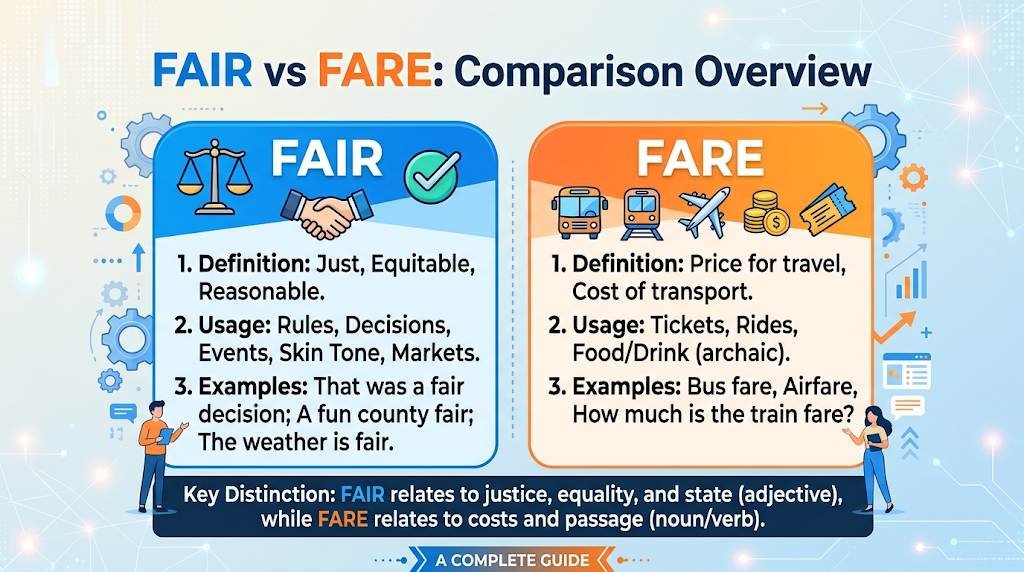
| Feature | Fair | Fare |
| Main parts of speech | Adjective, noun, adverb, verb (rare) | Noun, verb |
| Core meaning | Just, pale, average, or an event | Travel cost, food, or how you get on |
| Pronunciation | /fɛər/ | /fɛər/ |
| Typical phrases | fair play, fair share, county fair | bus fare, hearty fare, fare well |
| Past tense | faired (rare) | fared |
| Used for fairness? | Yes | No |
| Used for ticket prices? | No | Yes |
Definition and Meaning of Fair
“Fair” is a flexible word. It has many senses, so it helps to take them one part of speech at a time.
Fair as an Adjective
This is the most common use. As an adjective, fair can mean:
- Just and unbiased: a fair referee, a fair deal
- Light in colour: fair skin, fair hair
- Fairly good or average: a fair result, a fair amount
- Clear and pleasant (weather): fair skies, fair weather
- Within the rules: fair play, a fair fight
Fair as a Noun
As a noun, a fair is a public event with stalls, games, rides, or displays. Many types exist:
- A county fair
- A job fair
- A book fair
- A trade fair
- A science fair at school
Fair as an Adverb
As an adverb, fair means “in an honest or rule-following way.” You see it in a few set phrases:
- play fair
- fight fair
- fair and square
Fair as a Verb: Special Uses
The verb form is rare. It mostly shows up in technical work, like shipbuilding and engineering, where “to fair” a surface means to smooth it so the lines flow without bumps.
You may never need it. Just know it exists, and don’t mix it up with “fare.”
Examples of Fair in Sentences
- The coach promised a fair chance to every player.
- She has fair hair and freckles.
- We spent Saturday at the village fair.
- The weather stayed fair all weekend.
- That’s fair enough. I’ll wait until Monday.
Definition and Meaning of Fare
“Fare” has fewer senses than “fair,” but they are very different from each other.
Fare as a Noun
As a noun, fare has three main meanings:
- The cost of a trip: bus fare, taxi fare, train fare
- A passenger who pays: the driver picked up a fare outside the hotel
- Food and drink, or the things on offer: pub fare, light fare, family fare
Fare as a Verb
As a verb, fare means to get along or do (well or badly) in a situation. It is almost always used with a word like “well,” “badly,” or “better.”
The forms are fare, fares, fared, faring.
Different Meanings of Fare
Here is a handy summary of the different senses:
| Sense | Part of speech | Example |
| Cost of a journey | Noun | The fare to the airport is £12. |
| A paying passenger | Noun | The taxi driver took a fare to the station. |
| Food or offerings | Noun | The café serves simple, tasty fare. |
| Entertainment on offer | Noun | The cinema’s summer fare is mostly comedies. |
| To get along or do | Verb | How did the team fare in the finals? |
| To travel (old use) | Verb | They fared forth at dawn. |
The old “to travel” meaning lives on inside words like farewell (go well), wayfarer, and warfare.
Examples of Fare in Sentences
- The bus fare went up by fifty cents.
- The festival offered street fare from five countries.
- How did you fare in the interview?
- My cousin has fared well since moving abroad.
- Most reality TV is light fare, not deep drama.
Main Differences Between Fair and Fare
Fair vs Fare: Meaning and Usage
- Fair deals with justice, looks, weather, quality, and events.
- Fare deals with travel costs, food, and how someone gets along.
The two words never overlap in meaning. That is helpful, because once you know the topic, the choice becomes clear.
Fair vs Fare: Parts of Speech
| Part of speech | Fair | Fare |
| Adjective | Yes | No |
| Noun | Yes | Yes |
| Adverb | Yes | No |
| Verb | Yes (rare) | Yes (common) |
Only “fair” works as an adjective. If you are describing something, “fare” is wrong.
Fair vs Fare: Pronunciation
Both words are pronounced the same way. In British English it sounds like “fair” with a soft “air,” and in American English it sounds like “fair” with a flat “er.” The sound of the word cannot help you choose.
Context has to do the work.
Fair vs Fare: Example Sentences
| Fair | Fare |
| The judges gave a fair score. | The train fare was cheap. |
| A fair crowd came to the fair. | The fair’s fare included corn dogs and lemonade. |
| Her fair skin burns quickly. | How does the new player fare so far? |
Why Do People Confuse Fair and Fare?
Are Fair and Fare Homophones?
Yes. They are homophones: words that sound alike but differ in spelling and meaning. Other well-known pairs include their/there and peace/piece.
Why Fair and Fare Sound the Same
The two words share a pronunciation because English spelling carries many old patterns. The vowel sound is the same, while the spelling follows older forms. You hear one sound but see two spellings.
Add the many meanings of each word, and confusion is almost guaranteed.
How to Remember the Difference
Try these quick tricks:
- Fare → far. You pay a fare to go far.
- Fair → air. Fresh air and fair weather at an outdoor fair.
- Fare → food and fees. Both are things you pay for or consume.
- Fair → fairness. If you can swap in “just” or “equal,” use fair.
- Say it out loud. Ask: “Is this about travel, food, or getting along?” If yes, it is fare.
Fair vs Fare: Common Expressions and Confusing Phrases
Fair vs Fare vs Fayre: What’s the Difference?
“Fayre” is an old-style spelling of fair (the event). You see it on signs for fêtes and craft markets, such as a “Christmas fayre” or a “medieval fayre.”
It has nothing to do with “fare.” It is simply a decorative version of “fair.”
Synonyms of Fair and Fare
| Word | Synonyms |
| Fair (just) | equitable, impartial, balanced, even-handed |
| Fair (pale) | light, pale, blond |
| Fair (event) | fete, festival, market, exhibition |
| Fare (cost) | ticket price, fee, charge |
| Fare (food) | meals, dishes, cuisine |
| Fare (verb) | get on, manage, do, cope |
Fair and Fare in the Same Sentence
You can use both words together, and doing so is a good test of your skills:
- “The bus fare to the fair was fair, so we all went.”
- “How did the pie stall fare at the fair this year?”
How Did You Fare vs How Did You Fair?
The correct phrase is “How did you fare?” It uses the verb fare, meaning “How did things go for you?”
“How did you fair” is a spelling mistake. The same goes for “faired well.” Write fared well instead.
Fare or Fair for a Carnival?
For the event itself, use fair, as in “We went to the carnival fair.”
For the food served there, use fare, as in “The carnival fare was fried dough and toffee apples.” Both can be right in the same sentence, just with different meanings.
This Is Not Fair or Fare: Which Is Correct?
“This is not fair” is correct. Here, fair means just or right.
“This is not fare” is wrong unless you are talking about food or travel costs, which would be a very different statement.
Faired vs Fared: What’s the Difference?
Fared is the past tense of fare (to get along). It is the one you will need most.
Faired is the past tense of the rare verb fair (to smooth a surface). For everyday writing, if you mean “how things went,” pick fared.
| Sentence | Correct form |
| She ___ well on the exam. | fared |
| The shipbuilders ___ the hull for a smooth finish. | faired |
Grammar Guide: How to Use Fair and Fare Correctly
How Each Term Is Used in Sentences
- Fair (adjective): goes before a noun or after a linking verb. A fair trial. The result was fair.
- Fair (noun): names an event. We visited the fair.
- Fare (noun): names a cost or food. The fare was low.
- Fare (verb): works like a normal verb with endings. He fares well. They are faring better.
Common Grammar and Spelling Mistakes
- Writing “bus fair” instead of bus fare
- Writing “how did you fair” instead of how did you fare
- Writing “pub fair” when you mean food (pub fare)
- Writing “fare skin” or “fare weather” (use fair)
- Writing “faired” when you mean fared
Simple Rules to Remember
- If it describes something, use fair.
- If it names a ticket price, use fare.
- If it names food on offer, use fare.
- If it asks how someone is doing, use fare.
- If it names an event with stalls or rides, use fair.
Quick Tips for Writing and Speaking
- Slow down at the point where you type the word and ask what it means.
- Reread any sentence with “bus,” “taxi,” “food,” or “how did” in it.
- Use a spell checker as a backup, but not as the only check, since both words are real.
- Write “fare” for travel or food, and “fair” for everything else, as a rule of thumb.
When to Use Fair
Fair for Justice and Equality
Use “fair” when something is honest and just:
- A fair trial
- A fair wage
- Fair play
- Your fair share
Fair for Events and Exhibitions
Use “fair” for gatherings with stalls, shows, or displays:
- A job fair for new graduates
- A book fair at school
- The county fair each summer
Fair for Weather and Appearance
Use “fair” for pleasant weather or light colouring:
- Fair skies tomorrow
- A fair complexion
- Fair hair
When to Use Fare
Fare for Transportation Costs
Use “fare” when you talk about the price of a trip:
- Bus fare
- Taxi fare
- Airfare (the full word is spelled with “fare”)
- Fare hike or fare increase
Fare for Food and Cuisine
Use “fare” when you describe food on offer:
- Pub fare
- Home-style fare
- Street fare
- Hearty fare for winter
Fare for Performance and Progress
Use “fare” as a verb when you ask how something went:
- How did the new product fare?
- She fared better than expected.
- We’ll see how they fare next season.
Fair vs Fare: Which One Should You Use?
Quick Decision Guide
| If your sentence is about… | Use |
| Justice, rules, equality | fair |
| Skin, hair, or weather | fair |
| An event with stalls or rides | fair |
| A ticket price | fare |
| Food or dishes on offer | fare |
| How well someone is doing | fare |
Common Incorrect vs Correct Examples
| Incorrect | Correct |
| The taxi fair was too high. | The taxi fare was too high. |
| How did you fair on the test? | How did you fare on the test? |
| We loved the local fair at the café. | We loved the local fare at the café. |
| That ruling isn’t fare. | That ruling isn’t fair. |
| She faired well in the race. | She fared well in the race. |
| We went to the county fare. | We went to the county fair. |
Real-World Practical Examples
Fair Examples in Everyday English
- “Is it fair that everyone pays the same?”
- “The school’s science fair opens at nine.”
- “She was tall, with fair hair and green eyes.”
- “The forecast says fair weather until Friday.”
- “We split the bill in a fair way.”
Fare Examples in Everyday English
- “The metro fare is cheaper after 7 p.m.”
- “The cafeteria’s fare is simple but filling.”
- “How did your sister fare in her first week?”
- “Dinner at the lodge is hearty mountain fare.”
- “He paid the fare and stepped off the bus.”
Frequently Asked Questions
Is it fair or fare, and how do you know which spelling is correct?
Use fair for justice, looks, weather, or an event, and fare for ticket prices, food, or how someone gets along. Check the meaning first, since the sound is identical.
What is the difference between fair and fare in meaning and usage?
“Fair” means just, pale, average, or an event. “Fare” means the cost of travel, food on offer, or the act of getting on in a situation.
When should I use fair or fare in a sentence?
Use fair to describe something as just, pleasant, or light, or to name an event. Use fare for a trip price, a menu, or the question “how did you do?”
Is fair or fare used when talking about bus, train, or taxi tickets?
It is fare. Bus fare, train fare, and taxi fare all use that spelling.
What does fair mean in English, and what are some common examples?
Fair means just, light-coloured, fairly good, clear (for weather), or a public event. Examples: “a fair price,” “fair hair,” “the county fair.”
What does fare mean besides the price of a ticket, and how is it used in everyday English?
Fare can also mean food on offer (“pub fare”) or, as a verb, to get along (“How did you fare?”). It also appears in older words such as “farewell.”
Final Thoughts
Fair and fare are homophones with clearly separate jobs. Fair covers justice, looks, weather, and events, while fare covers travel costs, food, and how someone gets along.
When you hesitate, ask what the word is describing. If it is a price, a menu, or a “how did it go,” choose fare. For everything else, fair is almost always the right pick. For more sound-alike pairs, see soo vs so and of course or ofcourse.