

Is it “separate” or “seperate”? The correct spelling is separate, with an “a” in the middle. “Seperate” is a common misspelling, and no dictionary lists it as a valid variant.
This guide explains why people get it wrong, what the word means, and how to use it in a sentence. You will also find a simple memory trick that makes the right spelling stick.
Separate or Seperate: Which Spelling Is Correct?
Separate is the only correct spelling in standard English. It is spelled the same way in American, British, Canadian and Australian English.
The word has two “a” letters and just two “e” letters, placed like this: s-e-p-a-r-a-t-e. The middle vowel is “a”, not “e”.
Why Is “Seperate” Incorrect?
“Seperate” is wrong because it ignores the word’s history. English borrowed separate from the Latin verb separare, which combines se- (“apart”) and parare (“to prepare” or “to arrange”). That par root is where the “a” comes from.
The mistake is also a sound problem. In everyday speech, the middle syllable is soft and often sounds like “uh” or “eh”. Our ears suggest an “e”, but the spelling follows the Latin root instead.
Separate vs. Seperate: Quick Comparison
| Feature | Separate | Seperate |
| Correct spelling? | Yes | No |
| Found in dictionaries? | Yes | No (flagged as an error) |
| Part of speech | Verb, adjective, noun | None |
| Used in American English? | Yes | No |
| Used in British English? | Yes | No |
| Middle vowel | A | E |
| Example | Keep the files separate. | ~~Keep the files seperate.~~ |
What Does Separate Mean?
At its core, separate means to set apart, divide, or keep things from touching or mixing. It can also describe something that exists on its own and is not joined to something else.
The word works as a verb, an adjective and, less often, a noun. Each role has a slightly different meaning.
Separate as a Verb
As a verb, separate means to divide, pull apart, or move away from something. It describes an action.
- To divide a group into parts
- To stop living or working together
- To sort items by type
- To split a mixture into its components
Separate as an Adjective
As an adjective, separate describes things that are distinct, independent or not connected. It answers the question “which one?” or “what kind?”
- Not joined or attached
- Different from one another
- Existing on its own
- Kept apart for a reason
Separate as a Noun
As a noun, separate is rare and appears mostly in the plural: separates. In fashion, separates are clothing items sold individually, such as a skirt, a blazer or trousers. The term also appears in publishing, where a “separate” can mean a reprint of one article from a larger work.
Common Uses of the Word Separate
You will meet this word in schools, offices, kitchens, legal papers and daily conversation. Knowing which role it plays in a sentence helps you use it with confidence.
How to Use Separate as a Verb
Use the verb form when someone or something is doing the dividing. It usually takes an object and often pairs with from or into.
- Separate + object: She will separate the laundry before washing.
- Separate + from: The river separates the old town from the new one.
- Separate + into: The teacher separated the class into small teams.
- Separate (no object): The two companies separated last year.
How to Use Separate as an Adjective
Place the adjective before a noun or after a linking verb like is or are. It often means “individual” or “not shared.”
- Before a noun: We booked separate rooms.
- After a linking verb: The two issues are separate.
- With “from”: Her job is separate from her hobby.
Separate in Everyday English
People use separate in many common situations. Here are some of the most frequent:
- Household: separate bins for recycling and trash
- Finance: separate bank accounts for savings
- Travel: separate checks at a restaurant
- Relationships: a couple who decide to separate
- Work: separate teams handling different projects
- Science: separating oil from water
Common phrases include “separate ways,” “separate the wheat from the chaff,” “separate entrance,” and “a separate issue.”
Separate or Seperate: Examples in Sentences
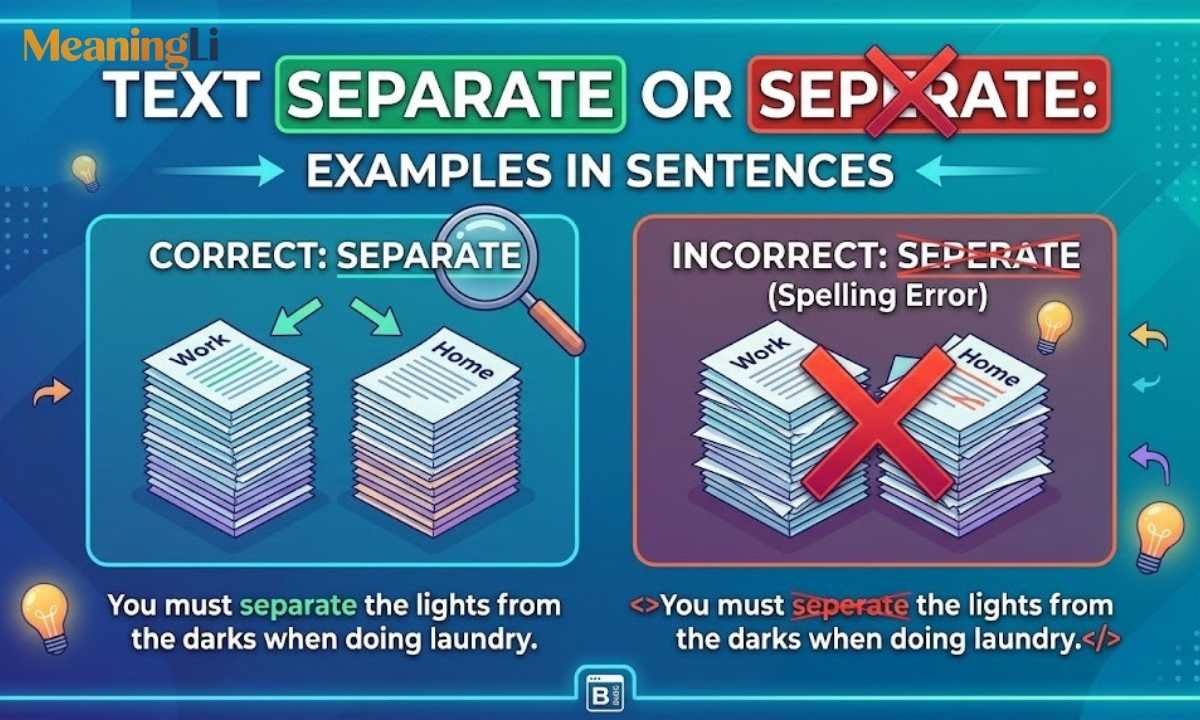
Seeing the word in context is one of the fastest ways to lock in the spelling. All examples below use the correct form.
Examples of Separate as a Verb
- Please separate the egg whites from the yolks.
- A narrow bridge separates the two islands.
- The coach decided to separate the beginners from the advanced players.
- They plan to separate their finances after the move.
- Customs officers separate the luggage by flight number.
- The friends separated at the station and went home.
Examples of Separate as an Adjective
- Each child has a separate desk.
- That is a separate matter, so let’s discuss it later.
- We took separate taxis to the airport.
- The company runs two separate offices in the city.
- She keeps her work email and personal email separate.
- The manual comes as a separate download.
Common Spelling Mistakes
The word shows up misspelled in many ways. Use this table to spot and fix the usual errors.
| Incorrect | Correct |
| seperate | separate |
| seperately | separately |
| seperated | separated |
| seperation | separation |
| seprate | separate |
| separete | separate |
| sepereate | separate |
Is Separate Spelled Differently in British and American English?
No. Separate has one spelling worldwide. Unlike words such as color/colour or organize/organise, there is no regional version.
If you see “seperate” in a British text, it is still a typo and not a local variant. Spellcheck tools in both US and UK English will flag it.
How Do You Pronounce Separates?
The pronunciation changes depending on how you use the word. That shift is one reason so many people mix up the letters.
Separate as a Verb vs. an Adjective
| Word role | Pronunciation (simplified) | Ending sound |
| Verb | SEP-uh-rayt | Long “ay” like late |
| Adjective | SEP-rit or SEP-uh-rit | Short, weak “it” |
Say it aloud: “We will separate the files” (verb, ending in “rayt”), versus “These are separate files” (adjective, ending in “rit”).
Why Pronunciation Causes Spelling Confusion
Many speakers squash the middle syllable, so the adjective can sound like “sep-rit.” When a vowel sound is weak, it is hard to know which letter belongs there.
This is called a schwa sound, and it can be written with almost any vowel. The only reliable fix is to memorize the spelling, not to trust your ear.
Related Word Forms of Separate
Once you know the base word, its relatives follow the same rule. The middle letter is always “a.”
| Word | Part of speech | Meaning |
| separate | verb, adjective, noun | to divide; distinct |
| separates | verb, noun | divides; clothing pieces |
| separated | verb, adjective | divided; living apart |
| separating | verb | in the act of dividing |
| separately | adverb | individually; apart |
| separation | noun | the act or state of being apart |
| separable | adjective | able to be divided |
| separator | noun | something that divides |
| inseparable | adjective | impossible to divide |
Separate vs. Separated
Separate is the base form. Separated is the past tense or past participle, and it can also be an adjective.
- Separate: I will separate the colors.
- Separated: I separated the colors yesterday.
- Separated (adjective): The separated couple remain friends.
Separate vs. Separately
Separate describes a noun or acts as a verb. Separately is an adverb that describes how something is done.
- Separate: They have separate accounts.
- Separately: They pay their bills separately.
Separate vs. Separation
Separation is the noun for the act, process or state of being apart.
- Separate: The judge will separate the cases.
- Separation: The separation of the cases took a week.
What Is “Seperate”?
“Seperate” is not a word. It is a spelling error that appears in emails, essays, social posts and even professional writing.
It is one of the most frequently misspelled words in English. Because the error is so common, it often slips past tired eyes.
Is Seperate Ever a Correct Spelling?
No. “Seperate” is not an alternative, older or regional spelling. Standard dictionaries do not accept it in any context.
The only time you should type it is when you are quoting an error on purpose, such as in a spelling guide like this one.
How to Remember the Correct Spelling of Separate
Memory tricks, also called mnemonics, are the easiest way to fix a habitual spelling mistake. Try one or all of these.
- Use the “rat” trick (see below).
- Think “two A’s.” Separate has two “a” letters, just like automatic.
- Remember “par.” The Latin root parare gives you the “par” in the middle.
- Say it slowly. Pronounce it as “sep-ah-rate” in your head while you type.
- Write it five times. Short bursts of practice help the spelling become automatic.
The “There Is a RAT in Separate” Memory Trick
Look closely at the word: sepARATe. Hidden in the middle is the word RAT.
Just picture a small rat sitting in the middle of the word. If you can find the rat, you will always put an “a” before it: sep-a-rat-e.
Common Spelling Mistakes to Avoid
Here are the errors to watch for, along with quick fixes.
- Swapping the vowel: Writing “seperate” instead of “separate.” Fix: find the rat.
- Dropping a letter: Writing “seprate.” Fix: make sure you have four syllable-like parts: sep-a-rate.
- Doubling the wrong letter: Writing “seperrate” or “separrate.” Fix: only one “r” appears in each position.
- Misspelling related words: “seperation,” “seperated,” “seperately.” Fix: check the root first, and the rest follows.
- Trusting spellcheck blindly: A tool may miss typos in names, headlines or image text. Fix: proofread once more before publishing.
Frequently Asked Questions
Is it spelled separate or seperate?
It is spelled separate. “Seperate” is a common misspelling and is never correct.
What is the correct spelling of separate and why is seperate wrong?
The correct spelling is s-e-p-a-r-a-t-e, taken from the Latin separare. “Seperate” is wrong because it replaces the “a” in the Latin root with an “e” based on how the word sounds.
How do you spell separate words correctly in English?
Spell it S-E-P-A-R-A-T-E. Remember there is an “a” before the “r” and another “a” after it.
What does the word separate mean, and how do you use it in a sentence?
Separate means to divide or keep apart (verb) or distinct and independent (adjective). Example: “Please separate the paper from the plastic” or “We stayed in separate rooms.”
What is the difference between separate and seperate?
Separate is the correct word, while “seperate” is a spelling error with no meaning. There is no difference in sense, only in correctness.
How can I remember the correct spelling of separate?
Look for the word “rat” hiding inside: separate. You can also remember that the word has two “a” letters and no “e” in the middle.
Final Thoughts
The answer is simple: always write separate, never “seperate.” It follows its Latin roots, and every related form, including separated, separately and separation, uses the same “a” in the middle.
Keep the rat trick in mind, proofread the word whenever you use it, and your writing will look sharper and more professional. A small spelling fix like this one can make a real difference to how readers judge your work.
For more on commonly confused words, see: Input or Imput, Excel or Excell, and Of Course or Ofcourse.


4 thoughts on “Separate vs Seperate: Which Spelling Is Correct? Meaning, Examples & Usage (2026)”