

Is it “input” or “imput”? The correct spelling is input, written with an “n” before the “p”. “Imput” is a common misspelling that comes from the way the word is spoken.
This guide covers the meaning of input, how to use it as a noun and a verb, and which past tense is correct. You will also learn how it differs from the look-alike word “impute.”
Input or Imput: Which Spelling Is Correct?
Input is the correct spelling in American, British and all other standard varieties of English. It is built from two small words: in and put.
If you can break the word into those two parts, the spelling becomes easy: in + put = input. There is no “m” anywhere in it.
Why Is “Imput” a Common Spelling Mistake?
The mistake starts with pronunciation. When people say “input” quickly, the “n” sound shifts toward an “m” because the lips close for the “p” that follows. The result sounds like “im-put.”
Spell-by-ear habits do the rest. English has many words that begin with im- before a “p” or “b”, such as impact, import and impose. The brain applies the same pattern to input, even though input does not follow it.
Input vs. Imput: Quick Comparison
| Feature | Input | Imput |
| Correct spelling? | Yes | No |
| Standard dictionary entry? | Yes | No |
| Word parts | in + put | none |
| Parts of speech | Noun, verb | None |
| Accepted in US English? | Yes | No |
| Accepted in UK English? | Yes | No |
| Example | Share your input. | ~~Share your imput.~~ |
What Does Input Mean?

In general, input means something that is put into a system, process or discussion. That “something” can be an idea, a piece of data, energy or effort.
Its exact meaning depends on the setting. The three main senses are below.
Input as a Contribution or Advice
In everyday and workplace English, input means an opinion, suggestion or piece of feedback that someone offers. It is the sense you hear most often in meetings.
- A manager asks for your input on a plan.
- A teacher welcomes student input on class rules.
- A designer collects customer input before a redesign.
Input as Data Entry
In computing and office work, input means the information entered into a device, program or form. It can also describe the act of typing or loading that information.
- Typing a password into a login box
- Scanning a barcode at checkout
- Entering numbers into a spreadsheet
- Speaking a command to a voice assistant
Input as a Technical or Scientific Term
In science, engineering and economics, input is whatever goes into a process to produce a result. The result is called the output.
- Electronics: the signal or power fed into a circuit
- Manufacturing: raw materials, labor and energy
- Economics: resources used to produce goods and services
- Biology: nutrients or stimuli that enter a living system
Is Input a Noun or a Verb?
Input is both. It started as a noun, and the verb form became widespread later, mainly through computing language. Today both uses are standard.
Input as a Noun
As a noun, input names a thing: advice, data or a resource that goes into something. It can be uncountable (“We need more input”) or countable (“The system has two inputs”).
Input as a Verb
As a verb, input means to enter or feed information into a system. It is a transitive verb, so it normally needs an object.
- She inputs the sales figures every Friday.
- Please input your account number below.
How to Use Input in Everyday English
Use these quick rules to choose the right form:
- Asking for opinions: use the noun. (“I’d love your input.”)
- Entering data: use the verb. (“Input the code.”)
- Describing a machine part: use the countable noun. (“a USB input”)
- Formal writing: consider feedback, advice or enter if input feels too much like jargon.
Input or Imput: Examples in Sentences
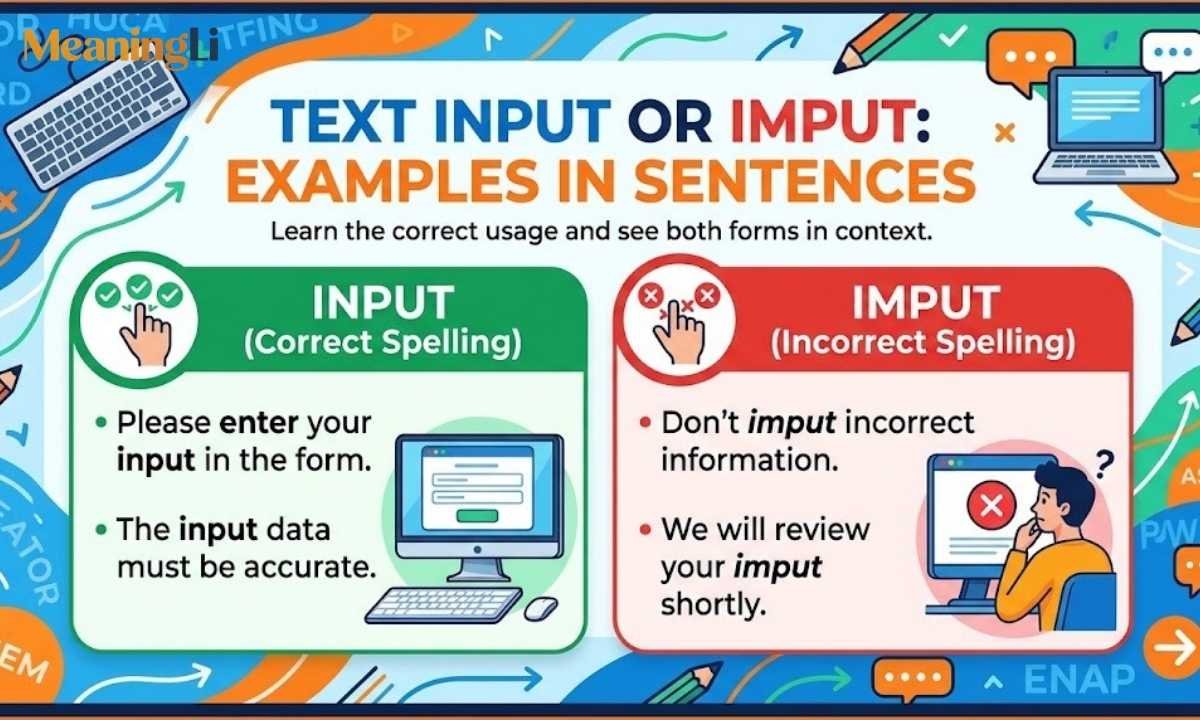
Reading the word in context helps lock in both the meaning and the spelling.
Examples of Input as a Noun
- Your input will shape the final report.
- The mayor welcomed public input before the vote.
- This monitor has two HDMI inputs.
- The chef values input from every member of the kitchen team.
- Small farms depend on low-cost inputs like seed and fertilizer.
- Without clear input, the software cannot produce a useful answer.
Examples of Input as a Verb
- Please input your email address to continue.
- The nurse input the patient’s details into the system.
- He is inputting the survey results now.
- Each employee must input their hours by noon.
- I inputted the wrong date and had to start over.
- You can input text by typing or speaking.
Incorrect vs. Correct Spelling Examples
| Incorrect | Correct |
| I need your imput on this. | I need your input on this. |
| Please imput the password. | Please input the password. |
| She is imputting the data. | She is inputting the data. |
| The imputs were all wrong. | The inputs were all wrong. |
| Thanks for the imput! | Thanks for the input! |
What Does Imput Mean?
“Imput” has no meaning of its own in standard English. When someone writes it, readers almost always understand that they meant input.
That said, the error can make writing look careless, especially in emails, reports and job applications.
Is Imput a Correct English Spelling?
No. Standard dictionaries and style guides treat “imput” as an error. A few online word lists note it only as a nonstandard pronunciation spelling of input, which is not the same as being correct.
Spellcheck tools will flag it and usually suggest input or impute. Choose input unless you truly mean the other word.
Why Do People Confuse Input and Imput?
Three things cause most of the confusion:
- Sound blending: the “n” often sounds like “m” before “p.”
- Pattern matching: many English words start with im-.
- Similar words: impute and impulse sit close to input in the mind.
Input vs. Imput vs. Impute: What Is the Difference?
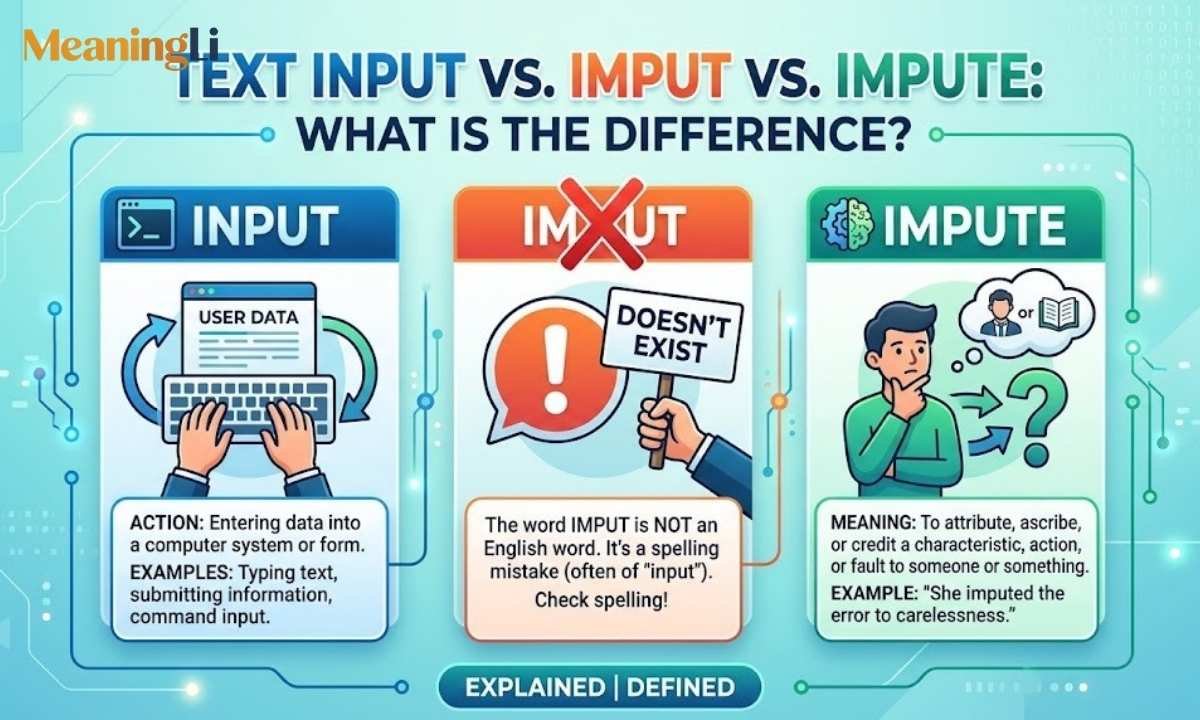
Impute is a real word, and it is the reason spellcheck sometimes offers it as a fix. It has a completely different meaning from input.
What Does Impute Mean?
Impute is a verb that means to credit or assign something to a person or cause, usually a fault or a quality. It appears often in legal, financial and statistical writing.
- The report imputed the delay to poor planning.
- Imputed income is a value assigned for tax purposes.
- In data science, to impute means to fill in missing values with estimates.
Input, Imput, and Impute Compared
| Word | Correct? | Meaning | Example |
| Input | Yes | Something put in; advice or data | Send me your input. |
| Imput | No | A misspelling of input | ~~Send me your imput.~~ |
| Impute | Yes | To attribute or assign | They imputed blame to him. |
Input Word Forms and Grammar
Because input works as both a noun and a verb, it has a few forms that trip people up. Here is a quick view before the details.
| Form | Example |
| Base form | input |
| Third-person singular | inputs |
| Present participle | inputting |
| Past tense | input or inputted |
| Past participle | input or inputted |
| Plural noun | inputs |
Input or Inputs: What Is the Plural?
The plural of the countable noun is inputs. Use it when you mean separate items, such as ports, signals or sources of information.
When input means advice or feedback, it is usually uncountable and stays singular. Say “Thanks for your input,” not “Thanks for your inputs,” unless you are talking about several distinct contributions.
Input or Inputted: Which Past Tense Is Correct?
Both are correct. Major dictionaries list input and inputted as acceptable past tense and past participle forms.
- “I input the numbers yesterday.”
- “I inputted the numbers yesterday.”
Pick one and stay consistent within the same piece of writing. Inputted is clearer in speech because it signals the past tense.
Inputting or Inputing: Which Spelling Is Correct?
The correct form is inputting, with a double “t.” The final consonant doubles for the same reason it does in putting, since input is built on the verb put.
“Inputing” with one “t” is a misspelling. The same goes for the misspelling “imputting.”
Synonyms for Input

Repeating one word too often can make writing feel flat. These alternatives help you vary your language, but check the meaning first because they are not always interchangeable.
Synonyms for Input as a Noun
| Meaning | Synonyms |
| Advice or opinion | feedback, suggestion, advice, comment, contribution |
| Data | information, entry, data, material |
| Resource | contribution, investment, supply |
| Machine part | port, socket, connection, entry point |
Synonyms for Input as a Verb
- enter
- type in
- key in
- feed
- load
- record
- submit
- insert
When to Use Input Correctly
The right word depends on your audience and setting. A few simple habits keep your writing clear.
Input in Professional and Workplace Communication
In business, input usually means feedback or ideas. Some style guides discourage it as corporate jargon, so use it in moderation.
- Good: “Please send your input on the draft by Monday.”
- More formal: “Please send your comments on the draft by Monday.”
Input in Technology and Data Contexts
In tech writing, input is standard and precise. It names what a user or system provides, and its counterpart is output.
- Input fields on a form
- Input devices such as a keyboard or mouse
- User input that a program must validate
Input in Academic and Everyday Writing
In essays and reports, define the term if the sense is not obvious. In casual writing, it is safe to use input to ask for opinions or to describe entering information.
Common Input Spelling and Grammar Mistakes
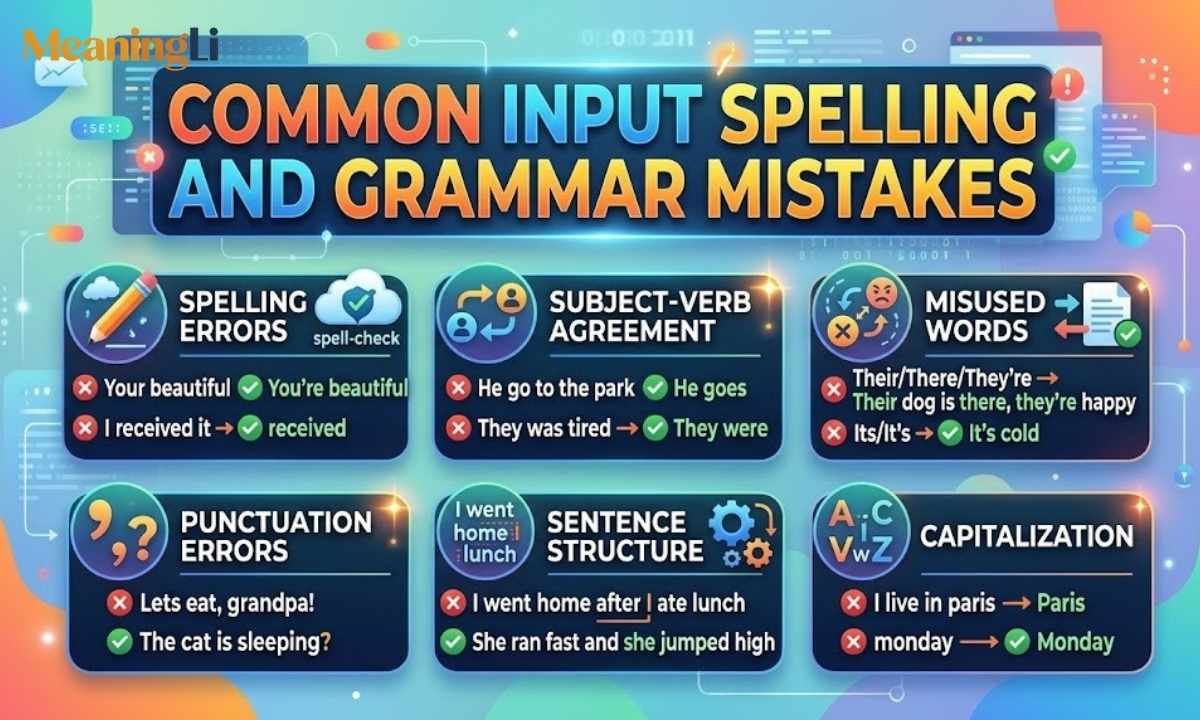
Watch for these frequent slips:
- Writing “imput”: always use input.
- Writing “inputing”: use inputting with two “t” letters.
- Writing “imputting”: both the “m” and the extra letter are wrong.
- Mixing up impute and input: impute means to attribute, not to enter or contribute.
- Using “inputs” for advice: say “your input” unless you mean several separate items.
- Overusing the word: swap in feedback, advice or enter when it fits better.
Frequently Asked Questions
Is it spelled input or imput?
It is spelled input. “Imput” is a common misspelling and not standard English.
What is the correct spelling of input, and why is imput wrong?
The correct spelling is i-n-p-u-t, made from in and put. “Imput” is wrong because it copies the “m” sound people hear in fast speech.
What does input mean in English, and how do you use it in a sentence?
Input means something put into a system, such as advice, data or resources. Example: “Your input helped us fix the plan.”
How do you use the word input in everyday conversation and writing?
Use it as a noun for feedback (“I’d like your input”) or as a verb for entering data (“Input the code”). In formal writing, feedback or enter may sound more natural.
Is input pluralized as inputs or input, and which form is correct?
Both can be correct. Use inputs for separate items like ports or signals, and input when it means advice or feedback.
What is the difference between input, output, and imputed?
Input is what goes in, and output is what comes out. Imputed means attributed or assigned, as in imputed income.
Final Thoughts
The right spelling is always input. Think of it as a plus put, and the stray “m” will disappear from your writing.
Remember its main forms too: inputs, inputting, and input or inputted for the past tense. Keep impute for the rare moments when you mean to attribute something, and your writing will stay accurate and polished.
Also see these commonly confused words: Excel or Excell, Separate vs Seperate, and Gases or Gasses.


2 thoughts on “Input or Imput: Which Spelling Is Correct? Meaning, Examples & Usage (2026)”