

Should you write “labelling” or “labeling”? Both spellings show up everywhere, from food packaging to school essays. It is easy to wonder if one of them is a typo.
Neither is wrong. They are two accepted spellings of the same word, and the right one depends on where your readers are. This guide shows you how to choose, with rules, tables, and examples.
Quick Answer: Labelling or Labeling – Which Is Correct?
Both are correct. “Labelling” (double L) is the British spelling, and “labeling” (single L) is the American spelling.
| Spelling | Used in | Example |
| Labelling | UK, Canada, Australia, and most other English-speaking countries | Food labelling rules are strict. |
| Labeling | United States | Food labeling rules are strict. |
The same split applies to the past tense: “labelled” is British, and “labeled” is American.
Why Do People Confuse Labelling and Labeling?
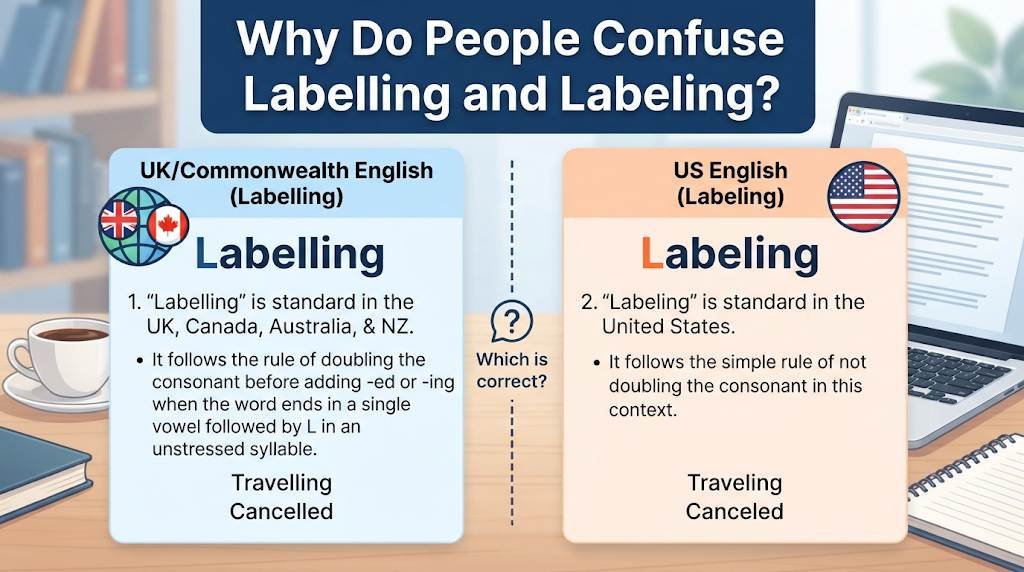
The meaning never changes, so the confusion is only about spelling. Most people have seen both versions and cannot tell which one belongs where.
Why Does One Spelling Have a Double L?
The double L comes from a British spelling habit. When a verb ends in a single vowel plus a single consonant, British English often doubles the consonant before “-ed” or “-ing.”
That habit applies even when the last syllable is not stressed. In “label,” the stress falls on the first syllable (LAY-bel), yet British English still writes “labelled.”
How to Remember the Correct Spelling
Use one of these quick memory tricks:
- Think “more letters, more tradition.” Britain keeps the extra L. America trims it.
- Pair it with similar words. If you write travelled and cancelled, write labelled. If you write traveled and canceled, write labeled.
- Match your audience. Decide whether you are writing for a UK-style or US-style reader, then keep that choice for the entire piece.
Labelling vs Labeling: Key Differences at a Glance
| Feature | Labelling | Labeling |
| Variety of English | British | American |
| Number of L’s | Two | One |
| Past tense | Labelled | Labeled |
| Person who labels | Labeller | Labeler |
| Meaning | Same | Same |
| Pronunciation | Same | Same |
| Correct in formal writing | Yes, in UK-style writing | Yes, in US-style writing |
What Do Labelling and Labeling Mean?
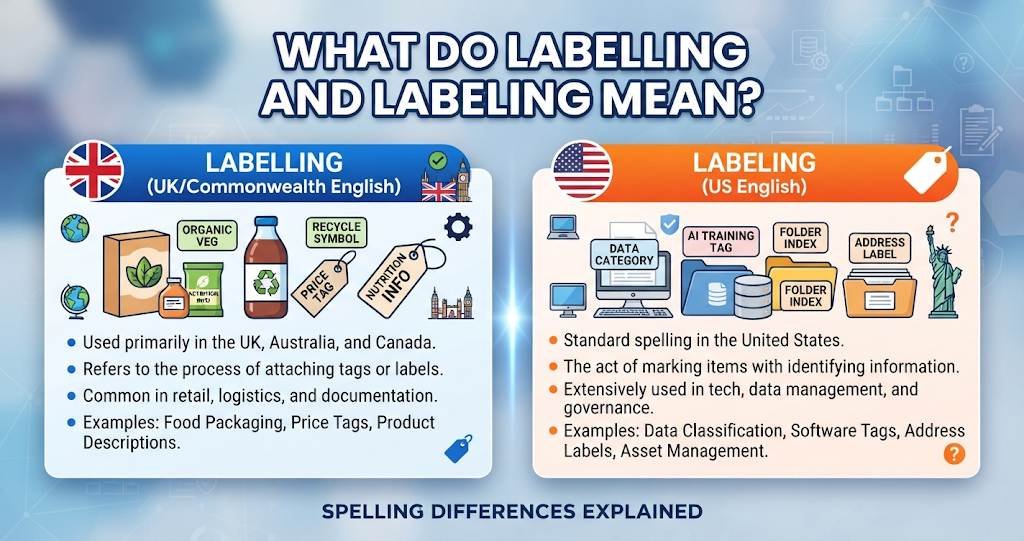
Both spellings come from the word “label.” At its core, to label something is to attach a tag, mark, or name to it so people know what it is. The word also has a figurative meaning: calling a person or group by a fixed category.
Labelling and Labeling as a Verb
As a verb, labelling/labeling is the action of putting a label on something or describing it in a certain way.
- She is labelling the jars before they go in the pantry.
- The teacher is labeling each diagram with small tags.
- It is unfair to start labelling a child after one bad day.
The verb often has a negative tone when used for people, because it can suggest putting someone in a box.
Labelling and Labeling as a Noun
The word can also work as a noun (called a gerund) that names the activity or the system.
- Clear labelling helps shoppers choose healthier foods.
- Proper labeling of chemicals keeps workers safe.
Note that the plain noun “label” (a tag or sticker) has only one L in both varieties. The double L only appears when you add “-ed,” “-ing,” or “-er.”
Labelling Products and Packaging
This is the most common use in business. Product labelling covers the information printed on packaging, such as:
- Ingredients and nutrition facts
- Allergy warnings
- Weight, size, and quantity
- Country of origin
- Safety symbols and handling instructions
- Barcodes, batch numbers, and expiry dates
Different countries have their own rules about what must appear on a label. Always check the requirements of the market where you sell.
British English vs American English: Which Spelling Is Used?
Here is how the spelling breaks down by region.
Labelling in British English
In the UK, “labelling” and “labelled” are standard. You will see them in government guidance, newspapers, and schoolbooks.
Labeling in American English
In the US, “labeling” and “labeled” are standard. Major American dictionaries list the single-L form first, and style guides for US publishing follow it.
Which Spelling Is Common in Canadian and Australian English?
Both Canadian and Australian English usually follow the British pattern here. That means “labelling” and “labelled” are the common choices in Canada, Australia, and New Zealand, as well as in India and South Africa.
Canadian writing mixes American and British habits in some words. In this case, the double L usually wins.
| Region | Common spelling |
| United States | Labeling |
| United Kingdom | Labelling |
| Canada | Labelling |
| Australia | Labelling |
| New Zealand | Labelling |
| India | Labelling |
Why Does British English Use Double L in Labelling?
In British English, a final “l” after a single vowel is usually doubled before a suffix, whether or not the syllable is stressed. That is why you get travelling, cancelling, modelling, and labelling.
American English simplified the rule. It doubles the final consonant only when the stress falls on that last syllable, as in compelled or rebelled. Because “label” stresses the first syllable, the American form stays at one L.
The change is often tied to the American lexicographer Noah Webster, who pushed for simpler spellings in the early 1800s. Whatever the exact cause, the split is now fixed in each region’s usage.
Which Spelling Should You Use?
The best choice depends on your reader, your publisher, and your own style guide.
When to Use Labelling
Use “labelling” when:
- Your audience is in the UK, Canada, Australia, New Zealand, or similar regions
- You are following British style guidelines
- Your document uses other British spellings, such as colour and organise
When to Use Labeling
Use “labeling” when:
- Your audience is mainly in the United States
- You are following an American style guide
- Your document uses other US spellings, such as color and organize
Which Spelling Is Better for Formal and Academic Writing?
Neither is better. Formal writing only requires you to be consistent.
- Follow your school, journal, or employer’s style guide.
- Pick one variety and stick with it from start to finish.
- Set your word processor’s language to match, so the spell checker helps instead of fighting you.
Labelled or Labeled: What’s the Difference?
There is no difference in meaning. The difference is only in spelling, and it follows the same UK and US split.
Is Labelled or Labeled Correct?
Both are correct. Use “labelled” for British-style writing and “labeled” for American-style writing.
What Is the Past Tense of Label?
The past tense of “label” is labelled (UK) or labeled (US). The past participle is spelled the same way.
- UK: The boxes were labelled by hand.
- US: The boxes were labeled by hand.
Is Labeled a Real Word?
Yes. “Labeled” is the standard American spelling and appears in all major US dictionaries. It is not a mistake or a shortened version of “labelled.”
Common Word Forms of Label
Each form follows the same rule: one L in the base word, then a UK or US choice when a suffix is added.
Label
The base word. It is a noun (a tag) and a verb (to tag). It is spelled the same everywhere.
Labels
The plural noun and the third-person verb form. Same spelling worldwide.
- The labels peeled off in the heat. (noun)
- She labels every shelf. (verb)
Labelled and Labeled
The past tense and past participle.
- UK: labelled
- US: labeled
Labelling and Labeling
The present participle and the gerund.
- UK: labelling
- US: labeling
Labeller and Labeler
A person or machine that labels.
- UK: labeller
- US: labeler
The same patterns apply to related words like “relabelled” (UK) and “relabeled” (US), or “mislabelled” (UK) and “mislabeled” (US).
| Form | British | American |
| Base | Label | Label |
| Plural / 3rd person | Labels | Labels |
| Past | Labelled | Labeled |
| -ing | Labelling | Labeling |
| Agent noun | Labeller | Labeler |
Labelling and Labeling in Example Sentences
All examples here are original. Notice that the meaning does not change from one column to the other.
Examples of Labelling in British English
- The charity is labelling donated clothes by size.
- Supermarkets must follow strict labelling rules for allergens.
- I spent the evening labelling folders for the new term.
- Accurate labelling builds trust with customers.
Examples of Labeling in American English
- The lab is labeling each sample with a barcode.
- Federal law requires clear labeling on packaged foods.
- She spent Sunday labeling boxes for the move.
- Honest labeling helps people shop with confidence.
Examples of Labelled and Labeled
| British | American |
| The bottles were labelled in three languages. | The bottles were labeled in three languages. |
| He labelled the map with red pins. | He labeled the map with red pins. |
| Is the drawer clearly labelled? | Is the drawer clearly labeled? |
| They felt unfairly labelled by the press. | They felt unfairly labeled by the press. |
Examples of Labelling Products and Packages
- The brand is labelling its new snack line as vegan and nut-free.
- Each parcel was labelled with an address and tracking number.
- We are labeling every carton “fragile” before shipping. (US)
- Mislabelled goods were returned to the warehouse. (UK)
Common Spelling Mistakes and How to Avoid Them
| Mistake | Why it is a problem | Fix |
| Mixing “labelled” and “labeling” in one text | Inconsistent variety of English | Pick one style and use it throughout |
| Writing “labellin” or “lablelling” | Typo | Break it into label + ling |
| Writing “labelling” with three Ls | Extra letter | Only two Ls appear |
| Writing “lable” or “labal” | Wrong base word | The base word is label |
| Using “labelled” for a US audience | May look like an error to US readers | Use labeled |
| Using “labeled” for a UK audience | May look like an error to UK readers | Use labelled |
A simple habit helps: run a find-and-replace at the end to make sure every instance matches your chosen style.
Word Origin and History of Label
“Label” entered English in the 1300s from Old French. It originally meant a ribbon or narrow strip of cloth, and it is thought to trace back to a Germanic word for a rag or strip.
Over time it also came to mean a strip of paper or parchment attached to a document. By the 1800s, it was common for a tag stuck on a package or bottle. The figurative sense, as in “labelling someone,” grew from there.
The extra L in the British forms is not part of that history. It was added later through the British convention of doubling a final consonant before a suffix.
Frequently Asked Questions About Labelling or Labeling
Is it spelled labelling or labeling, and which spelling is correct?
Both are correct. “Labelling” is British and “labeling” is American.
What is the difference between labelling and labeling in British and American English?
There is no difference in meaning, only in spelling. British English uses a double L, and American English uses one L.
Why does British English use labelling while American English uses labeling?
British English doubles the final L before a suffix. American English only does so when the last syllable is stressed, which is not the case in “label.”
Is labelling or labeling correct in formal and academic writing?
Both are acceptable. Choose the one that matches your style guide and use it consistently.
What is the correct spelling: labelled or labeled, and labelling or labeling?
“Labelled” and “labelling” are British. “Labeled” and “labeling” are American.
How do you use labelling and labeling in a sentence?
Use it as a verb or a noun: “She is labelling the files” (UK) or “Clear labeling prevents mistakes” (US).
Final Thoughts
“Labelling” and “labeling” mean exactly the same thing. The only question is which version of English you are writing in. Use the double L for UK, Canadian, and Australian readers, and the single L for American ones.
Whichever you choose, stay consistent from the first line to the last. Check your style guide when in doubt, and your writing will look polished and professional. The same British-American split explains traveled vs travelled and organizing vs organising.


3 thoughts on “Labelling or Labeling: Which Is Correct? Meaning, Spelling & Examples (2026)”