

You are typing an email, a school essay, or a blog post, and you stop on one word. Is it organizing or organising? The red squiggle under one of them makes it worse.
The short version is that both are correct. The right choice depends on where your reader lives and which style guide you follow. This guide explains the difference, the reason behind it, and how to pick one with confidence.
Quick Answer: Organizing vs Organising
Organizing is the standard spelling in American English. Organising is the standard spelling in British English, Australia, and New Zealand. The meaning, the pronunciation, and the grammar are identical.
| Organizing | Organising | |
| Spelling | -ize | -ise |
| Used in | US, Canada | UK, Australia, New Zealand |
| Meaning | Arranging or coordinating | Arranging or coordinating |
| Correct? | Yes | Yes |
What Is the Difference Between Organizing and Organising?
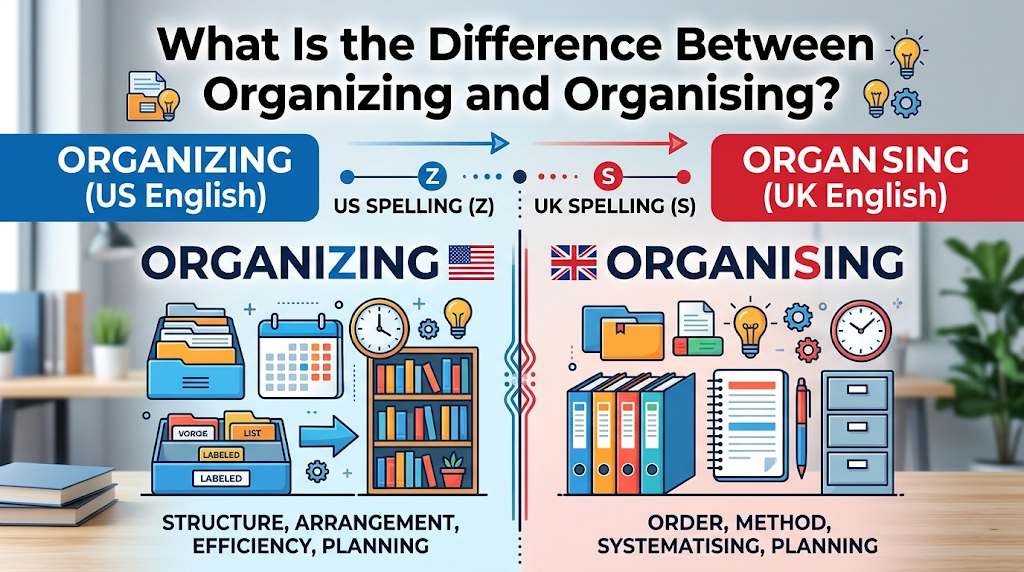
The only difference is one letter: z or s. Nothing else changes. It is the same word, spelled to suit different regions.
American English: Organizing
In the United States, organizing is the only spelling you will see in newspapers, schools, government documents, and business writing. The same rule applies to every related word: organize, organized, organizer, and organization.
British English: Organising
In the United Kingdom, organising is the common spelling in news outlets, schools, and most workplaces. Related words follow the same pattern: organise, organised, organiser, and organisation.
Are Both Spellings Correct in British English?
Yes. British English actually accepts two systems. Most publishers use -ise, but some, such as Oxford University Press and many academic journals, use -ize. So you may spot “organizing” in a British book and it will not be a mistake.
Meaning of Organizing and Organising
Both words describe the same action. Here is what they mean.
What Does Organizing Mean?
Organizing means arranging people, things, or tasks into a clear order so they work well together. It can be physical, like sorting a closet. It can also be mental or practical, like planning a schedule or setting up an event.
What Does Organising Mean?
Organising carries exactly the same meaning. If a British speaker says they are organising a trip, they are planning and arranging it, just like an American who says organizing a trip.
Do Organizing and Organising Have the Same Meaning?
Yes. They have the same meaning, the same pronunciation, and the same grammar role. Only the spelling changes. Your reader will understand either one.
Key Differences Between Organizing and Organising
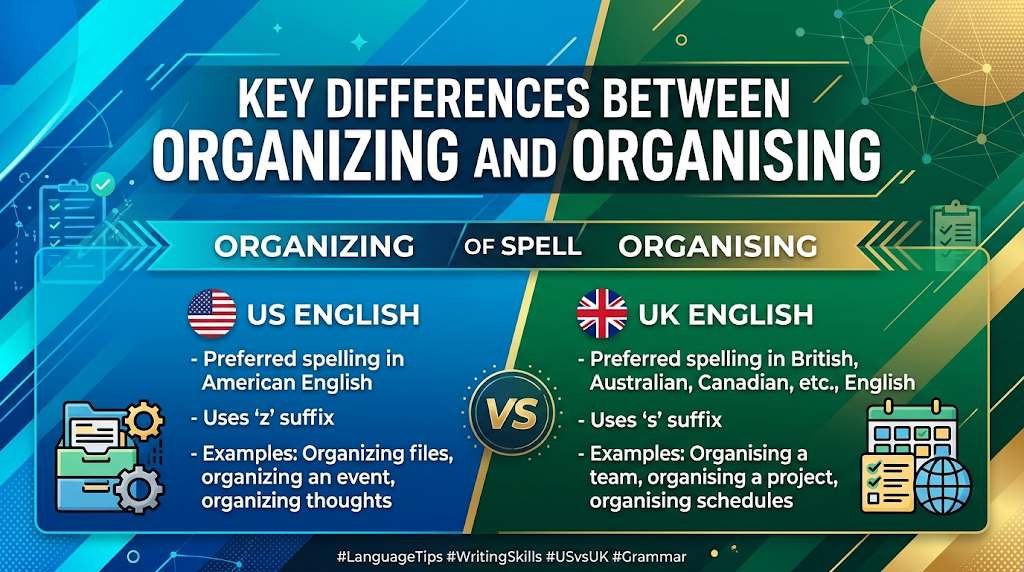
| Feature | Organizing | Organising |
| Spelling style | American | British |
| Letter in the middle | z | s |
| Pronunciation | Same | Same |
| Meaning | Same | Same |
| Common regions | US, Canada | UK, Australia, New Zealand |
| Related noun | Organization | Organisation |
| Related person noun | Organizer | Organiser |
The Spelling Rule Behind Organizing and Organising
The split between -ize and -ise is a long story, but the main points are easy to follow.
Why American English Uses -ize
The ending comes from the Greek suffix -izein, which later passed into Latin. American English kept the z. In the 1800s, Noah Webster pushed for simpler, more consistent spellings in his dictionaries, and the -ize form became the American standard.
Why Many British Style Guides Prefer -ise
French had its own version of the ending, spelled with an s. British writers were influenced by French spelling, and over time -ise became the more common choice in everyday British publishing.
Oxford Spelling: Why Organize Is Also Used in British English
Oxford spelling, used by Oxford University Press, keeps -ize because it follows the Greek source. It is still British English in every other way, so it will use “colour” and “centre” but “organize” and “recognize.” That is why you might see the z in a UK academic text.
Organizing vs Organising in American and British English
Which Spelling Is Used in the UK?
Organising is more common in the UK. Newspapers, government websites, and most businesses use -ise. Some universities and publishers follow Oxford style and use -ize.
Which Spelling Is Used in the US?
Only organizing is standard in the US. Writing “organising” in an American document will usually be treated as a spelling error.
What About Australia, Canada, and Other Countries?
| Country | Usual Spelling |
| United States | organizing |
| United Kingdom | organising (organizing in Oxford style) |
| Australia | organising |
| New Zealand | organising |
| Canada | organizing (mostly) |
| India and South Africa | organising (usually) |
Canadian English mixes habits. It generally uses -ize, but keeps British forms like “colour.” If your readers are Canadian, check the style guide of the publication or company.
Organizing vs Organising in Sentences
Organizing Examples
- She spent the weekend organizing her home office.
- The club is organizing a food drive for the winter.
- We are organizing the files by project name.
Organising Examples
- He spent the weekend organising his garage.
- The school is organising a charity run in March.
- They are organising the books by the author.
Examples in Everyday and Professional Writing
| Setting | US Version | UK Version |
| Everyday | I’m organizing a birthday surprise. | I’m organising a birthday surprise. |
| I’m organizing the meeting for Thursday. | I’m organising the meeting for Thursday. | |
| CV | Skilled in organizing large events. | Skilled in organising large events. |
| Academic | The study focuses on how teams are organizing remote work. | The study focuses on how teams are organising remote work. |
Organizing in Management: Meaning and Examples
In business, organizing is one of the core functions of management, alongside planning, leading, and controlling. It means setting up the structure that helps a team reach its goals. That includes assigning roles, dividing tasks, and deciding who reports to whom.
Here are a few real-world uses:
- Setting up teams: A manager groups staff into departments based on skills.
- Allocating resources: A project lead assigns budget, tools, and people.
- Defining workflows: A team writes clear steps so work moves smoothly.
- Community work: Volunteers organizing a campaign share jobs and deadlines.
The spelling follows the same rule. A US company writes about “organizing resources,” while a UK company may write “organising resources.”
Synonyms for Organizing and Organising
Common Synonyms
- Arranging
- Sorting
- Coordinating
- Structuring
- Planning
- Systematizing
- Ordering
Synonyms in Different Contexts
| Context | Better Word | Example |
| Home | tidying, decluttering | She is decluttering the hall closet. |
| Events | coordinating, arranging | He is coordinating the wedding. |
| Work | structuring, streamlining | They are streamlining the workflow. |
| Data | sorting, categorizing | We are categorizing the customer records. |
| Campaigns | mobilizing, rallying | They are rallying local volunteers. |
Grammar and Related Word Forms
Once you choose a spelling, use it for every form of the word. Mixing them in one document is the most common slip.
Base Verb: Organize and Organise
Organize (US) and organise (UK) are the base forms. Example: “We need to organize/organise the schedule.”
Present Participle: Organizing and Organising
This is the -ing form, used in continuous tenses and as a gerund. Example: “Organizing/Organising is her favorite hobby.”
Past Tense: Organized and Organised
The past tense and past participle are the same. Example: “They organized/organised the event last month.”
Noun: Organization and Organisation
The noun can mean a group, such as a company or charity, or the act of arranging something. Example: “The organization/organisation hired ten new staff.”
Related Words: Organizer and Organiser
An organizer/organiser can be a person who arranges events, or a tool like a planner or a drawer divider. Related words follow the same split, including organizational/organisational and reorganize/reorganise.
| US Spelling | UK Spelling |
| organize | organise |
| organizing | organising |
| organized | organised |
| organization | organisation |
| organizer | organiser |
| organizational | organisational |
| reorganize | reorganise |
Common Spelling Mistakes and Quick Fixes
| Mistake | Why It Happens | Quick Fix |
| Mixing “organizing” and “organisation” in one text | Switching between US and UK habits | Pick one style and apply it to every form |
| Using “organising” in a US document | Copying a UK source | Change every -ise to -ize |
| Using “organizing” in a UK essay without a reason | Autocorrect set to US English | Set your language to British English |
| Writing “orginizing” or “organzing” | Dropped or swapped letters | Break it down: or-gan-iz-ing |
| Treating the z version as “wrong” in the UK | Not knowing about Oxford spelling | Accept both, but stay consistent |
A simple memory trick: British has an s in it, and so does organise. American English leans on the z.
Which Spelling Should You Use?
Pick based on your reader, not on personal taste.
When to Use Organizing
Use organizing when:
- Your audience is mainly in the United States
- You are writing for an American company, school, or publication
- You follow AP, Chicago, MLA, or APA style
- You use Oxford spelling in a British setting
- Your audience is Canadian and the style guide prefers -ize
When to Use Organising
Use organising when:
- Your audience is mainly in the UK, Australia, or New Zealand
- You are writing for a British publication or company
- Your school or employer requires British spelling
- Your style guide asks for -ise forms
How to Maintain Consistent Spelling
- Choose one style first. Decide before you start writing.
- Set your spellchecker. Switch your editor to US or UK English.
- Use find and replace. Search for “ize” or “ise” at the end to catch mixed forms.
- Watch words that are always -ise. Words like advertise, revise, surprise, and supervise use -ise in both US and UK English, so do not change them.
- Read it once more. Check the first and last pages of long documents, where inconsistencies often hide.
Frequently Asked Questions
What is the difference between organizing and organising in English?
The only difference is spelling. Organizing is American English and organising is British English, but the meaning is the same.
Is organizing or organising the correct spelling?
Both are correct. Use organizing for a US audience and organising for a UK, Australian, or New Zealand audience.
Why do Americans spell it organizing while British people write organising?
American English kept the Greek-based -ize ending, and Noah Webster helped make it standard. British English was influenced by French spelling, which led to -ise.
Should I use organizing or organising in academic and professional writing?
Follow the style guide of your school, journal, or employer. If none is given, match your readers’ region and stay consistent.
Is organising British English and organizing American English?
Yes, in general. Note that some British publishers, such as those using Oxford spelling, also use organizing.
Do organizing and organising have the same meaning and pronunciation?
Yes. They mean the same thing and sound the same when spoken.
Final Thoughts
Organizing and organising are two spellings of one word. One belongs to American English and the other to British English, with Oxford spelling and Canadian usage adding a few exceptions.
Pick the spelling that matches your readers, apply it to every related word, and keep it the same from start to finish. That consistency matters far more than which letter you choose. You can also check modelling or modeling and usage or useage for more US vs UK spelling pairs.


1 thought on “Organizing vs Organising: Meaning, Spelling & Which Is Correct? (2026)”