

Tying is the correct spelling. It is the present participle of the verb tie, as in “She is tying her shoes.” Tieing is a misspelling that usage guides flag as an error, even though you will see it online.
The confusion is easy to understand. The word tie has an e at the end, so many writers expect it to stay when -ing arrives. English has a different rule for this case, and this guide explains it step by step.
Tying or Tieing: Quick Comparison Overview
| Feature | Tying | Tieing |
| Correct spelling? | Yes | No |
| Verb form | Present participle and gerund of tie | Common misspelling |
| Accepted in dictionaries? | Yes | No (not as a standard form) |
| Safe for formal writing? | Yes | No |
| Example | He is tying a knot. | ~~He is tieing a knot.~~ |
| Pronunciation | /ˈtaɪ.ɪŋ/ | Same sound, wrong spelling |
Quick memory trick: tie becomes tying just like lie becomes lying and die becomes dying. If you can spell those two, you can spell this one.
What Does Tying Mean?
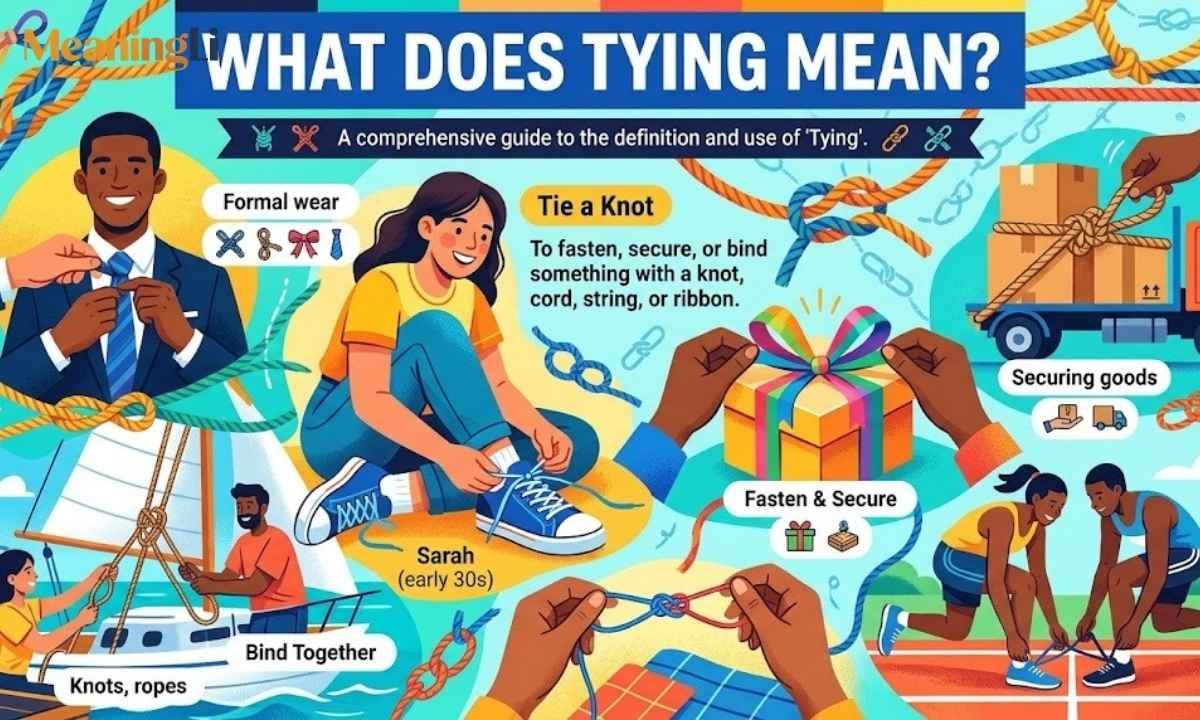
Tying Definition and Meaning
Tying is the -ing form of the verb tie. It describes the act of fastening, binding, or connecting something with a knot, string, rope, or similar material.
It can also be used figuratively, to describe linking ideas, events, or people together.
Different Meanings of Tying
The word carries several meanings depending on the context:
- Fastening with a knot: tying a shoelace, a rope, or a ribbon.
- Making a bow or knot in clothing: tying a necktie, a scarf, or an apron.
- Finishing level in a contest: tying a game, a match, or a vote.
- Connecting or linking: tying a bonus to performance, or tying two ideas together.
- Restricting or limiting: being tied to a desk, or tied down by a contract.
- Getting married (informal): tying the knot.
Tying in a Sentence
- She is tying a bright red ribbon around the gift box.
- The goalkeeper made a save, tying the score at one apiece.
- My brother is tying his tie before the interview.
- We are tying the new bonus plan to quarterly targets.
- They are tying the knot in June.
What Does Tieing Mean?
Is Tieing a Correct Spelling?
No. Tieing is not a standard spelling in modern English. Dictionaries list tying as the present participle of tie, and usage guides treat tieing as an error.
Some sites describe it as an “old variant.” Even if you find it in older texts, do not use it today.
Why Do People Spell Tying as Tieing?
There are a few common reasons:
- Base-word habit: people see tie and simply add -ing to the end.
- Sound-based spelling: the word sounds like “tie-ing,” so the letters seem to follow.
- The silent-e rule: most verbs ending in a silent e simply drop it (make → making). People assume tie works the same way, which would give “tiing.”
- Autopilot typing: the error is common enough that readers sometimes stop noticing it.
Tieing vs. Tying: Correct and Incorrect Examples
| Incorrect | Correct |
| She enjoys tieing her hair in a bun. | She enjoys tying her hair in a bun. |
| The farmer is tieing the gate shut. | The farmer is tying the gate shut. |
| After tieing his laces, he left. | After tying his laces, he left. |
| Tieing a tie takes practice. | Tying a tie takes practice. |
| He scored the tieing goal. | He scored the tying goal. |
Why Is Tying Spelled Without the E?
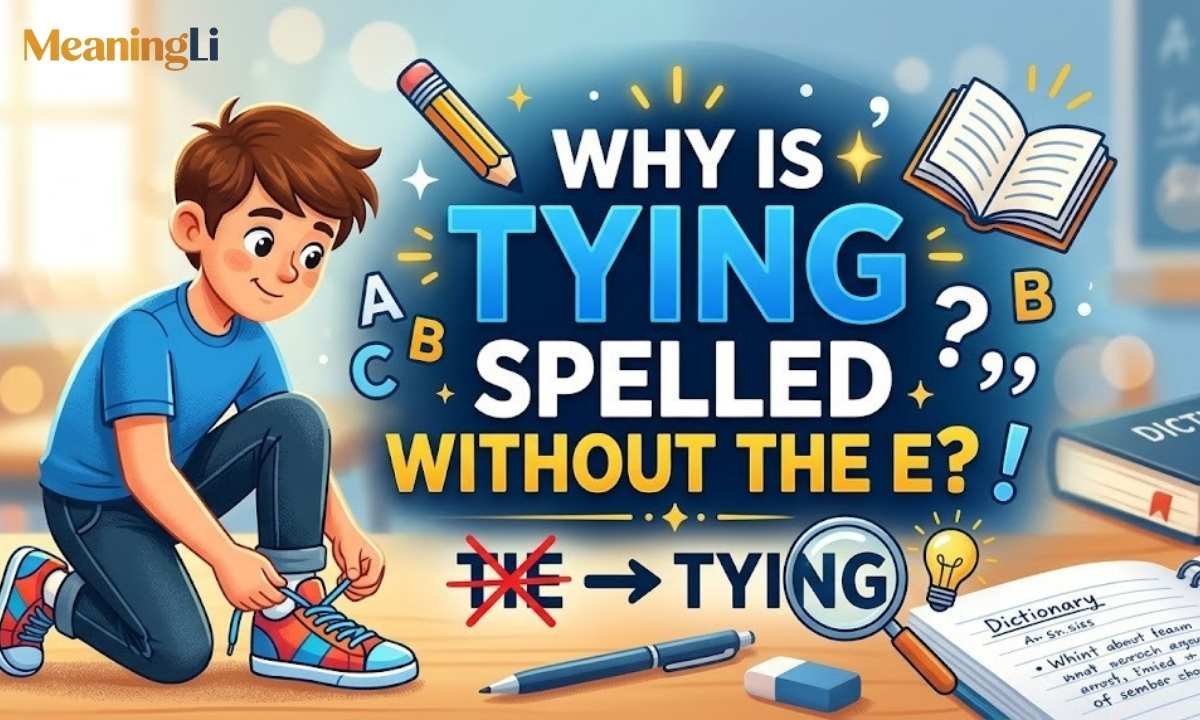
The Spelling Rule for Words Ending in -IE
The rule is short: when a verb ends in -ie, change the -ie to -y before adding -ing.
This avoids an awkward run of two i letters (tie + ing would put “ie” next to “ing,” giving tieing, which is crowded and confusing to read). Swapping in a y keeps the word clean.
The rule in action:
- Start with the base verb: tie
- Remove the -ie: t-
- Add -y: ty-
- Add -ing: tying
Tie, Tying, Tied, and Ties: Word Forms
Only the -ing form uses the y. The other forms are regular.
| Form | Spelling | Example |
| Base form | tie | Please tie the bag. |
| Third person singular | ties | He ties a tight knot. |
| Past tense | tied | She tied the boat to the dock. |
| Past participle | tied | The match was tied at halftime. |
| Present participle / gerund | tying | They are tying up loose ends. |
| Noun | tie | He wore a blue tie. |
The past tense does not change the -ie ending at all. You add only a d, so the word is tied.
Similar Words: Die and Dying, Lie and Lying
The same rule applies to other verbs that end in -ie:
| Base verb | -ing form | Wrong spelling |
| tie | tying | tieing |
| die | dying | dieing |
| lie | lying | lieing |
| vie | vying | vieing |
| belie | belying | belieing |
| untie | untying | untieing |
| retie | retying | retieing |
Careful with “dyeing”: dye (to color fabric) keeps its e in dyeing so it stays different from dying. That is a separate verb, not an -ie word.
Tying or Tieing: Main Differences
Spelling and Grammar Differences
- Tying follows the standard English rule for verbs ending in -ie.
- Tieing breaks that rule and looks like a plain “add -ing” mistake.
- Both describe the same action, but only one is accepted in school, business, and publishing.
- Spellcheck tools in Word and Google Docs underline tieing.
Meaning and Usage Differences
There is no difference in meaning, because tieing is not a separate word. It is simply a wrong version of tying.
So the real question is not “which meaning fits?” but “which spelling is correct?” The answer is always tying.
Common Uses of Tying in Everyday English
Tying a Game or Match
In sports, tying means reaching the same score as your opponent. American English uses it often, while British English more often says drawing or levelling.
- The striker is tying the game with a late header.
- Tying the series at two games each, the team forced a decider.
- The tying run is on third base.
A related word is tiebreaker, a method used to decide a winner after a tie.
Tying the Knot: Meaning and Usage
Tying the knot is a well-known idiom that means getting married. It comes from the image of two lives being bound together.
- They are tying the knot at a beach resort next spring.
- After five years together, Ana and Sam are finally tying the knot.
Tying a Tie: Meaning and Examples
Here, tying a tie means knotting a necktie around your collar. The common styles include the four-in-hand, the Windsor, and the half-Windsor.
- He spent ten minutes tying his tie in front of the mirror.
- Tying a Windsor knot takes a little patience.
Tying Shoes, Knots, and Other Objects
This is the most literal use of the word. You can tie almost anything that has a lace, string, rope, or strap.
- tying shoes or shoelaces
- tying a bow or ribbon
- tying a rope to a post
- tying back hair with a band
- tying a bandage or scarf
- tying up a boat at the harbor
Common phrases with “tying”:
- tying up loose ends (finishing remaining tasks)
- tying one’s hands (limiting someone’s options)
- tying it all together (connecting every point)
Tying or Tieing: Grammar Guide
How to Use Tying in a Sentence
Use tying after a helping verb such as is, are, was, or were, or as a noun-like word at the start of a sentence.
- After a helping verb: Mia was tying her scarf when the bus arrived.
- As a subject: Tying a bowline is easier than it looks.
- After a preposition: He is good at tying complicated knots.
- As an adjective: The tying run crossed the plate.
Is Tying a Verb, Gerund, or Present Participle?
It can be either, depending on how it is used.
| Role | What it does | Example |
| Present participle | Forms continuous tenses | She is tying her shoes. |
| Gerund | Works as a noun | Tying knots is a useful skill. |
| Participial adjective | Describes a noun | He hit the tying home run. |
All three roles use the same spelling. It never becomes tieing.
Common Spelling Mistakes to Avoid
- Writing “tieing” instead of tying.
- Writing “tiing” by dropping the e without making the y change.
- Writing “tyed” for the past tense. The correct word is tied.
- Writing “tying” for the noun. The necktie is a tie, not a tying.
- Confusing “dying” with “dyeing.” Dying means ceasing to live, while dyeing means coloring.
- Mixing up “lie” and “lay.” The forms lying and laying have different meanings.
Simple Rules to Remember
- Verbs ending in -ie change to -y before -ing.
- The past tense adds only -d: tied.
- The third person adds -s: ties.
- If it ends in -ing and starts with t-i-e, it is wrong.
When Should You Use Tying or Tieing?
When to Use Tying
Use tying every time you need the -ing form of tie. That includes essays, emails, social media posts, product listings, instructions, and news writing.
It is correct in American, British, Canadian, and Australian English alike.
When to Avoid Tieing
Avoid tieing in all writing. It has no regional variety, no formal exception, and no special meaning.
The only reason to type it is when you are quoting a mistake on purpose, for example in a grammar lesson like this one.
How to Choose the Correct Spelling
Try this quick three-step check:
- Find the base verb. Is it a tie?
- Check the ending. It ends in -ie, so apply the -ie → -y rule.
- Add -ing. You get tying.
Another shortcut is to compare it with a word you already know: if you say “lying” and “dying,” then you also say “tying.”
Tying or Tieing: Real-World Examples
Examples of Tying in Everyday Sentences
- I am tying a ribbon on my daughter’s braid.
- Are you tying your laces double, or just once?
- The sailors spent the morning tying the ropes along the dock.
- She is tying her success to hard work and good planning.
- The florist is tying the stems with twine.
- He felt tied down by the long contract. (past participle, for comparison)
Examples of Tying in Sports and Games
- The home team is tying the match in stoppage time.
- A three-pointer in the final seconds is tying the score at 78.
- Tying the series gives the underdogs momentum.
- The golfer is tying the course record on the last hole.
- Two players are tying for first place on the leaderboard.
Incorrect Tieing Examples and Their Corrections
| Incorrect sentence | Corrected sentence |
| The kids are tieing balloons to the fence. | The kids are tying balloons to the fence. |
| She keeps tieing her hair too tight. | She keeps tying her hair too tight. |
| We are tieing the score late in the game. | We are tying the score late in the game. |
| He is tieing up the loose ends. | He is tying up the loose ends. |
| Tieing the knot took them five years. | Tying the knot took them five years. |
Frequently Asked Questions
Is it tying or tieing, and which spelling is correct?
Tying is correct. Tieing is a misspelling of the present participle of tie.
Why is tying spelled without an e?
English changes the -ie ending to -y before -ing, so tie becomes tying. This also stops two i letters from appearing close together.
What is the meaning of tying, and how do you use it in a sentence?
Tying means fastening or linking something with a knot or connection. Example: “She is tying her shoes before the race.”
What is the difference between tying and tieing?
There is no difference in meaning, only in correctness. Tying is the standard spelling, while tieing is an error.
How do you spell tying in the past tense?
The past tense of tie is tied, not tyed or tieed. For example: “He tied the rope to the post.”
What are some examples of tying in everyday English?
Common examples include tying shoes, tying a tie, tying a ribbon, tying a game, and tying the knot. Each of them uses the same spelling: tying.
Final Thoughts
The answer to the tying or tieing question is simple: always write tying. The -ie to -y rule is the reason, and it also explains dying, lying, and vying.
Keep the rule in mind and use the memory trick, and you will not have to second-guess this spelling again. Whether you are tying a shoe, tying a score, or tying the knot, the correct word is the same.
The -ie to -y rule reaches well beyond this one word, and English keeps serving up look-alike pairs that trip writers up. One is requester or requestor, where two near-identical spellings compete for the same job, and another is shown vs showed, where the tense decides which form is correct. The same check-it-first habit helps everywhere else too, even with swifty or swiftie, two words that differ by one vowel but point to entirely different things.


3 thoughts on “Tying or Tieing: Which Is Correct? Meaning, Spelling & Examples (2026)”