

Gray or grey? Both spellings are correct, and both name the same color between black and white. The only real question is which one fits your audience.
This guide gives you the rule in one line, then walks through regional spelling, names that never change, and the tricky forms like grayer and greyish. You will also get examples you can copy and a short FAQ.
Quick Answer: (Gray vs Grey)
Use “gray” in American English. Use “grey” in British English and in most other English-speaking countries.
- Gray: standard in the United States.
- Grey: standard in the UK, Ireland, Australia, New Zealand, and Canada.
- Meaning: exactly the same.
Memory shortcut: grAy = America. grEy = Everywhere else.
What Is the Difference Between Gray and Grey?
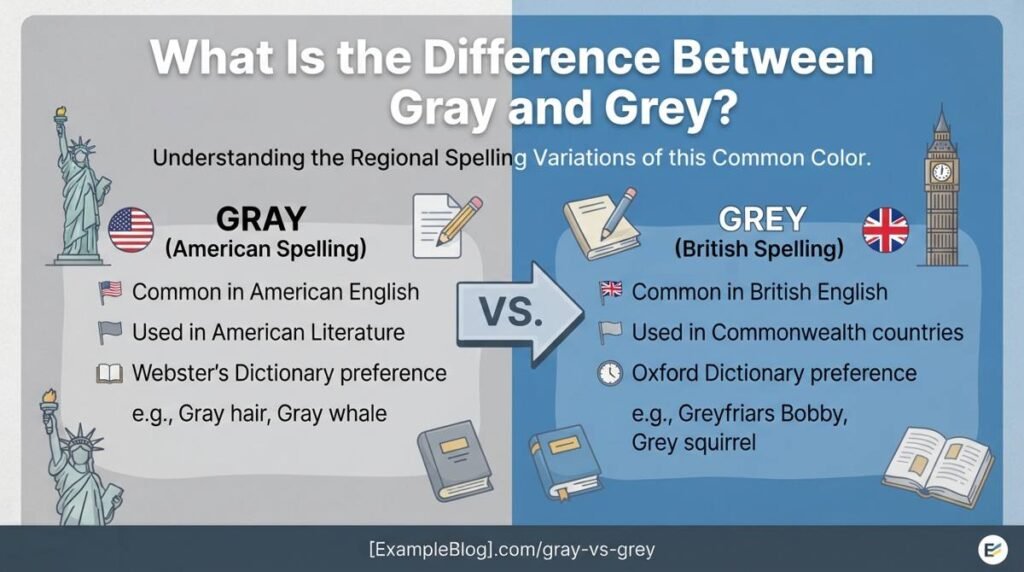
There is no difference in meaning. Gray and grey are two spellings of one word, and dictionaries treat them as regional variants. Neither is a mistake.
The word itself is very old. Both spellings trace back to the Old English word grǣg. English writers spelled it in different ways for centuries, and the two spellings we use now settled into regional habits.
So the difference is about place, not color, shade, or grammar. Think of it like color and colour.
Gray vs Grey: The Core Spelling Rule
The rule is short: pick the spelling that matches your readers, then stay consistent. Mixing both in one piece looks careless.
Gray in American English
In the United States, gray is the usual spelling. American dictionaries list it first and treat grey as a less common variant.
It fits the wider American habit of simpler spellings, like color and center. Many historians credit Noah Webster’s dictionary work in the 1800s with helping gray take hold in the US, though the shift was gradual.
- The gray clouds rolled in before noon.
- Her gray sweater was on the chair.
Grey in British English
In the UK, grey is the standard form. British newspapers, books, and government pages use it as the default.
- The grey clouds rolled in before noon.
- His grey suit looked sharp.
Which Spelling Is Used in Canada, Australia, and Other Countries?
Most English-speaking countries outside the US lean toward grey. That includes Canada, where grey is the more common choice even though many other Canadian spellings follow American habits.
| Country / region | Usual spelling |
| United States | gray |
| United Kingdom | grey |
| Ireland | grey |
| Canada | grey |
| Australia | grey |
| New Zealand | grey |
| South Africa | grey |
| India (British-based usage) | grey |
Some places mix both in everyday use, so check a local style guide if the choice matters.
How to Use Gray and Grey Correctly
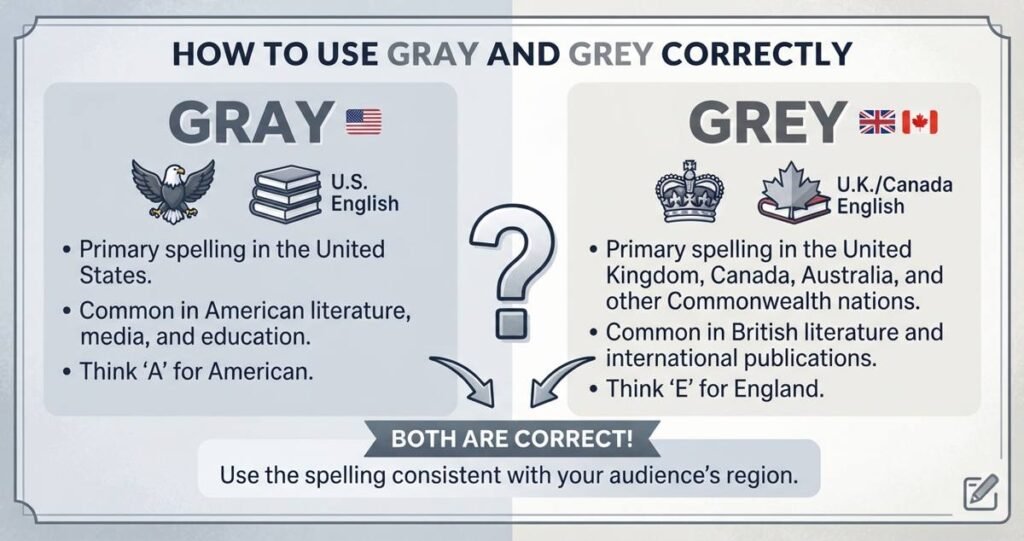
Both spellings work in every part of speech. Pick one spelling, then apply it everywhere.
Gray and Grey as Adjectives
Most of the time, the word describes something.
- American: a gray coat, a gray morning, gray eyes.
- British: a grey coat, a grey morning, grey eyes.
The adjective can also mean dull, gloomy, or lacking energy, as in “a gray mood” or “a grey Monday.”
Gray and Grey as Nouns
As a noun, it names the color or a shade of it.
- American: She painted the room in a soft gray.
- British: She painted the room in a soft grey.
You can also use it for a person, an animal, or a horse, such as “a dapple grey.”
Gray and Grey as Verbs
Yes, it is a verb too. It means to turn gray or to make something gray.
| Form | American | British |
| Base | gray | grey |
| Past | grayed | greyed |
| -ing form | graying | greying |
| Third person | grays | greys |
- His beard has grayed over the years. (US)
- The screen greyed out when the app froze. (UK)
Gray Area or Grey Area
A “gray area” is a situation that is unclear or not covered by clear rules. The spelling follows the usual regional rule.
- US: The policy leaves a gray area around remote work.
- UK: The policy leaves a grey area around remote work.
Gray Hair or Grey Hair
The same rule applies. Americans write gray hair, and most British, Canadian, and Australian writers write grey hair.
Related forms follow along: graying hair (US), greying hair (UK), and gray-haired or grey-haired.
Gray vs Grey: American vs British English
A quick way to see the split is to read both versions of the same sentence. Only the vowel changes.
Examples of Gray in American English
- The gray skyline faded into the evening fog.
- He wore a gray hoodie to the gym.
- We argued about whether the contract left a gray area.
- A gray wolf crossed the road ahead of us.
- Her gray hair caught the light.
Examples of Grey in British English
- The grey skyline faded into the evening mist.
- He wore a grey jumper to the pub.
- We argued about whether the contract left a grey area.
- A grey squirrel darted along the fence.
- Her grey hair caught the light.
Which Spelling Should You Use in International English?
If your readers come from many countries, choose by your main audience. Check where most of your traffic or customers live, then follow that region.
- Mostly US readers: gray.
- Mostly UK, Commonwealth, or global readers: grey.
- Mixed audience and no clear winner: grey is the safer pick, since more English-speaking countries use it.
Whatever you decide, set it in your style guide so every writer follows it.
Gray vs Grey Pronunciation: Do They Sound the Same?
Yes. Both are pronounced the same way, rhyming with day, play, and say. The vowel sound is the long “ay” in either spelling.
That is why you cannot rely on your ear. Only the spelling shows which version a writer chose.
Do Gray and Grey Refer to Different Colors?
No. Both words mean a neutral shade between black and white.
Some people believe one spelling means a lighter shade and the other a darker one. That idea is a myth. Paint brands and design tools may name their swatches differently, but that is a product choice, not a language rule.
To describe a specific shade, use a modifier instead:
- light gray / light grey
- charcoal gray / charcoal grey
- silver, slate, ash, or steel
Gray vs Grey in Names, Titles, and Fixed Expressions
Names are the one place where you should not switch spellings to match your region. A title or brand keeps the form it was given.
Fifty Shades of Grey or Gray
It is Fifty Shades of Grey. The title plays on the name of the character Christian Grey, so even American publishers kept the e.
Earl Grey or Earl Gray
It is Earl Grey tea. The tea is named after Charles Grey, 2nd Earl Grey, a British prime minister in the early 1830s. Writing “Earl Gray” is usually seen as a mistake.
Gray or Grey as a Name or Surname
People spell their names the way their families do, and both versions exist everywhere.
- Grey: Zane Grey (American author), Grey’s Anatomy (TV drama).
- Gray: Dorian Gray (from Oscar Wilde’s novel), Henry Gray (author of Gray’s Anatomy, the anatomy textbook), and the SI unit gray (Gy), named after physicist Louis Harold Gray.
Always copy a person’s name exactly as they write it.
Greyhound or Grayhound
It is greyhound in nearly all writing, including in the US. Merriam-Webster notes that the “grey” in the dog’s name is not the color word at all. It comes from an older word linked to the dog’s name, so Americans should not “fix” it to grayhound.
The Greyhound bus line also keeps the e.
Grayer vs Greyer and Grayish vs Greyish
The regional rule carries over to forms built from the word. Change only the vowel, and keep the rest of the spelling as usual.
Is It Grayer or Greyer?
- American English: grayer, grayest.
- British English: greyer, greyest.
Example: “The sky turned grayer by the hour” (US) or “The sky turned greyer by the hour” (UK).
Is It Grayish or Greyish?
- American English: grayish.
- British English: greyish.
Example: “The walls had a grayish tint” (US) or “The walls had a greyish tint” (UK).
The same pattern applies to grayness/greyness, grayscale/greyscale, gray-green/grey-green, and grayed out/greyed out.
Gray vs Grey: Correct Examples in Sentences
Examples Using Gray
- The painter mixed black and white to get the right gray.
- A gray fog settled over the harbor.
- The company’s rules leave a gray area for freelancers.
- After the move, the gray cat hid under the couch.
- Parts of the menu are grayed out until you log in.
- His gray eyes gave nothing away.
Examples Using Grey
- The painter mixed black and white to get the right grey.
- A grey mist settled over the harbour.
- The company’s rules leave a grey area for freelancers.
- After the move, the grey cat hid under the sofa.
- Parts of the menu are greyed out until you log in.
- His grey eyes gave nothing away.
Common Gray vs Grey Spelling Mistakes
| Mistake | Why it is a problem | Fix |
| Mixing “gray” and “grey” in one article | Looks inconsistent | Choose one spelling for the whole piece |
| Writing “Earl Gray tea” | Proper name is fixed | Earl Grey tea |
| Writing “Fifty Shades of Gray” | Wrong title spelling | Fifty Shades of Grey |
| Writing “grayhound” for the dog | Standard spelling keeps the e | Greyhound |
| Changing “Gray’s Anatomy” to “Grey’s Anatomy” | They are two different works | Textbook: Gray’s. TV show: Grey’s |
| Writing “grey” in a US-only legal or brand document | Does not match the audience | Use gray for US readers |
| Claiming gray and grey are different shades | Not true | Use a modifier like “light” or “charcoal” |
Gray vs Grey: Comparison Table
| Feature | Gray | Grey |
| Main region | United States | UK, Ireland, Canada, Australia, NZ, and others |
| Meaning | Color between black and white | Same |
| Pronunciation | /ɡreɪ/ | /ɡreɪ/ |
| Adjective | gray sky | grey sky |
| Comparative | grayer | greyer |
| “Somewhat gray” | grayish | greyish |
| Verb forms | grayed, graying | greyed, greying |
| Common idiom | gray area | grey area |
| Fixed names | Dorian Gray, Gray’s Anatomy (book), SI gray | Earl Grey, Greyhound, Fifty Shades of Grey, Grey’s Anatomy (TV) |
| Dictionary status | Main US spelling | Main spelling outside the US |
Easy Ways to Remember the Difference Between Gray and Grey
Try one of these tricks until it feels natural.
- A for America, E for England. Gray has an A like America. Grey has an E like England.
- “Everywhere else” rule. Gray is the US choice. Grey is the choice nearly everywhere else.
- Match your other spellings. If you write color and center, go with gray. If you write colour and centre, go with grey.
- Names do not move. Earl Grey, Greyhound, and Dorian Gray keep their spelling in any country.
- Set a house style. If you write for a team or a brand, put the decision in a one-line style note.
Frequently Asked Questions
Is Gray or Grey the Correct Spelling?
Both are correct. Use gray for American readers and grey for British and most other English-speaking readers.
Is Gray American or British English?
Gray is the standard American English spelling. British writers usually use grey.
Is Grey American or British English?
Grey is the standard British English spelling, and it is also common in Canada, Australia, and New Zealand. It is a less common variant in the US.
Is It Gray Hair or Grey Hair?
It depends on your region. Write gray hair for a US audience and grey hair for a UK or Commonwealth audience.
Is It Gray Area or Grey Area?
The meaning is identical. Americans write gray areas, while British and Commonwealth writers write grey areas.
Are Gray and Grey Pronounced the Same?
Yes. Both rhyme with day and are pronounced exactly alike.
Do Gray and Grey Mean Different Colors?
No. They are two spellings of the same color, a neutral shade between black and white.
Which Spelling Should I Use in Formal Writing?
Use the spelling that matches your audience’s regional English and keep it consistent. Always keep proper names such as Earl Grey in their original form.
Final Thoughts
The simple answer is to follow your audience. Choose gray for readers in the US and grey for readers in the UK and most other English-speaking countries. Neither spelling changes the meaning, so there is no “wrong” choice, only a mismatched one.
The real traps are names and fixed terms. Keep Earl Grey, Greyhound, and Fifty Shades of Grey exactly as they are, and stay consistent everywhere else. Do that, and your writing will read as polished in any region. You can also read our guide on humour or humor and our breakdown of cosy or cozy for more pairs like this.