

You have probably typed a word, stared at it, and wondered if it looked wrong. “Chosing” is one of those words. It looks believable, but it is not real English.
The correct spelling is choosing, with two O’s. This guide explains the meaning, the grammar behind the spelling, and how to use the word with confidence.
Quick Answer: Is It Choosing or Chosing?
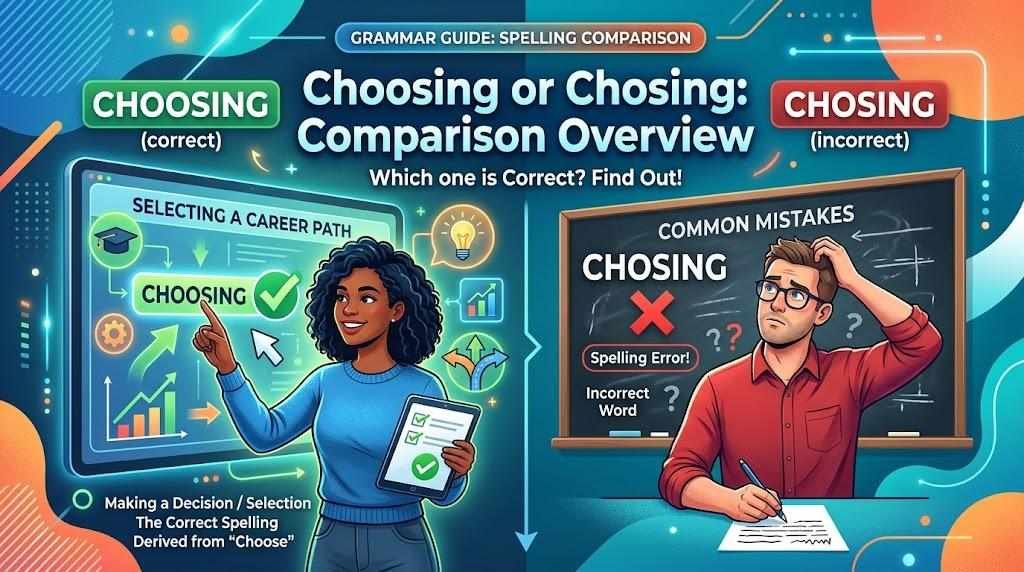
Choosing is correct. Chosing is a misspelling.
“Choosing” is the present participle of the verb choose. It keeps both O’s because the base verb is spelled with two.
- ✅ She is choosing a new phone.
- ❌ She is chosing a new phone.
Spell-checkers, dictionaries, and style guides all agree. No version of English, whether American, British, Australian, or Canadian, accepts “chosing.”
| Feature | Choosing | Chosing |
| Correct spelling? | Yes | No |
| Found in dictionaries? | Yes | No |
| Base verb | Choose | None (confused with chose) |
| Grammatical form | Present participle / gerund | Not a valid form |
| Number of O’s | Two | One |
| Pronunciation | /ˈtʃuːzɪŋ/ (CHOO-zing) | Would imply /ˈtʃoʊzɪŋ/ |
| Safe for formal writing? | Yes | Never |
What Does Choosing Mean?
Definition of Choosing
Choosing means selecting one option, person, or course of action from two or more possibilities. It describes the act of making a decision, often after some thought.
Part of Speech and Meaning
“Choosing” is the -ing form of the verb choose. Depending on the sentence, it works as:
- A present participle (part of a continuous verb): They are choosing a venue.
- A gerund (a verb acting as a noun): Choosing takes time.
- A participial adjective or modifier: The committee, choosing carefully, delayed its vote.
Choosing in Everyday English
People use the word constantly, usually without noticing:
- Choosing a meal at a restaurant
- Choosing a career path
- Choosing a password
- Choosing sides in a debate
- Choosing between saving and spending
It fits casual talk and formal writing equally well.
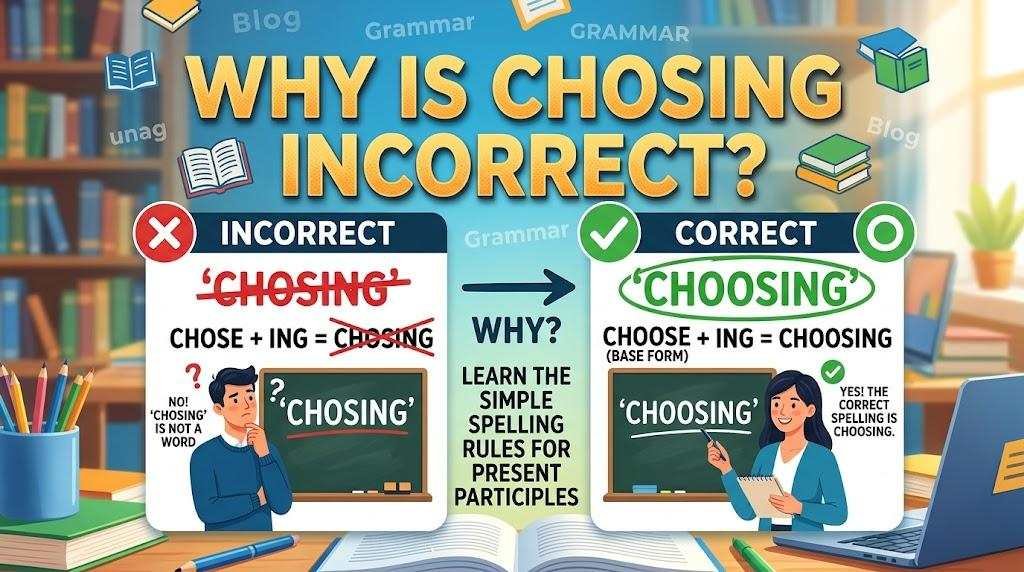
“Chosing” breaks the spelling pattern of the verb it comes from. The verb is choose, and when you add -ing, the base keeps its double O. Nothing in English spelling rules removes one.
Why People Confuse Choosing and Chosing
Three habits cause the error:
- Mixing it up with “chose.” The past tense chose has one O, so writers tack on -ing and get “chosing.”
- Applying the drop-the-e rule too broadly. Many verbs lose a final e before -ing (make → making). Writers drop the e here and then forget the vowel pair stays.
- Pronunciation shifts. “Choose” sounds like CHOOZ, while “chose” sounds like CHOHZ. The vowel sound changes, but writers often trust their eyes instead of the sound.
The Difference Between Choose, Chose, and Choosing
| Form | Type | Example |
| Choose | Base / present tense | I choose the blue one. |
| Chooses | Third-person singular | She chooses carefully. |
| Chose | Past tense | He chose the red one yesterday. |
| Chosen | Past participle | They have chosen a winner. |
| Choosing | Present participle / gerund | We are choosing a winner now. |
Notice that chose is the only form with a single O in its main vowel spot, and it belongs to the past tense only.
Main Differences Between Choosing and Chosing
Choosing vs Chosing Spelling
“Choosing” has seven letters: c-h-o-o-s-i-n-g. “Chosing” has six and is missing the second O. That one missing letter turns a real word into an error.
Choosing vs Chosing Grammar
“Choosing” follows normal verb rules. It can pair with am, is, are, was, or were to form continuous tenses. “Chosing” has no grammatical role because it does not exist as a verb form.
Choosing vs Chosing Meaning and Usage
“Choosing” carries a clear meaning: selecting. “Chosing” carries none. Readers who see it usually guess what you meant, but it can make writing look careless, especially in resumes, emails, or articles.
Grammar Rules for Choosing
How to Add -Ing to Choose
Follow this short process:
- Start with the base verb: choose
- Drop the silent final e: choos-
- Add -ing: choosing
Only the silent e disappears. Everything else stays in place.
Why Choosing Keeps Both O’s
The double O in choose is a vowel pair that makes the long “oo” sound. Dropping the final e does not change that pair. Removing one O would change the vowel sound and break the word.
Compare these similar verbs:
| Base Verb | + ing | Notes |
| Choose | Choosing | Keeps double O |
| Lose | Losing | Keeps single O (base has one) |
| Loose | Loosing | Keeps double O |
| Move | Moving | Keeps single O |
| Boost | Boosting | Keeps double O |
Common Spelling Mistakes to Avoid
Watch for these related errors:
- ❌ Chosing → ✅ Choosing
- ❌ Choosen → ✅ Chosen
- ❌ Choosed → ✅ Chose
- ❌ Choses → ✅ Chooses
- ❌ Choise → ✅ Choice
Simple Rules to Remember
- If the base verb has two O’s, the -ing form has two O’s.
- Chose is past tense only. Never add -ing to it.
- When in doubt, start from choose, drop the e, add -ing.
When to Use Choosing
Choosing as a Verb
Use “choosing” with a helping verb to show an action in progress.
- I am choosing my courses for next semester.
- The jury was choosing between two finalists.
- They will be choosing a new manager next week.
Choosing as a Gerund
A gerund works like a noun, so it can be a subject or an object.
- Choosing the right tools makes the job easier.
- She is afraid of choosing wrongly.
- His hobby is choosing vintage furniture.
Choosing in Formal and Informal Writing
The spelling stays identical in every setting, but the tone around it changes.
| Setting | Example |
| Formal | The board is choosing a replacement in accordance with company policy. |
| Informal | Still choosing what to wear lol. |
Choosing in a Sentence
Choosing Examples in Everyday Conversations
- “I’m choosing pizza tonight. You pick the movie.”
- “Are you choosing the window seat or the aisle?”
- “My sister keeps choosing the same song on repeat.”
- “We spent an hour choosing paint colors.”
Choosing Examples in Academic Writing
- Choosing an appropriate research method is the first step of any study.
- Participants were observed choosing between short-term and long-term rewards.
- The author argues that choosing a narrow topic improves the depth of analysis.
- Students choosing this elective must complete a prerequisite course.
Choosing Examples in Professional Emails
- Thank you for choosing our team to handle your account.
- We are currently choosing a vendor and will update you by Friday.
- I appreciate you choosing to join the call on short notice.
- Our focus is on choosing solutions that save time and cost.
Choosing Synonyms and Related Words
Several words overlap with “choosing,” but each has its own flavor.
| Word | Best Used When | Example |
| Selecting | The process is formal or structured | The panel is selecting candidates. |
| Picking | The tone is casual and quick | She is picking a snack. |
| Deciding | The focus is on reaching a conclusion | He is deciding where to live. |
| Opting for | You prefer one choice over others | They are opting for the cheaper plan. |
| Electing | A vote or official process is involved | Voters are electing a mayor. |
| Preferring | A personal preference matters | I am preferring tea these days. |
Choosing vs Selecting
“Selecting” sounds more careful and official. You would say selecting a candidate in a report, but choosing a candidate works almost anywhere.
Choosing vs Picking
“Picking” is relaxed and fast. It suits everyday situations, like picking a movie, but feels too casual for legal or academic writing.
Choosing vs Deciding
“Choosing” points to the act of selecting an option. “Deciding” points to the mental process of settling a question. You can be deciding without having any options yet, but you cannot be choosing without them.
Common Expressions and Phrases With Choosing
Thank You for Choosing
This is a popular line in business, travel, and customer service.
- Thank you for choosing our hotel.
- Thank you for choosing to work with us.
Choosing Between Two Options
Use this phrase when facing a straightforward either-or decision.
- I am choosing between a new laptop and a tablet.
- She struggled with choosing between two job offers.
Choosing the Right One
This phrase stresses accuracy, fit, or quality.
- Choosing the right one can save you money in the long run.
- There are many brands, so choosing the right one takes research.
Other useful phrases:
- Choosing sides
- Choosing wisely
- Choosing a path
- Choosing to ignore
- Of one’s own choosing
How to Remember the Correct Spelling of Choosing
Try these quick memory tricks:
- Think “choose” first. Choose has two O’s, so choosing does too.
- Hear the sound. “Choosing” rhymes with “boozing” and “cruising.” That long oo sound needs two O’s.
- Link it to “choice.” Both have ch-o-, and choose is the verb family behind the noun.
- Remember “chose” is past only. If the sentence is not in the past, do not use it.
- Two eyes, two O’s. Picture the double O as two eyes looking at the options before you pick.
Frequently Asked Questions
Is it choosing or chosing, and which spelling is correct in English?
Choosing is correct. “Chosing” is a common misspelling and is not accepted in any English dictionary.
What does choosing mean, and how do you use it in a sentence?
Choosing means selecting something from a set of options. Example: She is choosing a gift for her friend.
Why is choosing spelled with two O’s instead of chosing?
It comes from the verb choose, which has two O’s. Adding -ing only removes the silent e, not the double O.
Is choosing the present participle of choose?
Yes. “Choosing” is the present participle and also works as a gerund.
What is the difference between choose, chose, and choosing?
Choose is the base or present form, chose is the past tense, and choosing is the -ing form used for ongoing action.
How do you use choosing correctly in everyday English? Can you give some examples?
Use it after am, is, are, was, or were, or as a noun-like subject. Examples: I am choosing a book, and Choosing a book can be hard.
Final Thoughts
The answer is simple: choosing is the only correct spelling, and “chosing” is a typo that comes from mixing up chose and choose. Keep the double O and drop only the silent e.
Next time you write the word, start with choose and add -ing. A small habit like this keeps your emails, essays, and posts clean and professional.
Small spelling slips like this one are easy to repeat, so it helps to check the tricky ones as they come up. If you are ever unsure whether it is nosy or nosey, our guide clears up the y-versus-ey ending, and the same goes for privilege or priviledge, where the middle letters catch plenty of writers out. English is full of these traps, and a quick look at requester or requestor before you send something off can save you from an awkward correction later.


2 thoughts on “Choosing or Chosing : Which Is Correct? Meaning, Spelling & Examples (2026)”