

Few verbs trip people up like “show.” You write “I have showed him the report,” then pause and wonder if “shown” looks better. Both words feel familiar, yet only one fits each sentence.
The good news is that the rule is simple. Showed is the simple past tense, and shown is the past participle. This guide explains both forms, with clear examples, a comparison table, and quick memory tricks.
Shown vs Showed: Which Is Correct?
Both words are correct, but they do different jobs.
- Showed is used on its own for a finished action: “She showed me the photos.”
- Shown is used after a helping verb such as have, has, had, is, was, or been: “She has shown me the photos.”
Quick answer: If there is no helping verb, use showed. If there is a helping verb, use shown.
What Do Shown and Showed Mean?
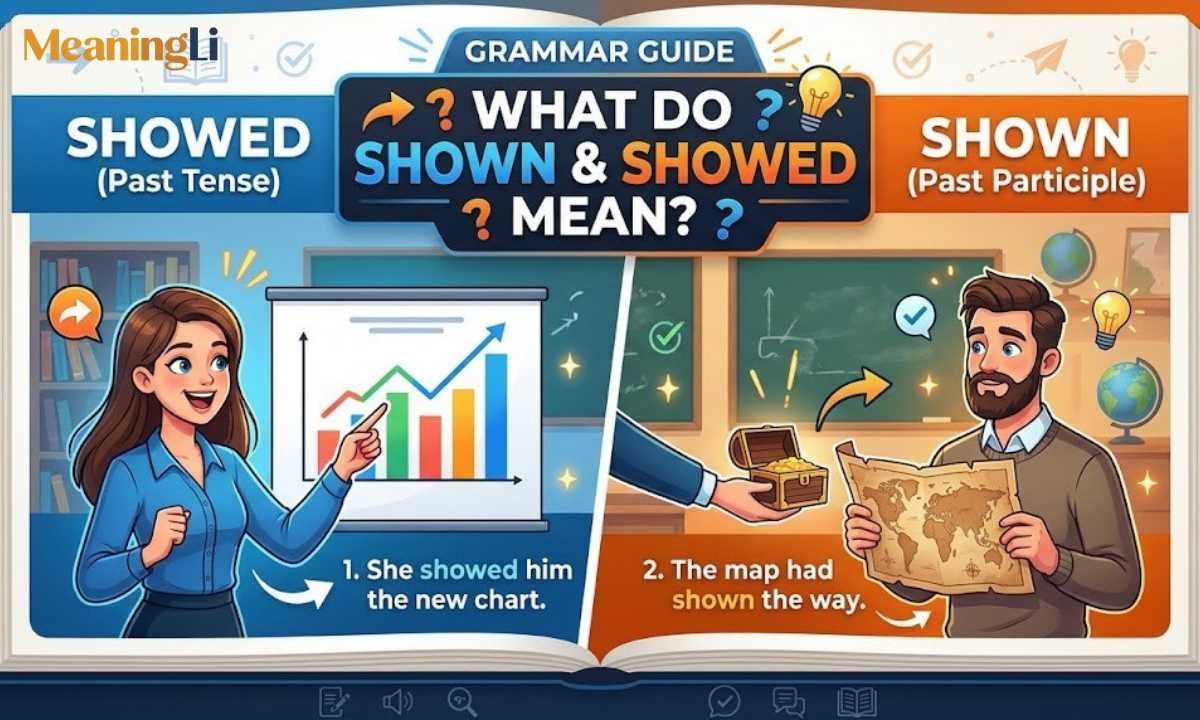
Both words come from the irregular verb “show.” They share the same core meaning: to present, reveal, prove, or guide. The difference is grammatical, not a difference in meaning.
Meaning of Showed
“Showed” is the simple past tense of “show.” It describes an action that started and finished in the past. It needs no helping verb.
- To let someone see something: “The agent showed us the apartment.”
- To prove or demonstrate: “The test showed a clear improvement.”
- To guide someone: “The waiter showed them to their table.”
Meaning of Shown
“Shown” is the past participle of “show.” It carries the same meanings but always works with an auxiliary (helping) verb. It also appears in passive sentences.
- Perfect tenses: “The study has shown strong results.”
- Passive voice: “The film will be shown on Friday.”
- Adjective-like use: “As shown below, sales rose in March.”
Understanding the Verb “Show”
“Show” is an irregular verb, which means it does not follow the standard “add -ed” pattern in every form. Its past tense takes -ed, but its participle usually takes -n, like blown, grown, and thrown.
Show, Showed, and Shown: The Three Verb Forms
| Verb Form | Word | Example |
| Base form (present) | show | I show the team the results every week. |
| Simple past | showed | I showed the team the results last week. |
| Past participle | shown | I have shown the team the results. |
| Present participle | showing | I am showing the team the results. |
When to Use “Showed” (Simple Past Tense)
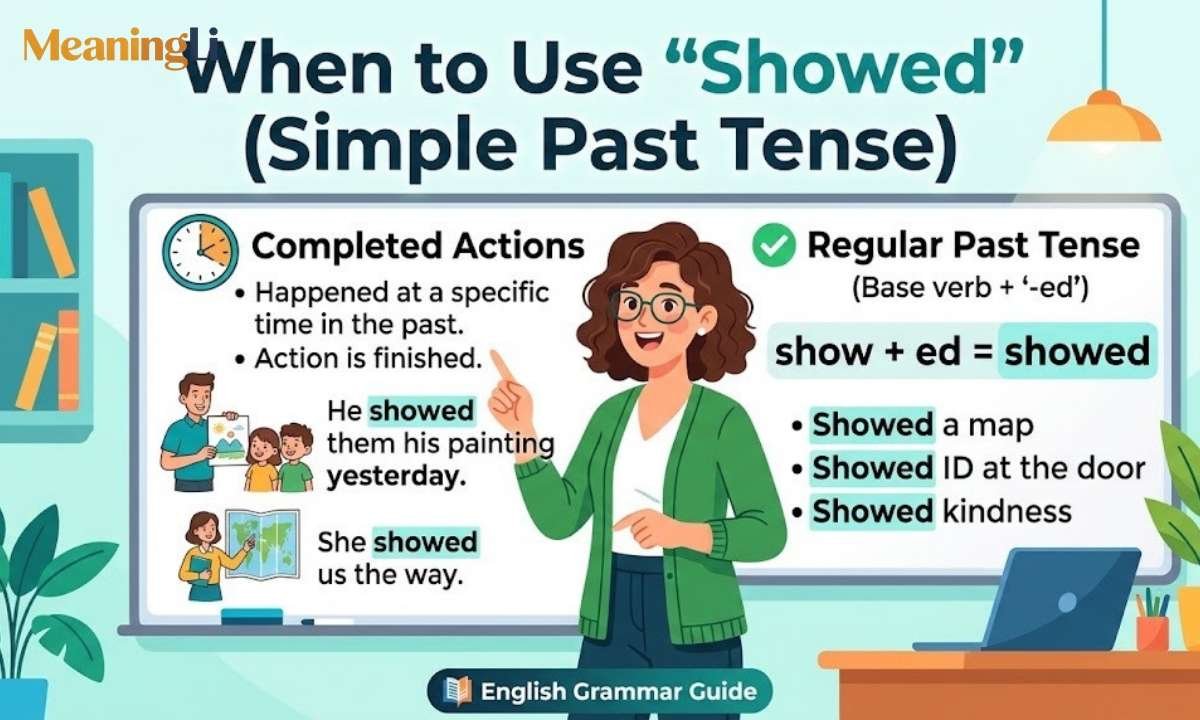
Use “showed” when the action happened at a specific time in the past and is now complete. Time markers like yesterday, last year, or in 2020 often appear nearby.
Examples of Showed in Sentences
- My neighbor showed me how to prune the roses.
- The survey showed that most people prefer remote work.
- He showed up late to the meeting.
- The guide showed the tourists around the old fort.
- Her smile showed how relieved she felt.
- We showed our passports at the gate.
When to Use Showed
- For a completed action in the past: “The coach showed the new play.”
- When no helping verb comes before it: “They showed great courage.”
- In phrasal verbs such as showed up (arrived), showed off (boasted), and showed around (gave a tour).
When to Use “Shown” (Past Participle)
Use “shown” when the verb needs a helping verb. It links the action to the present, to a result, or to a passive structure.
Examples of Shown in Sentences
- Research has shown that sleep improves memory.
- The new model has been shown to the board.
- Nobody had shown her where the exit was.
- The results are shown in Table 2.
- He has shown real talent since joining the team.
- The documentary will be shown at 8 p.m.
How to Recognize the Past Participle
Look for these signs:
- A form of have comes right before it: have, has, had, having.
- A form of be comes right before it: is, are, was, were, been, being, will be.
- You can add “by” and a person or thing: “was shown by the guide.”
A simple test: swap “show” for “grown” or “thrown.” If “grown” fits, use “shown.” “She has grown” works, so “She has shown” works.
Shown vs Showed: Grammar Rules Explained
The main rule: perfect tenses and passive voice use “shown.”
Have Shown vs Have Showed
- ✅ “We have shown the data to our clients.”
- ⚠️ “We have showed the data to our clients.”
“Have shown” is the standard, preferred choice. Some dictionaries record “showed” as a rare variant participle, but it sounds dated and can look like an error in formal writing.
Has Shown vs Has Showed
- ✅ “The company has shown steady growth.”
- ⚠️ “The company has showed steady growth.”
Use “has shown” for third-person singular subjects such as he, she, it, or a single noun.
Had Shown vs Had Showed
- ✅ “She had shown him the exit before the alarm rang.”
- ⚠️ “She had showed him the exit before the alarm rang.”
“Had shown” is the past perfect. It describes an action that happened before another past event.
Would Have Shown vs Would Have Showed
- ✅ “If you had asked, I would have shown you.”
- ❌ “If you had asked, I would have showed you.”
After “would have,” “could have,” “should have,” and “might have,” always use “shown.”
Will Be Shown vs Will Be Showed
- ✅ “The trailer will be shown next week.”
- ❌ “The trailer will be showed next week.”
Passive constructions need “shown,” so “will be showed” is a mistake.
Shown vs Showed in Active and Passive Voice
In an active voice, the subject performs the action. In a passive voice, the subject receives it.
Examples in Active Voice
Active sentences use “showed” for simple past and “shown” after have/has/had.
- “The teacher showed the class a short video.”
- “The teacher has shown the class several videos.”
- “The manager had shown the staff the new system.”
Examples in Passive Voice
Passive sentences always use “shown,” since they are built with a form of be plus a past participle.
- “A short video was shown to the class.”
- “The new system is being shown to the staff.”
- “Samples were shown to every buyer.”
Shown vs Showed: Example Sentences
Everyday Conversation Examples
- “My sister showed me her new haircut.”
- “Have you shown your mom the photos yet?”
- “He showed off his new sneakers all day.”
- “I would have shown you the shortcut if I had known.”
- “That café has shown up on my feed all week.”
Examples in Academic and Professional Writing
- “The experiment showed a 12% increase in accuracy.”
- “Earlier studies have shown a link between diet and focus.”
- “As shown in Figure 3, revenue peaked in the third quarter.”
- “The findings were shown to be consistent across regions.”
- “The audit has shown several gaps in the process.”
Shown vs Showed: Side-by-Side Comparison
| Feature | Showed | Shown |
| Grammatical form | Simple past tense | Past participle |
| Need a helping verb? | No | Yes |
| Used in perfect tenses? | No | Yes (have/has/had shown) |
| Used in passive voice? | No | Yes (was shown, will be shown) |
| Typical time reference | A finished moment in the past | Past action linked to now or to another event |
| Example | He showed me the way. | He has shown me the way. |
Common Mistakes When Using Shown and Showed
Using Shown as the Simple Past Tense
- ❌ “Yesterday, she shown me her notes.”
- ✅ “Yesterday, she showed me her notes.”
“Shown” cannot stand alone as a past tense verb. This is the most common error, especially in speech.
Using Showed After Have, Has, or Had
- ❌ “They have showed no interest.”
- ✅ “They have shown no interest.”
Many people write “have showed” because “showed” ends in -ed like other past forms. Still, “shown” is the safer and more widely accepted choice.
Using Showed in Passive Constructions
- ❌ “The results were showed on the screen.”
- ✅ “The results were shown on the screen.”
Passive voice with “showed” is nonstandard. Always use “shown.”
Quick Tips to Remember the Difference
- No helper, use showed. If the verb stands alone, pick “showed.”
- Helper present, use shown. After have, has, had, is, was, be, or been, pick “shown.”
- Match the pattern. Think grew/grown, threw/thrown, showed/shown.
- Test with “grown.” If “grown” fits the sentence, “shown” fits too.
- When in doubt, choose shown after any helping verb. It is never wrong there.
- Don’t confuse it with “shone.” Shone is the past tense of “shine” (the sun shone), and it only sounds like “shown.”
Frequently Asked Questions
What is the difference between shown and showed?
“Showed” is the simple past tense, used without a helping verb. “Shown” is the past participle, used with have, has, had, or be verbs.
Is it correct to say “I have showed” or “I have shown”?
“I have shown” is the standard and preferred form. “I have showed” appears in some dictionaries as a variant but is rare and can look like a mistake.
Is showed the past tense of show?
Yes. “Showed” is the simple past tense of “show,” as in “She showed me the way.”
When should I use shown instead of showed?
Use “shown” after helping verbs like have, has, had, is, was, or been, and in passive sentences like “The film was shown.”
Which is grammatically correct: “I showed him” or “I shown him”?
“I showed him” is correct. “Shown” cannot be used alone as a past tense verb.
Can shown and showed be used interchangeably in a sentence?
Not in most cases. “Showed” works as simple past, “shown” works with helping verbs, and only the participle role sometimes allows both, with “shown” strongly preferred.
Final Thoughts
The difference comes down to one question: is there a helping verb? Use “showed” for a simple, finished action, and use “shown” with have, has, had, or any passive structure.
Keep the “grown/thrown” trick in mind, and the choice becomes automatic. With a little practice, you will write both forms correctly in emails, essays, and everyday conversation.
Once the shown-versus-showed pattern clicks, a few other small mix-ups still catch writers out. Some are just one space apart, like in fact or infact, while others hinge on a single vowel, like deciding between nosy or nosey. And then there are the longer traps, such as privilege or priviledge, where a run of letters hides the mistake until you read the word twice.


2 thoughts on “Shown vs Showed: Meaning, Differences & Examples (2026)”