

You are writing a sentence and stop at one word. Is it “incomplete” or “uncomplete”? It is a small question, but it can make a report, email, or form look careless.
The short version: use incomplete. In this guide you will see why, where “uncomplete” came from, and how “uncompleted” and “unfinished” fit in. Real examples are included, so you can copy the right pattern.
Quick Answer: Incomplete or Uncomplete?
Incomplete is the correct word. It is the standard adjective for something that is missing parts or not finished.
“Uncomplete” does appear in a few dictionaries, but it is very rare and sounds odd to most native speakers. Writers almost always choose “incomplete” instead.
| Incomplete | Uncomplete | |
| Correct in modern English? | Yes | Rarely used, not recommended |
| Found in everyday writing? | Very often | Almost never |
| Safe for school, work, and formal writing? | Yes | No |
| Better choice? | ✅ | ❌ |
Definition of “Incomplete” and “Uncomplete”
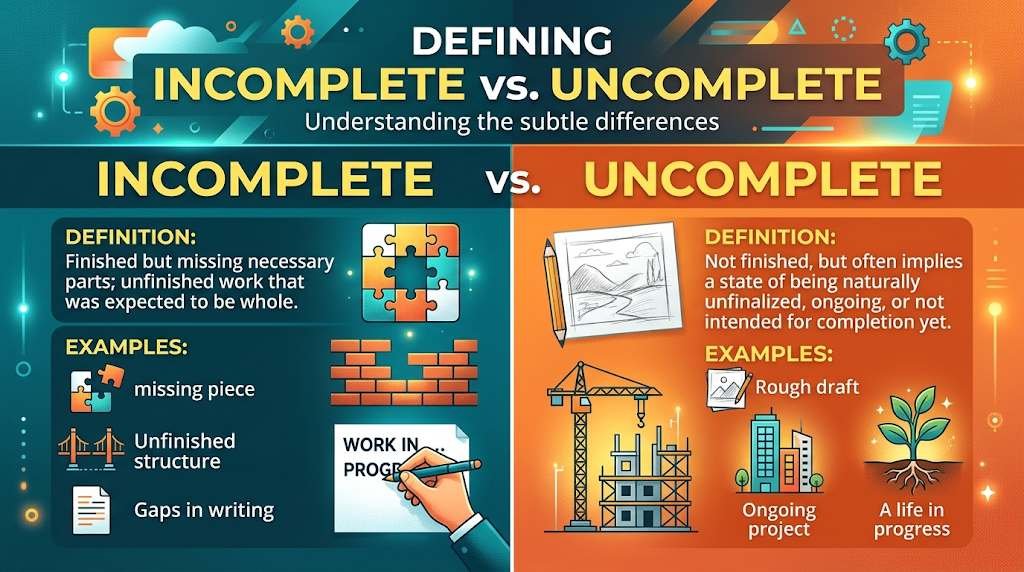
Both words are adjectives, and both describe something that is not whole. The difference is in how people actually use them.
What Does Incomplete Mean?
Incomplete means lacking one or more parts, or not yet finished. It can describe objects, tasks, information, and even feelings.
- The form was incomplete, so the bank sent it back.
- He gave an incomplete answer.
- She felt incomplete until the project was done.
The word was built from the Latin completus, with the prefix in- meaning “not.”
What Does Uncomplete Mean?
Uncomplete is listed as an adjective meaning “not complete” or “not completed.” Some online dictionaries, including Vocabulary.com, show it as a synonym of incomplete.
One older dictionary, Webster’s 1828, also lists it. Even there, the entry adds a note that “incomplete” is the form mainly used.
Is Uncomplete a Real English Word?
Technically, yes. It has been recorded, so you can’t call it a made-up word.
In practice, though, it is a leftover form. Modern speakers don’t say it, editors usually change it, and learners who use it will probably be corrected. If you want your writing to sound natural, skip it.
Incomplete or Uncomplete: Key Differences
On paper the two words mean almost the same thing. In real life they are treated very differently.
Spelling and Grammatical Differences
Both words are adjectives. They sit before a noun (“an incomplete list”) or after a linking verb (“the list is incomplete”).
The only difference in spelling is the prefix: in- versus un-.
| Feature | Incomplete | Uncomplete |
| Part of speech | Adjective | Adjective |
| Prefix | in- | un- |
| Related adverb | incompletely | uncompletely (rare, not standard) |
| Related noun | incompleteness | uncompleteness (rare, not standard) |
| Pronunciation | /ˌɪnkəmˈpliːt/ | /ˌʌnkəmˈpliːt/ |
Notice that the whole word family (incompletely, incompleteness) is built on “incomplete.” That is another sign it is the established form.
Meaning and Usage Differences
The meanings overlap. Dictionaries that list “uncomplete” simply define it as “not complete.”
The usage does not overlap. “Incomplete” appears in schools, offices, courts, hospitals, and everyday talk. “Uncomplete” shows up mostly in old texts, dictionary lists, and mistakes.
Which Word Should You Use in Formal Writing?
Always choose incomplete. Academic papers, business emails, legal documents, job applications, and technical reports all expect it.
Using “uncomplete” in a formal setting can make the reader pause or doubt your command of English. There is no upside, so there is no reason to risk it.
Why “Incomplete” Is the Correct Word
Three things make “incomplete” the clear winner: dictionary support, wide use, and a full family of related words.
Standard Dictionary Recognition
“Incomplete” is a main entry in every major English dictionary. It comes with a clear definition, example sentences, and a full set of synonyms and antonyms.
Learner dictionaries, which focus on current everyday English, treat it as a core word. You will not find that level of attention given to “uncomplete.”
When to Use Incomplete in Everyday English
Use “incomplete” any time something lacks a part or has not reached its end. Common situations include:
- Paperwork: an incomplete application, form, or tax return
- School and work: an incomplete assignment, report, or checklist
- Data: incomplete records, results, or information
- Projects: an incomplete renovation, design, or draft
- Sports: an incomplete pass in football
- Feelings: feeling incomplete without someone or something
- Grades: getting an “incomplete” (often written as “I”) when coursework is still due
Why “Uncomplete” Is Incorrect or Rare
“Incorrect” may be a bit strong, since the word is recorded. “Rare and not recommended” is more accurate. Here is why it fell out of use.
Historical and Uncommon Usage
Older English allowed a looser use of the prefix un-. Writers often attached it to adjectives and participles, and some of those forms were recorded in dictionaries and then left behind as speech changed.
“Uncomplete” is one of them. It sits in older references as a possible form, but real usage moved on to “incomplete.” Even Webster’s 1828 entry pointed readers in that direction.
Why Uncomplete Is Not Standard in Modern English
There are a few clear reasons:
- A better word already exists. “Incomplete” does the job, so “uncomplete” adds nothing.
- Nobody says it. Native speakers don’t use it, so it sounds wrong.
- Style guides and editors avoid it. Spellcheck tools and teachers usually flag it.
- The word family is built on “incomplete.” Incompletely, incompleteness, and incompletion all follow it.
Incomplete vs Uncompleted vs Unfinished: What’s the Difference?
This is where many writers get stuck. “Uncompleted” is a real word with real dictionary support. “Unfinished” is a very common one. Here is how the three differ.
Incomplete Meaning and Usage
Incomplete describes a state: something is missing pieces or is not whole. It does not say anything about whether someone stopped working on it.
Example: The puzzle is incomplete. Three pieces are missing.
Uncompleted Meaning and Usage
Uncompleted means that something has not been finished. Oxford Learner’s Dictionaries gives “an uncompleted project” as an example. Merriam-Webster also lists it, and notes use going back to 1513.
It is more formal and less common than “incomplete.” It often points to a task or action that was started and not carried through. In American football, “uncompleted pass” is a standard phrase.
Example: The bridge remained uncompleted when funding ran out.
Unfinished Meaning and Usage
Unfinished means not brought to an end. It is the most natural, friendly choice for something left half-done, such as a story, painting, or meal.
It can also carry a feeling of something left hanging, as in “unfinished business.”
Example: He left the painting unfinished.
Examples of Each Word
| Word | Core idea | Sample sentence |
| Incomplete | Missing parts or information | The list of guests is incomplete. |
| Uncompleted | Task not carried to the end | Several uncompleted tasks remain on the board. |
| Unfinished | Left before the end | She put the unfinished sweater in a drawer. |
A simple way to remember: incomplete is about what is missing, while uncompleted and unfinished are about what was not done.
Incomplete Synonyms and Alternative Words
Using the same word again and again can make writing feel flat. Here are some options.
Common Synonyms of Incomplete
- unfinished
- partial
- fragmentary
- lacking
- deficient
- sketchy
- patchy
- half-done
- unfulfilled
- imperfect
Best Alternatives for Different Contexts
| Context | Better word | Example |
| Forms and paperwork | missing, blank, outstanding | The form has two blank fields. |
| Data and research | partial, fragmentary, patchy | We only have partial results. |
| Creative work | unfinished, rough, in progress | The song is still in progress. |
| Tasks and to-do lists | pending, outstanding, open | Three tasks are still open. |
| Arguments or explanations | sketchy, thin, underdeveloped | Her explanation was thin. |
| Buildings | half-built, under construction | The tower is still under construction. |
Choose the word that matches your exact meaning. “Pending,” for example, suggests waiting, while “partial” suggests that only some of it exists.
Incomplete or Uncomplete: Examples in Sentences
Seeing the word in action is the fastest way to learn it. These examples are all original.
Examples of Incomplete in Everyday Sentences
- My application is incomplete because I forgot the signature page.
- The recipe seemed incomplete without a pinch of salt.
- Her knowledge of the subject is still incomplete.
- The map was incomplete, so we took a wrong turn.
- He felt that his life was incomplete without music.
Incomplete Sentence Examples
In grammar, an incomplete sentence (also called a sentence fragment) leaves out something essential, such as a subject or a main verb. It does not express a full thought.
| Incomplete sentence (fragment) | Complete sentence |
| Because the train was late. | We missed the meeting because the train was late. |
| Running down the street. | He was running down the street. |
| The tall man in the blue coat. | The tall man in the blue coat waved at us. |
| After we finished dinner. | After we finished dinner, we walked home. |
Fragments are fine in casual writing and ads when used on purpose. In essays and formal writing, fix them.
Examples of Incomplete Buildings, Projects, and Tasks
- The stadium is still incomplete, and the opening has been delayed.
- An incomplete foundation can cause cracks in the walls later.
- The team handed in an incomplete project report on Friday.
- I have three incomplete tasks on my to-do list.
- The software update was incomplete, so the app kept crashing.
Incorrect vs Correct Sentence Examples
| ❌ Incorrect | ✅ Correct |
| Your form is uncomplete. | Your form is incomplete. |
| The data looks uncomplete. | The data looks incomplete. |
| She submitted an uncomplete essay. | She submitted an incomplete essay. |
| The building is in complete. | The building is incomplete. |
| He gave an incompleted answer. | He gave an incomplete answer. |
Common Mistakes and Confusions
Beyond “uncomplete,” a few other slips come up often. Watch for these.
Incomplete vs In Complete
“Incomplete” is one word. “In complete” is two separate words and only works in a different kind of phrase, such as “in complete silence” or “in complete control.”
- ✅ The report is incomplete.
- ✅ The room sat in complete darkness.
- ❌ The report is in complete.
Incomplete vs Uncompleted
Both mean “not finished,” but “incomplete” is far more common and works almost everywhere. “Uncompleted” fits best when you want to stress a task or action that was left undone, and it reads as more formal.
If you aren’t sure, “incomplete” is the safer pick.
Confusing Incomplete with Unfinished
They overlap, but not always.
A thing can be incomplete without being unfinished. A finished set of encyclopedias can be incomplete if one volume is missing. And a thing can be unfinished and still complete in a loose sense, like a painting the artist chose to stop on.
Use “incomplete” when something is missing, and “unfinished” when the work stopped before the end.
Linguistic Insight: Prefix “In-” vs “Un-“
Why does English have two similar negative prefixes? The answer explains why “incomplete” feels right and “uncomplete” feels off.
How the Prefix In- Changes Word Meaning
The prefix in- comes from Latin and usually means “not.” It attaches to words that came into English from Latin or French.
Examples: incorrect, inactive, inaccurate, indirect, insecure, incomplete.
In some words it changes shape: impossible, illegal, irregular.
How the Prefix Un- Changes Word Meaning
The prefix un- is native to English. It means “not” or, with verbs, “undo.”
Examples: unhappy, unclear, unlock, undo, unfinished, uncompleted.
It is very flexible. It easily attaches to participles such as “finished” and “completed,” which is why “unfinished” and “uncompleted” sound acceptable.
Why Incomplete Is the Established Form
English has no strict rule that says which prefix a word must take. Habit decides.
“Complete” arrived from Latin, and “incomplete” followed the same path with the Latin-style prefix. Over centuries, that form won out, while “uncomplete” faded.
A helpful guide: for the adjective complete, use in-. For the participle completed, un- is possible (uncompleted).
Frequently Asked Questions
Is it incomplete or uncomplete, and which spelling is correct?
Incomplete is the correct and standard spelling. “Uncomplete” is a rare form that most writers and editors avoid.
What is the difference between incomplete and uncomplete?
Both mean “not complete,” but “incomplete” is the everyday standard. “Uncomplete” is recorded in a few dictionaries and is almost never used today.
What does incomplete mean in English, with examples?
It means missing a part or not finished. For example: “The form is incomplete,” or “Her story felt incomplete without an ending.”
Is uncomplete a real word or an incorrect spelling?
It appears in some dictionaries, so it is technically a word. It is so rare in modern English that using it will usually be treated as an error.
How do you use incomplete sentences correctly?
Place it before a noun or after a linking verb: “an incomplete list” or “the list is incomplete.”
What is the opposite of incomplete, and can complete be used instead?
The opposite of incomplete is complete, and yes, you can use it directly. Other opposites include whole, full, finished, and entire.
Final Thoughts
When you have to choose between the two, choose incomplete. It is standard, widely understood, and safe for every kind of writing.
“Uncomplete” is a rare older form that adds nothing and often looks like a mistake. Use “uncompleted” or “unfinished” when you want to stress a task that was left undone, and keep “incomplete” for anything missing a piece. Spelling pairs like this are easy to mix up, so you may also like seal or seel and separate vs seperate.


3 thoughts on “Incomplete or Uncomplete: Which Is Correct? Meaning, Difference & Examples (2026)”