
Seen “SME” in a work chat, a business article, or a group text and weren’t quite sure what it meant? You’re not alone, this three-letter abbreviation carries two completely different meanings, and picking the wrong one can leave you confused mid-conversation.
This guide breaks down exactly what SME means, how to tell the two meanings apart, and how the term is used across workplaces, business discussions, and everyday chats in 2026.
What Does SME Mean in Text?
SME is an abbreviation with two widely used meanings: Subject Matter Expert and Small and Medium-sized Enterprise. The correct meaning depends entirely on the context it’s used in: one refers to a person, the other to a type of business.
SME Meaning in Simple Words
In plain terms, SME can either describe a person who knows a topic inside and out, or a business that’s neither tiny nor huge. Think of it as a label for expertise on one hand, and a company size category on the other.
What Does SME Stand For?
SME most commonly stands for:
- Subject Matter Expert – a person with deep knowledge in a specific area
- Small and Medium-sized Enterprise – a business below a certain size or revenue threshold
The Two Main Meanings of SME
| Meaning | Refers To | Common Setting |
| Subject Matter Expert | A person | Workplaces, training, project teams |
| Small and Medium-sized Enterprise | A business | Economics, finance, government policy |
What Does SME Mean in a Text or Chat?
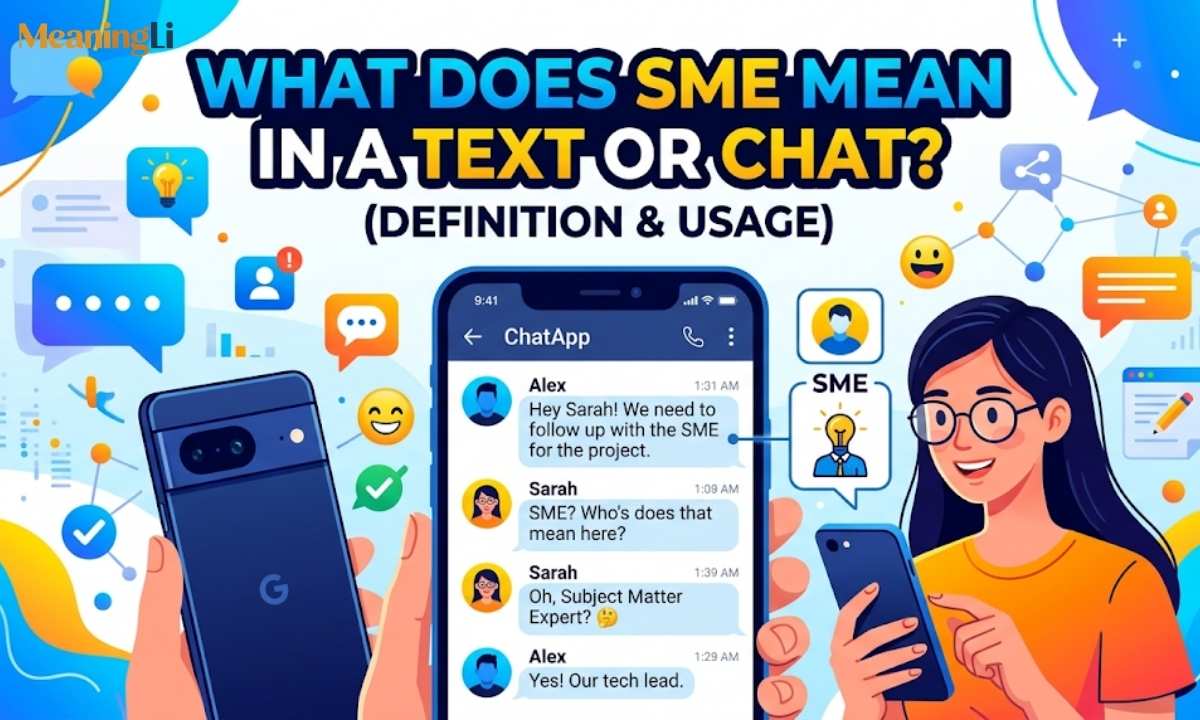
When SME shows up in a text message or casual chat, it’s almost always referring to a person’s expertise rather than a business category.
SME as Subject Matter Expert
Here, SME describes someone who’s the go-to person on a specific topic. For example, a coworker who knows everything about payroll software might be called the SME for that system.
SME as Small and Medium-sized Enterprise
Less common in casual texting, this meaning shows up when the conversation is about companies, funding, or the economy rather than individual knowledge.
How Context Tells You Which Meaning Is Intended
The easiest way to figure out which meaning applies is to check what’s being discussed:
- Talking about a person’s skills or knowledge? It means Subject Matter Expert.
- Talking about a company’s size, funding, or revenue? It means Small and Medium-sized Enterprise.
What Does SME Mean at Work?
SME Meaning for an Employee
At work, being called an SME is generally a compliment; it means colleagues see you as the expert on a particular process, tool, or subject.
SME Meaning in Corporate Settings
In corporate environments, SMEs are often pulled into meetings, training sessions, or documentation reviews to confirm technical accuracy before something goes company-wide.
SME Meaning in Management
Managers rely on SMEs to make informed decisions, since these are the people with the hands-on knowledge needed to evaluate risks, timelines, or technical feasibility.
SME Meaning in Project Management
In project management, an SME is brought in to validate requirements, review deliverables, or answer technical questions that fall outside the project manager’s own expertise.
SME Meaning in Engineering
In engineering fields, an SME might be the person with years of hands-on experience in a specific system, material, or process, often relied on to sign off on technical documents.
SME Meaning in Business
Small and Medium-sized Enterprise
In a business or economic context, SME refers to companies that fall below a certain employee count or revenue threshold smaller than large corporations but bigger than solo operations.
How SMEs Are Different From Large Businesses
- Fewer employees and smaller teams
- Lower annual revenue and turnover
- Simpler organizational structure
- Often more flexible and quicker to adapt
SME vs. Startup
Not every SME is a startup, and not every startup stays small. SMEs can be decades-old, stable businesses, while startups are specifically new ventures often built around rapid growth or innovation.
Examples of SME in Text and Conversation
Example of SME Meaning Subject Matter Expert
“Loop in Sarah, she’s our SME on the new CRM system.”
Example of SME in a Work Chat
“Can our SME review this before it goes to the client?”
Example of SME in Project Management
“We need SME sign-off before moving to the next phase.”
Example of SME Meaning Small and Medium-sized Enterprise
“The new loan program is designed to help local SMEs grow.”
Example of SME in a Business Discussion
“Most job creation in the region comes from SMEs, not large corporations.”
SME Meaning on Social Media
SME on Instagram
On Instagram, SME usually shows up in captions or bios belonging to consultants, coaches, or business owners describing themselves as experts in their niche.
SME on TikTok
On TikTok, creators sometimes use SME when discussing business growth content, especially videos aimed at small business owners or industry specialists.
SME in WhatsApp Chats
In WhatsApp work groups, SME is typically used the same way it is in email referring to whichever team member has the deepest knowledge of a specific topic.
SME in Online Discussions
In forums or comment sections, SME can appear in both senses, so it’s worth reading a sentence or two of surrounding context before assuming which meaning applies.
SME vs. Similar Business and Workplace Terms
SME vs. SMB
SMB stands for “Small and Medium-sized Business” and is essentially interchangeable with the business meaning of SME, though SMB is more commonly used in American English.
SME vs. Startup
An SME can be an established, steady business, while a startup is typically newer and focused on rapid scaling or disrupting a market.
SME vs. Freelancer
A freelancer works independently on a project basis, while an SME may be an employee, consultant, or business owner recognized specifically for deep expertise in one area.
SME vs. Consultant
A consultant is hired externally for advice, while an SME can be either an internal employee or an outside expert; the title is about knowledge, not employment status.
SME vs. Manager
A manager oversees people and processes, while an SME is valued specifically for technical or specialized knowledge, regardless of whether they manage anyone.
| Term | Meaning | Key Difference From SME |
| SMB | Small and Medium-sized Business | Same concept, different regional term |
| Startup | New, high-growth business | Focused on growth stage, not size alone |
| Freelancer | Independent contractor | Defined by work arrangement, not expertise |
| Consultant | External advisor | Defined by hiring relationship |
| Manager | Oversees a team | Defined by authority, not subject knowledge |
Common Misunderstandings About SME
Thinking SME Has Only One Meaning
Many people assume SME only means one thing, which leads to confusion when the same abbreviation pops up in a completely different context.
Assuming SME Always Means Subject Matter Expert
While common in workplace chats, this assumption falls apart quickly in business, finance, or government-related conversations.
Assuming SME Always Means Small Business
On the flip side, assuming SME always refers to a company can cause confusion in technical or corporate training discussions about individual expertise.
Confusing SME With Startup
Because both terms relate to businesses, people sometimes treat them as synonyms, even though company age, size, and growth intent set them apart.
Confusing SME With Manager
Being an SME doesn’t require any managerial authority; it’s entirely based on specialized knowledge, not job title or team oversight.
How to Use SME Correctly?
When to Use SME in Professional Communication
Use SME confidently in workplace emails, meetings, or documentation once it’s clear from context whether you mean a person or a business.
When to Spell Out Subject Matter Expert
If you’re addressing a mixed audience or writing for people outside your industry, spell it out the first time to avoid confusion.
When to Use SME for a Business
Use SME when discussing funding programs, government policy, or economic reports where the audience is likely familiar with the business terminology.
When to Avoid SME for Clarity
Avoid using SME without context in any message where both meanings could reasonably apply; a quick clarifying phrase saves everyone time.
Frequently Asked Questions
What does SME mean in text and online conversations?
SME usually means either “Subject Matter Expert” or “Small and Medium-sized Enterprise,” depending on the topic being discussed.
What does SME stand for in business and professional communication?
In business settings, it most often stands for “Small and Medium-sized Enterprise,” referring to companies below a certain size or revenue.
What does SME mean when referring to a person?
When referring to a person, SME means “Subject Matter Expert,” someone with deep, specialized knowledge in a particular field.
What does SME mean when referring to a business?
When referring to a business, SME means “Small and Medium-sized Enterprise,” a company smaller than a large corporation.
Is SME a slang term or a professional abbreviation?
SME is a professional abbreviation, not slang, and it’s widely used in business, technical, and corporate communication.
How can you tell which meaning of SME someone intends?
Look at the surrounding conversation. If it’s about a person’s knowledge, it means expert; if it’s about a company, it means small business.
Final Thoughts
SME is one of those abbreviations that carries real weight in two very different worlds, one built around personal expertise, the other around business size. Knowing both meanings, and reading the context around them, makes it easy to avoid mix-ups in emails, meetings, or casual conversations.
Whether someone’s calling you the SME on a project or discussing SME funding programs in the news, the key is simple: check what’s being talked about before assuming which definition applies. Once you get the hang of it, switching between the two meanings becomes second nature.