

You see it in text messages, comments, and quick chats: “What happen?” It looks harmless, but it makes many people stop and wonder which version is actually right.
The short answer is that “what happened” is the standard form when you ask about something that already took place. This guide explains why, shows where “happen” still works, and gives you simple examples you can use right away.
What Is the Correct Phrase: What Happen or What Happened??
Quick Answer
“What happened?” is correct. Use it when you ask about an event in the past.
“What happen?” is incorrect in standard English. It uses the base form of the verb, which does not signal past time.
- ✅ What happened at the meeting?
- ❌ What happen at the meeting?
Why “What Happened?” Is Correct for Past Events
“Happen” is a regular verb. To make its simple past tense, you add -ed, which gives you “happened.”
When the event is over, the verb must show it. “Happened” does that job. “Happen” does not.
Think of it this way:
- Something occurred earlier.
- You are asking about it now.
- The verb needs a past tense form, so you use “happened.”
What Does “What Happened” Mean?

“What happened” asks for information about an event, change, or situation that has already occurred. It is a question about cause, details, or outcome.
Depending on tone, it can mean:
- “Tell me the facts of this event.”
- “Why did this turn out this way?”
- “Are you okay? Something seems wrong.”
Simple Examples of “What Happened”
- What happened to the printer? It stopped working this morning.
- What happened after the movie ended?
- What happened to your phone screen?
- I heard a loud noise. What happened?
- Nobody told me what happened last night.
How to Use “What Happened” in a Sentence
You can use it as a direct question or inside a longer sentence.
As a direct question:
- What happened to the bus?
- What happened in the second round?
As part of a statement (indirect question):
- She explained what happened during the trip.
- I still don’t know what happened to my order.
- The report describes what happened before the outage.
Notice that in an indirect question, the word order stays normal and the past tense remains: “what happened,” not “what did happened.”
What Does “What Happen” Mean?
“What happen” is not a standard phrase. People usually mean “what happened” and drop the ending, often by habit or speed.
In casual speech, the “-ed” sound is soft and easy to miss. That is why “happened” can sound like “happen” out loud, and why the mistake carries over into writing.
Why “What Happen?” Is Usually Incorrect
There are three main reasons:
- Wrong tense. The base form “happen” does not show past time.
- Missing auxiliary. In a question, the base form normally needs a helper such as “did,” “will,” or “can.”
- Not standard in formal writing. Teachers, editors, and professional readers treat it as an error.
Some English dialects drop past tense endings in everyday speech, and that is a real feature of how people talk. Still, in school, work, and published writing, “what happened” is the expected form.
Common Examples of This Grammar Mistake
| Incorrect | Correct |
| What happen to him? | What happened to him? |
| What happen last night? | What happened last night? |
| Tell me what happen. | Tell me what happened. |
| I don’t know what happen to my keys. | I don’t know what happened to my keys. |
| What happen after you left? | What happened after you left? |
What Is the Difference Between “What Happen” and “What Happened”?
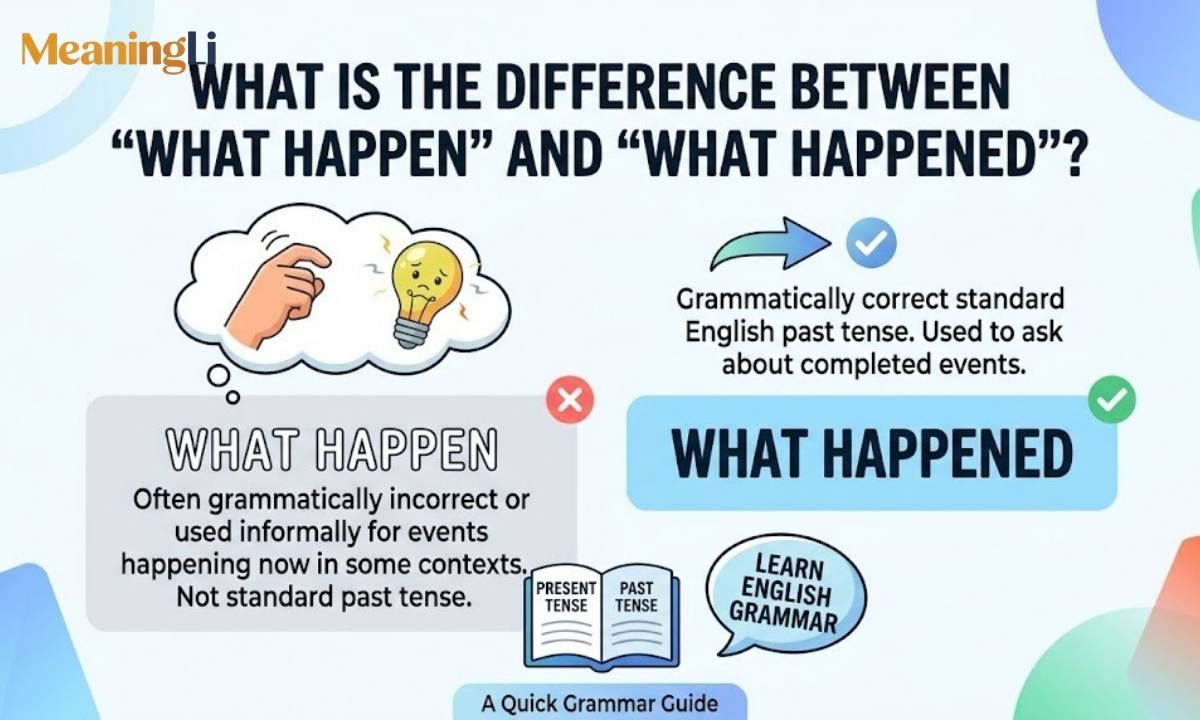
The difference comes down to tense. “Happened” is the simple past tense. “Happen” is the base (present) form, and it needs the right surrounding words to work.
What Happen vs. What Happened in a Sentence
- Incorrect: What happen to the cake?
- Correct: What happened to the cake?
Both sentences ask about the cake, but only the second one shows that the event is over.
What Happen vs. What Happened Examples
| Situation | Incorrect | Correct |
| Asking about a car accident | What happen on the highway? | What happened on the highway? |
| Checking on a friend | What happen to your hand? | What happened to your hand? |
| Asking about an office change | What happen to the old system? | What happened to the old system? |
| Following up on a story | And then what happen? | And then what happened? |
What Happens vs. What Happened
“What happens” is the present tense. It asks about a habit, a rule, or a general truth.
- What happens when you press this button?
- What happens if water reaches 100°C?
“What happened” is past tense. It asks about a specific event that is done.
- What happened when you pressed the button?
- What happened to the water?
Is “What Happen” Ever Grammatically Correct?
Not as a stand-alone question about the past. But the word “happen” itself is correct in many other patterns, and some of those patterns can place “what” and “happen” near each other.
When to Use “Happen” Correctly
Use the base form “happen” in these cases:
- After modal verbs: can, could, will, would, might, may, should, must
- After “did” or “do/does”: “What did happen?” is a valid emphatic question
- After “to”: “It’s about to happen.”
- With plural subjects in the present tense: “Accidents happen.”
- In the formal subjunctive: “It is vital that nothing happen to the data.”
Examples With “Will Happen,” “Can Happen,” and “Might Happen”
- What will happen if we miss the deadline?
- Anything can happen in the final minute.
- Something good might happen this week.
- Delays may happen during heavy rain.
- What should happen when a user logs out?
In each case, a helping verb comes first, and “happen” stays in its base form. That is the key rule to remember.
Why Do People Confuse “What Happen” and “What Happened”?
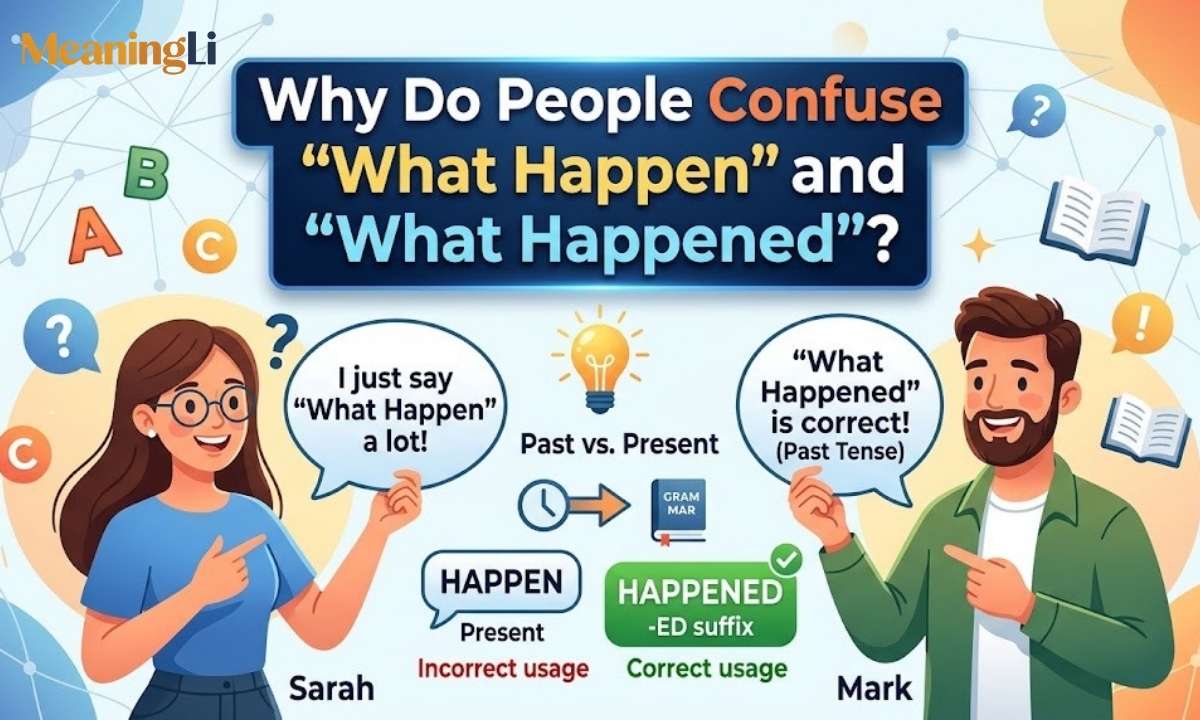
Several everyday habits cause the mix-up:
- Fast speech. The final “-ed” sound blends into the next word.
- Texting shortcuts. People type quickly and skip letters.
- Influence of other languages. Some languages mark past time with context or other words, not verb endings.
- Dialect patterns. Some varieties of English drop past tense endings in casual talk.
- Confusion with “what happens.” Learners may mix present and past forms.
The good news is that this is an easy fix. If the event is finished, add -ed.
What Is the Difference Between “What Happened?” and “What Did Happen?”
Both are grammatically correct, but they do not feel the same.
- “What happened?” is the normal, neutral question. Use it almost every time.
- “What did happen?” adds emphasis. It often shows doubt, a correction, or a push for the real story.
Examples:
- “What happened to the files?” (a plain question)
- “Everyone has a theory, but what did happen to the files?” (emphasis, searching for the truth)
Remember that after “did,” the verb goes back to its base form. So “What did happened?” is wrong.
How to Use “What Happened” in Texting and Everyday Conversations
In chats, “what happened” is short, natural, and clear. You can use it alone or add a few words for tone.
Examples in Text Messages and Online Chats
- “Wait, what happened? You left so fast.”
- “Why is the group so quiet? What happened?”
- “Saw your story. What happened to your bike?”
- “Call me when you can. I want to know what happened.”
- “My app crashed. What happened to my saved work?”
How to Ask Someone What Happened Politely
Tone matters, especially when the topic is sensitive. These softer versions work well:
- “Would you mind telling me what happened?”
- “If you’re comfortable sharing, what happened?”
- “I’m here to listen. What happened?”
- “Can you walk me through what happened?”
- “I noticed something had changed. Is everything okay?”
At work, a clear and calm version is best: “Could you share what happened so we can fix it?”
What Is the Difference Between “What Happens” and “What Will Happen”?
Both talk about the present or future, but they have different jobs.
When to Use “What Happens”
Use it for general facts, routines, rules, and repeated results.
- What happens when you mix blue and yellow?
- What happens at the end of the month?
- What happens if the power goes out?
It can also describe a story in progress, as in a summary: “In the final scene, what happens to the hero?”
When to Use “What Will Happen”
Use it for a prediction or a specific future event.
- What will happen if we raise the price?
- What will happen at tomorrow’s meeting?
- Do you know what will happen next season?
| Phrase | Time | Typical Use | Example |
| What happens | Present / general | Rules, habits, facts | What happens when ice melts? |
| What will happen | Future | Predictions, plans | What will happen if it rains? |
| What happened | Past | Finished events | What happened at the party? |
Common Grammar Mistakes to Avoid
“What Happen to You” vs. “What Happened to You”
- ❌ What happen to you?
- ✅ What happened to you?
Use this when you notice a change, an injury, or a surprising result. Say it kindly, because it can sound blunt if the tone is wrong.
“What Happen Yesterday” vs. “What Happened Yesterday”
- ❌ What happen yesterday?
- ✅ What happened yesterday?
Time words such as yesterday, last week, earlier, last night, and ago are clues. They almost always call for the past tense.
Quick checklist before you hit send:
- Did the event already occur? Use happened.
- Is it a general rule? Use happens.
- Is there a helper like will, can, did? Use happen.
- Is it going on right now? Use happening.
What Is the Difference Between Happen, Happens, Happened, and Happening?
These are all forms of the same verb. Each one fits a different tense or subject.
| Form | Name | Example |
| happen | Base form | Accidents can happen. |
| happens | Third-person singular present | It happens to everyone. |
| happened | Simple past / past participle | It happened last week. |
| happening | Present participle | Something strange is happening. |
Happen vs. Happens
Use happen with I, you, we, they, plural nouns, and after helping verbs.
- Mistakes happen.
- Things like this happen often.
Use happens with he, she, it and singular nouns in the present tense.
- It happens every spring.
- Nothing happens until the signal turns green.
Happened vs. Happening
Happened shows the event is over.
- The accident happened an hour ago.
Happening shows the event is in progress, or it is a planned event in the near future.
- What is happening outside?
- The concert is happening this Friday.
You can also use “happened” with has or have in the present perfect: “Has anything happened since I left?”
What Happen vs. What Happened: Comparison Table
| Feature | What Happen | What Happened |
| Correct in standard English? | No | Yes |
| Tense | Base form (no tense shown) | Simple past |
| Used for | Nothing in standard usage | Finished events |
| Formal writing | Not accepted | Accepted |
| Example | What happen to the file? | What happened to the file? |
| Fix | Add -ed | Already correct |
Frequently Asked Questions
Is it correct to say “what happen” or “what happened”?
“What happened” is correct. “What happen” is a common error that leaves out the past tense ending.
What is the difference between “what happen” and “what happened”?
“Happened” is the past tense and shows a finished event. “Happen” is the base form and needs a helping verb to work in a question.
Should I say “what happened” or “what happen” when asking about the past?
Say “what happened.” Any question about a finished event needs the past tense.
Is “what happen to you” grammatically correct?
No. The correct version is “What happened to you?”
How do you use “what happened” in a sentence?
Use it as a question (“What happened to the train?”) or inside a statement (“She told me what happened”).
When should I use “happen,” “happens,” and “happened”?
Use “happen” with plural subjects or after helping verbs, “happens” with singular present-tense subjects, and “happened” for past events.
Final Thoughts
The rule is simple. When the event is over, say “what happened.” The “-ed” ending is what tells your reader the action belongs to the past.
Save “happen” for cases with a helping verb, such as “what will happen” or “what can happen.” Keep this guide handy, and your texts, emails, and essays will read clean and confident.