

Someone just replied to your message with a simple “IDT” and now you are trying to figure out if they agreed, disagreed, or just fat-fingered their keyboard. You are not alone, it happens more than you think.
IDT is one of those short-form expressions that looks straightforward but carries more nuance than it first appears. Read it wrong and you might reply awkwardly, or worse, spark unnecessary confusion.
This guide breaks down exactly what IDT means in texting, how its tone shifts across platforms, when to use it, and how to respond when someone sends it to you.
Quick Answer
IDT stands for “I Don’t Think” in texting and online chat. It is used to express doubt, soft disagreement, or uncertainty in a casual and fast way without typing out a full sentence.
Quick Summary Table
| Term | Meaning | Common Use |
| IDT | I Don’t Think | Casual disagreement, doubt, soft rejection |
| IDTS | I Don’t Think So | Stronger, more final version of IDT |
| IDK | I Don’t Know | Uncertainty about facts, not opinion |
| IDC | I Don’t Care | Indifference, not disagreement |
| IMO | In My Opinion | Sharing a personal view |
What Does IDT Mean in Text Messages?
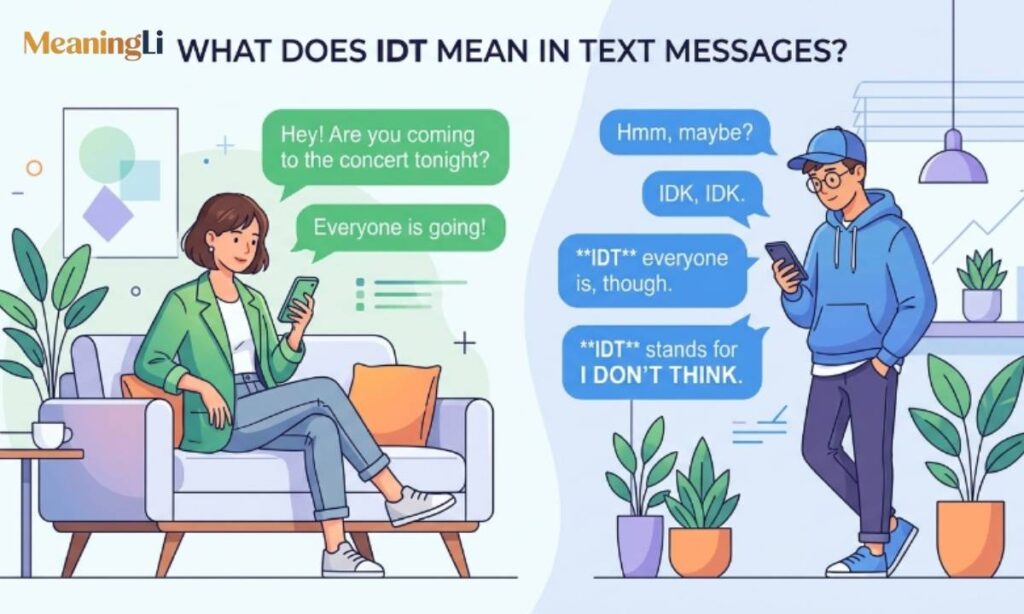
In text messages, IDT means “I Don’t Think.” It is a quick way to express doubt or mild disagreement without committing to a firm no. The tone is almost always soft and non-confrontational, more of a gentle pushback than a hard rejection.
It is one of the most practical texting abbreviations in modern digital communication because it leaves room for being wrong. Saying “IDT it’ll work” is less blunt than “It won’t work.” That hedge is exactly why people reach for it constantly in casual conversations.
What Does IDT Stand For?
IDT stands for “I Don’t Think” in casual texting; this covers roughly 95% of all uses you will encounter across messaging apps, social media platforms, and gaming chats.
In rare contexts, IDT can also stand for:
- “I Didn’t Try” used occasionally in gaming communities after a loss
- Integrated Device Technology a semiconductor company (professional use only)
- Interactive Diagnostic Tool used in IT and technical documentation
- International Direct Dialing a telecoms term
None of these non-slang meanings ever appear in casual text conversations. If you see IDT in a message from a friend, it means “I Don’t Think” every single time.
Why Do People Use IDT Instead of “I Don’t Think”?
Three reasons drive IDT’s popularity in digital communication:
- Speed Typing three letters instead of twelve takes less time in fast-paced chat environments.
- Tone softening IDT feels more casual and relaxed than typing out the full phrase, which can read as more serious or deliberate.
- Gen Z texting culture Short-form expressions are a core part of how younger digital communicators keep conversations flowing without over-explaining.
The shift from full phrases to abbreviations like IDT, ATP, and similar terms reflects how digital communication continues to evolve toward speed and efficiency.
When Someone Texts “IDT,” What Do They Mean?
The meaning shifts slightly depending on what surrounds IDT in the message:
- “IDT so” → Soft disagreement, leaning toward no
- “IDT it’ll happen” → Doubt about a future outcome
- “IDT that’s right” → Polite correction or counter-opinion
- “IDT I can make it” → Uncertainty about personal plans
- “IDT we should” → Hesitation or mild resistance to an idea
What stays consistent is the softness. IDT almost never signals a firm, final decision it signals a leaning.
How to Understand IDT Based on Context
| Situation | What IDT Likely Means |
| Replying to a yes/no question | Soft “no” or “probably not” |
| Reacting to a plan or idea | Hesitation or mild disagreement |
| Responding mid-story | Doubt about something you just said |
| Gaming or competition chat | “I didn’t try” (rare, context-specific) |
| After a debate or argument | Polite pushback not an attack |
The tone of the conversation always matters more than the abbreviation itself. A playful chat will make IDT feel lighthearted. A tense exchange can make it feel dismissive even if that was not the sender’s intention.
Where Is IDT Commonly Used?
IDT Meaning in WhatsApp
On WhatsApp, IDT appears frequently in both one-on-one and group chats. It is most common when someone is asked for an opinion and wants to respond quickly without overcommitting. A friend asked “Do you think they’ll cancel the event?” might get back “IDT, weather looks fine” without any friction or misreading.
IDT Meaning on Snapchat
Snapchat’s fast, low-pressure format makes IDT a natural fit. Because Snaps are short-lived and conversational, using IDT keeps the exchange moving. It is common in reaction messages to someone’s story or status “IDT that’s a good idea tbh 😬” captures a genuine opinion without making things awkward.
IDT Meaning on TikTok
On TikTok, IDT shows up in comment sections and caption reactions. Viewers use it to push back on a claim in a video or express mild skepticism about a creator’s take. Because TikTok comments are public and fast-scrolling, brevity is rewarded IDT fits naturally into that environment.
IDT Meaning on Instagram
On Instagram, IDT appears in DMs and comment threads. It is often paired with an emoji to soften the tone even further, like “IDT 🤷” or “IDT that outfit works tbh.” In direct messages, it is used the same way as in any casual chat to express doubt without sounding harsh.
IDT Meaning in Discord
In Discord servers, IDT is used across both casual channels and gaming-specific rooms. In general conversation, it means “I don’t think” as always. In gaming channels, there is a small but real sub-community that uses IDT to mean “I Didn’t Try” usually as light self-deprecating humor after a poor performance.
IDT Meaning in Gaming
Gaming chats are where IDT gets its most interesting secondary usage. After losing a round, getting eliminated early, or performing poorly, a player might post “IDT lol” to signal they were not really invested in that match. It is part excuse, part humor and most regular gamers understand it immediately from context.
How Is IDT Used in Text Messages?
Friend-to-Friend Chat
A: You think she’s upset with me?
B: IDT, she seemed fine earlier.
Family Chat Example
A: Is Dad coming to dinner?
B: IDT he mentioned it, I’ll ask him.
Group Chat Example
A: Should we leave at 6 or 7?
B: IDT 6 is realistic, everyone’s always late 😭
Social Media Comment Example
Post: “This is going to be the best movie of 2026.”
Comment: “IDT it’ll live up to the hype tbh”
Dating or Casual Chat Example
A: You think this is going anywhere?
B: IDT we want the same things if I’m honest.
Gaming Chat Example
A: How did you go out in the first round again??
B: IDT lol, wasn’t even trying 😂
What Does “IDT So” Mean?
“IDT so” is the most common expanded version of IDT. It stands for “I Don’t Think So” and functions as a slightly more complete and final-sounding reply than IDT alone. Where IDT leaves a door slightly open, IDT tends to nudge it closed though still without being harsh or aggressive.
The difference:
- “IDT” → Mild doubt or uncertainty
- “IDT so” → Leaning more firmly toward no
- “IDTS“ → Strongest version; “I Don’t Think So” as a standalone acronym
Can IDT Have Different Meanings?
Integrated Device Technology
Integrated Device Technology is a real semiconductor and electronics company. You might see it abbreviated as IDT in business news, investor reports, or tech documents completely unrelated to texting.
International Direct Dialing
In telecommunications, IDT refers to International Direct Dialing, a method for placing international phone calls. Again, a professional context with no crossover into casual messaging.
Interactive Diagnostic Tool
In IT and software documentation, IDT can refer to various interactive diagnostic or troubleshooting tools. This meaning lives entirely in technical manuals and support documentation.
Other Industry-Specific Meanings
IDT also appears in legal contexts (Intensive Dispute Training), academic scheduling software, and medical device documentation. None of these will appear in a casual text conversation if you see IDT in a message from a friend, it is always the slang meaning.
IDT vs. Other Common Texting Acronyms
IDT vs. IDK
| Feature | IDT | IDK |
| Full Form | I Don’t Think | I Don’t Know |
| Core Function | Opinion / disagreement | Lack of knowledge |
| Tone | Mild pushback | Neutral uncertainty |
| Example | “IDT that’s true” | “IDK what happened” |
| Implies | You have an opinion just a soft one | You genuinely have no information |
IDK is about not having knowledge. IDT is about having a view, just not a strong or certain one. They are not interchangeable. If you want to assert something you genuinely believe to be true, IMK “In My Knowledge” is the more confident alternative to both.
IDT vs. IMO
IMO means “In My Opinion” and is used to introduce a personal take. IDT is used to express doubt or disagreement with someone else’s view. IMO builds forward; IDT pushes back. Understanding OFC meaning in chat “of course” also helps, since it is the natural opposite response to IDT in many casual exchanges.
Is IDT Rude, Positive, or Neutral?
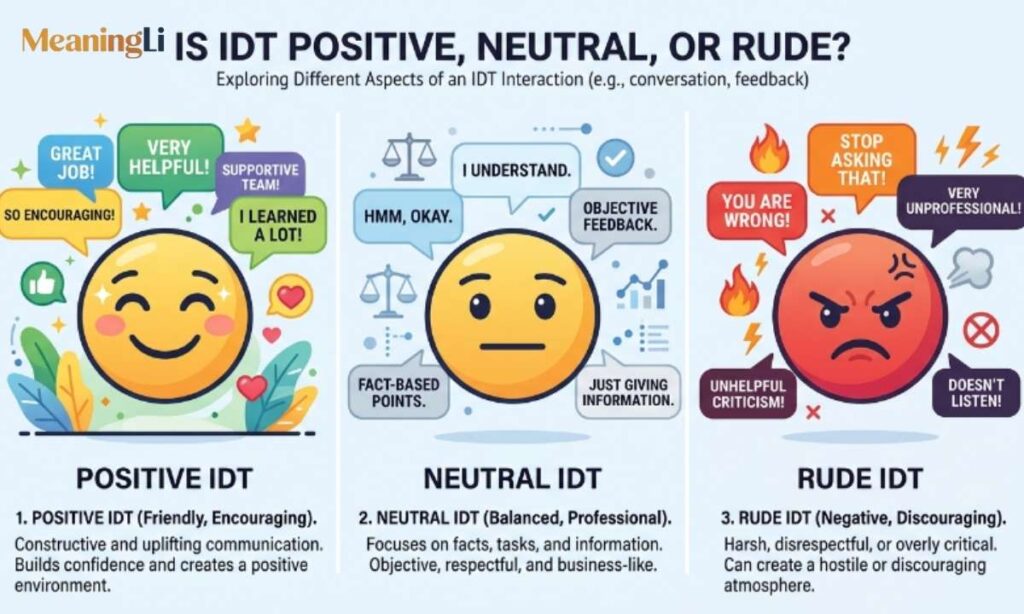
Neutral Usage
Most IDT uses carry no emotional weight at all. “IDT the game starts until 8” is pure information with no attitude attached.
Polite Disagreement
“IDT that’s the right call tbh” disagrees with someone without shutting them down or making it personal. This is IDT at its most socially useful.
Uncertainty or Hesitation
“IDT I can come” signals genuine uncertainty not disinterest or rudeness. It is the text equivalent of a shrug paired with an apologetic look.
Soft Rejection
“IDT we’re compatible if I’m honest” is harder to hear, but even here IDT softens the message. It is a cushioned no, not a harsh one. If someone wants to express complete indifference rather than a soft no, WTV “whatever” is the natural step beyond IDT in terms of emotional detachment.
Is IDT Formal or Informal?
IDT is firmly informal. It belongs in casual text conversations, social media interactions, and gaming chats nowhere else.
Can You Use IDT at Work or School?
Generally, no. Using IDT in a professional email or academic submission reads as either a typo or unprofessional shorthand. Even in casual workplace tools like Slack or Teams, IDT can come across as too casual depending on your team’s culture.
Safe Professional Alternatives to IDT
- “I’m not sure that approach will work as expected.”
- “I have some reservations about this plan.”
- “I’d like to revisit this before we move forward.”
Professional vs. Casual Chat Examples
| Context | Inappropriate | Appropriate |
| Client email | “IDT this will work” | “I have concerns about the timeline.” |
| Team Slack (casual team) | Fine between close colleagues | Use judgment based on team culture |
| Group text with friends | “IDT that’s a good idea 😂” | No issue at all |
| Social media comment | “IDT so” | Completely normal |
When Should You Use IDT?
Best Situations to Use IDT
- Replying quickly to a yes/no question from a friend
- Expressing a mild opinion without starting a debate
- Reacting to someone’s plan or idea with gentle skepticism
- Keeping a fast-moving group chat flowing naturally
Tips for Clear Communication
- Pair IDT with a brief reason when the conversation is important: “IDT it’ll work the timing seems off”
- Add an emoji if you want to make sure the tone reads as friendly and not cold
- Use IDTS if you want to signal you are leaning more firmly toward no
When Should You Avoid Using IDT?
Situations Where IDT May Cause Confusion
- Talking with someone who does not use internet slang
- Serious conversations about relationships, health, or emotional topics
- Any professional or academic communication
- Responding to someone who is already upset IDT can read as dismissive in tense moments
Better Alternatives to Use Instead
- “Probably not” simple and universally understood
- “I’m not sure” neutral and clear
- “I doubt it” casual but fully spelled out
- “That might not work” useful when giving feedback
How Do You Respond When Someone Says IDT?
Casual Replies
- “Fair enough”
- “Yeah IDT either honestly”
- “Makes sense, we’ll see”
If the person’s IDT turns out to be wrong and things go better than expected, a quick TYSM “Thank You So Much” is the natural follow-up once their doubt is proven wrong and someone comes through for them.
Funny Replies
- “Wait IDT you’d say that 😂”
- “Wow confidence at an all time low lmao”
Professional Replies
- “Understood, let’s talk through the concerns.”
- “Good point, I’d like to hear your reasoning.”
Flirty Replies
- “IDT you gave it a real chance though 😏”
- “Well I IDT either but here we are 👀”
Common Mistakes and Misunderstandings About IDT
- Thinking IDT is rude by default. It is almost never aggressive; the tone is determined by the surrounding message and context, not the letters themselves.
- Confusing IDT with IDK. IDK is about not knowing something. IDT is about having a soft opinion that leans toward no.
- Using IDT in professional writing. It is casual slang only to always write it out in formal settings.
- Assuming IDT means a hard no. IDT leaves a door open. If someone sends you “IDT,” they are not necessarily shutting the conversation down.
- Reading IDT as a typo. It is not a typo, it is widely used and intentional in digital communication.
Similar Texting Slang and Acronyms
IDT belongs to a broader family of casual opinion and doubt expressions in modern texting. Here are the closest relatives worth knowing:
| Acronym | Meaning | Relation to IDT |
|---|---|---|
| NGL | Not Gonna Lie | Like IDT, it softens a statement — but leans into honesty rather than doubt |
| TBH | To Be Honest | Both hedge a statement; TBH adds candor, IDT adds uncertainty |
| IDC | I Don’t Care | IDC signals indifference to an outcome; IDT signals doubt about it |
| IMO | In My Opinion | IMO asserts a view confidently; IDT holds the same view loosely |
| ISTG | I Swear To God | The emphatic opposite of IDT — used to assert something with full conviction |
| IIRC | If I Recall Correctly | Both are hedged and cautious; IIRC hedges memory, IDT hedges judgment |
| LMK | Let Me Know | Often follows IDT — “IDT I can make it, LMK if plans change” |
Is IDT Still Popular in 2026?
Yes IDT is not a trend, it is an embedded part of everyday digital communication. Search interest has remained consistent since 2021 with steady usage across WhatsApp, TikTok, Instagram, Snapchat, and Discord.
It belongs to a category of low-commitment phrases that digital communication keeps generating: soft, hedged, and non-confrontational. As long as people want to express doubt without sparking conflict, IDT has a permanent role in text conversations.
Frequently Asked Questions
What Does IDT Mean in Text Messages?
IDT means “I Don’t Think” a casual abbreviation used to express doubt, soft disagreement, or uncertainty in everyday texting and online chat.
What Does IDT Stand for on Snapchat?
On Snapchat, IDT stands for “I Don’t Think” used in quick snap replies and DMs to express a mild opinion or hesitation without typing a full sentence.
What Does IDT Mean on TikTok?
On TikTok, IDT means “I Don’t Think” and commonly appears in comment sections when viewers want to push back on a claim or express gentle skepticism about a video’s content.
What Does IDT Mean in Chat and Online Conversations?
In chat and online conversations, IDT means “I Don’t Think” a short, soft way to disagree or express doubt while keeping the tone friendly and conversational.
How Do You Use IDT in a Text Message?
Place IDT at the start of a sentence where you would normally write “I don’t think” for example: “IDT that’s a good idea” or “IDT I can make it tonight.”
What Is the Difference Between IDK and IDT?
IDK means “I Don’t Know” and signals a lack of information. IDT means “I Don’t Think” and signals a soft opinion or learning the key difference is knowledge versus judgment.
Is IDT a Common Texting Abbreviation?
Yes IDT is widely used across all major messaging apps and social media platforms, particularly among Gen Z and Millennial users who value speed and casual communication.
Final Thoughts on IDT Meaning in Text
IDT is one of the most useful abbreviations in modern digital communication and one of the most misread. At its core, it means “I Don’t Think,” and it does one job exceptionally well: expressing doubt or soft disagreement without sounding harsh, certain, or confrontational.
The next time someone sends you IDT, do not overthink it. Read the sentence around it, match their energy, and respond naturally. And the next time you reach for those three letters yourself, know that you are using one of the most quietly effective tools in casual texting a soft no wrapped in three characters, delivered without drama.


5 thoughts on “IDT Meaning in Text: Full Guide & Examples (2026)”