

If you have ever paused mid-sentence wondering whether to type “storys” or “stories,” you are not alone. The answer is short: “stories” is the correct plural of “story.” “Storys” is a spelling mistake in standard English.
The reason comes down to one simple spelling rule about words that end in “y.” This guide explains that rule, shows real examples, and clears up related mix-ups like Instagram Stories, “storey,” and “story’s.”
Storys vs. Stories: Which Spelling Is Correct?
Quick Answer: Storys or Stories?
Use stories whenever you mean more than one story. “Storys” is not accepted by standard dictionaries, style guides, or spell checkers.
- Correct: “She wrote three short stories last year.”
- Incorrect: “She wrote three short ~~storys~~ last year.”
Storys vs. Stories Comparison Table
| Spelling | Correct? | Why |
| Stories | Yes | Follows the consonant + y rule (y becomes ies) |
| Storys | No | Skips the required y-to-i change |
| Story | Yes | Singular form |
| Story’s | Yes (different use) | Possessive: “the story’s ending” |
| Storey | Yes (British) | A level of a building |
| Storeys | Yes (British) | Plural of storey |
What Does Story Mean?
A story is an account of real or imagined events, told to entertain, inform, or explain. It can be spoken, written, filmed, or shared online.
Story as a Singular Noun
Use “story” when you mean one account, one tale, or one news report.
- “My grandfather told me a story about his first job.”
- “The story made the front page.”
- “That is a different story altogether.” (an idiom meaning a separate matter)
In American English, “story” can also mean a floor of a building, as in “a five-story hotel.”
Stories as the Plural Form
Use “stories” for two or more tales, reports, or accounts.
- “The library has hundreds of children’s stories.”
- “The magazine runs stories on travel and food.”
- “We swapped ghost stories by the fire.”
Why Is Stories the Correct Spelling?
English has a pattern for plurals of words that end in “y.” Which pattern applies depends on the letter before the “y.”
The Consonant + Y to IES Rule
If a word ends in a consonant + y, drop the “y” and add -ies. In “story,” the letter before “y” is “r,” which is a consonant. So:
story → stor + ies → stories
When to Add Only S to Words Ending in Y
If a word ends in a vowel + y, you just add -s. The vowel keeps the word stable, so no change is needed.
- boy → boys (o is a vowel)
- day → days (a is a vowel)
- key → keys (e is a vowel)
Examples: Story to Stories, City to Cities, and Boy to Boys
| Singular | Ending | Rule | Plural |
| story | r + y | change y to ies | stories |
| city | t + y | change y to ies | cities |
| baby | b + y | change y to ies | babies |
| party | t + y | change y to ies | parties |
| boy | o + y | add s | boys |
| monkey | e + y | add s | monkeys |
| holiday | a + y | add s | holidays |
Once you see the pattern, “storys” stops looking right. You would never write “citys” or “babys.”
Is Storys a Real Word?
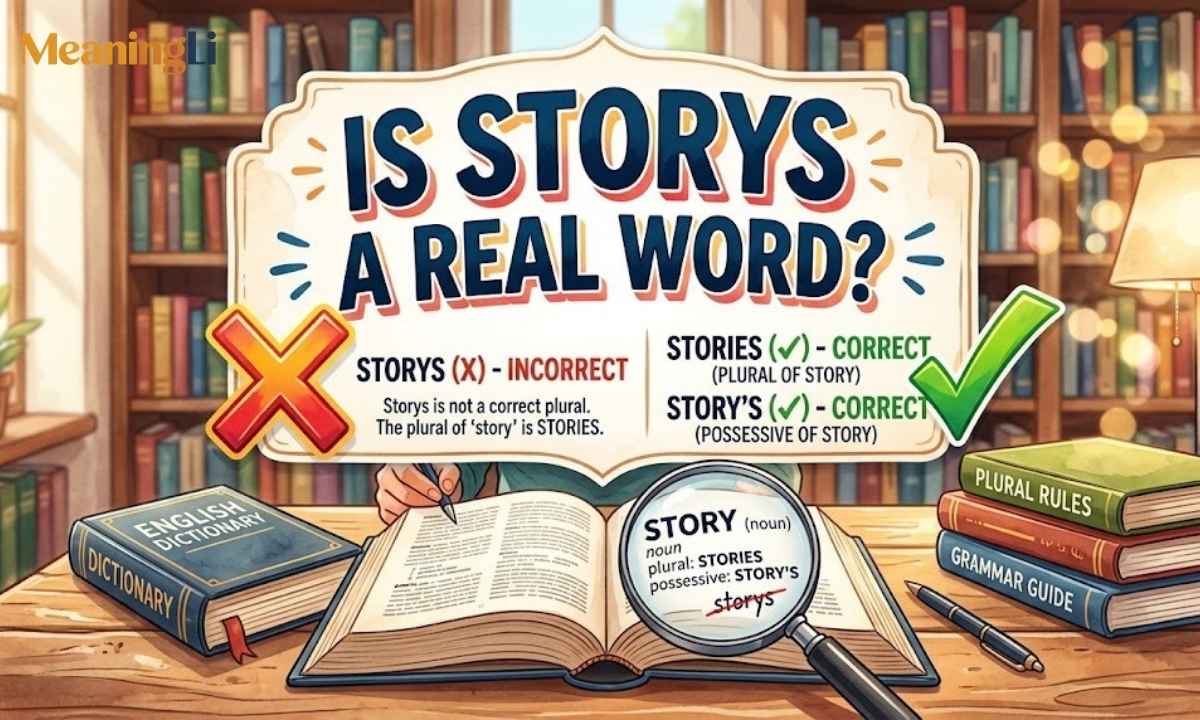
Why Storys Is Incorrect in Standard English
No major dictionary lists “storys” as a valid plural. Word processors flag it with a red underline, and teachers and editors mark it as an error.
There is one narrow exception: a name or brand may be spelled that way on purpose, such as a band, a username, or a product. That is a creative choice, not standard spelling.
Why People Commonly Write Storys
The mistake is easy to make for a few reasons:
- Pattern habit. Most English plurals just add “s,” so the brain defaults to it.
- Fast typing. On phones, people skip the extra letters.
- Vowel + y confusion. Words like “boys” and “days” work with just “s,” and the rules blur together.
- Casual online spelling. Captions, hashtags, and usernames spread the error.
Storys vs. Stories Examples in Sentences
Correct Examples Using Stories
- “The teacher read two stories before lunch.”
- “Our podcast shares true stories from small-town life.”
- “Several news stories covered the storm.”
- “He collects old detective stories.”
- “Those stories have been passed down for generations.”
Incorrect Examples and Their Corrections
| Incorrect | Correct |
| She told us funny storys. | She told us funny stories. |
| There are many storys in this book. | There are many stories in this book. |
| I posted three storys today. | I posted three stories today. |
| The storys were very touching. | The stories were very touching. |
Storys vs. Stories on Instagram and Social Media
Is It Instagram Storys or Instagram Stories?
It is Instagram Stories. That is the official feature name, and “Stories” is capitalized because it names a specific product. The same goes for Facebook Stories, WhatsApp Status-style stories, and similar features.
How to Use Stories in Social Media Sentences
- “I shared a quick poll in my Stories.” (the feature, capitalized)
- “Check my stories for the full recipe.” (casual, lowercase is common)
- “She posted ten stories from the trip.” (counting individual posts)
- “Her story disappeared after 24 hours.” (one post)
For brand copy or formal writing, capitalize the feature name. For everyday captions, lowercase is widely accepted.
Story vs. Storey: What Is the Difference?
Story Meaning and Usage
“Story” has two main meanings: a tale or account, and in American English, a floor of a building. In both cases, the plural is “stories.”
Storey Meaning in British English
“Storey” is the British spelling for a level of a building. It is never used for a tale or narrative. A narrative is always a “story,” in both American and British English.
Stories vs. Storeys for Building Levels
| Meaning | American English | British English |
| A tale or narrative | story / stories | story / stories |
| A building level | story / stories | storey / storeys |
- American: “It is a twelve-story office tower.”
- British: “It is a twelve-storey office tower.”
Pick the spelling that matches your audience and stay consistent.
Common Spelling Mistakes to Avoid
Adding S Instead of IES
Wrong: storys. Right: stories. Always swap the “y” for “ies” after a consonant.
Confusing Stories With Storeys
Use “storeys” only for floors of a building in British English. For tales, news reports, and social posts, use “stories.”
- Wrong: “I love bedtime storeys.”
- Right: “I love bedtime stories.”
Confusing Stories With Story’s
An apostrophe changes the meaning entirely:
| Form | Meaning | Example |
| stories | plural noun | “Her stories are popular.” |
| story’s | possessive or “story is” | “The story’s ending surprised me.” |
| stories’ | plural possessive | “The stories’ themes are similar.” |
Do not use an apostrophe just to make a plural.
Easy Tricks to Remember the Correct Spelling
Remember Story to Stories
Say it out loud: “stor-eez.” The sound ends in “eez,” and the letters “ies” spell that sound. Picture the “y” turning into an “i” and gaining “es.”
Use City to Cities as an Example
If you are unsure, test a word you already know. Nobody writes “citys” or “babys,” so “storys” fails the same test. Quick checklist:
- Look at the letter before the final “y.”
- If it is a consonant, change “y” to “ies.”
- If it is a vowel, just add “s.”
Frequently Asked Questions
What is the difference between “storys” and “stories”?
“Stories” is the correct plural of “story.” “Storys” is a misspelling and should be avoided.
Is “storys” ever correct, or is “stories” the only correct spelling?
“Stories” is the only correct standard spelling. “Storys” appears only in deliberate brand or username styling.
Why does the plural of “story” become “stories” instead of “storys”?
Words ending in a consonant plus “y” change the “y” to “ies” in the plural. “Story” ends in “ry,” so it follows that rule.
When should you use “story” versus “stories” in a sentence?
Use “story” for one tale or report, and “stories” for two or more. Match the noun to the number you mean.
Is it “Instagram storys” or “Instagram stories”? Which spelling is correct?
It is “Instagram Stories.” That is the official feature name, and “storys” is always wrong.
What is the plural of “story” in English, and what are some examples of how to use it correctly?
The plural is “stories.” Examples: “She writes short stories,” and “We shared stories all night.”
Final Thoughts
The plural of “story” is always “stories.” The “consonant + y becomes ies” rule explains it and also helps with words like “city,” “baby,” and “party.”
Keep the extras straight too: “storey” is a British building level, “story’s” is possessive, and “Instagram Stories” is a feature name. With those in mind, you can write the word correctly every time.