

You have probably seen “ppm” on a water report, a pool test kit, a factory quality sheet, or even a chat message. The letters look simple, yet they can point to very different things depending on where you find them.
In short, PPM most often means parts per million, a unit for very small concentrations. This guide explains the full form, the formula, and every major meaning of PPM, with clear examples so you can tell which one applies to you.
What Does PPM Mean?
PPM Meaning in Simple Words
PPM is a way to describe how much of something is present when the amount is tiny. It tells you how many parts of a substance exist in every one million parts of a mixture.
Think of one drop of ink in a large bathtub of water. The ink is there, but only in a very small share. PPM puts a number on that share.
What Does PPM Stand For?
The most widely used full form of PPM is Parts Per Million. Depending on the field, it can also stand for other terms.
| Full Form | Field |
| Parts Per Million | Chemistry, water, air, science, quality control |
| Planned Preventive Maintenance | Facilities and equipment upkeep |
| Project Portfolio Management | Business and IT |
| Pages Per Minute | Printing |
| Private Placement Memorandum | Finance and investing |
| Portable Pixmap | Image file format (.ppm) |
| Permanent Pacemaker | Medical notes |
Quick Examples of PPM
- A water sample with 2 ppm of fluoride has 2 parts fluoride in 1,000,000 parts water.
- A pool with 3 ppm chlorine has 3 mg of chlorine in every liter of water.
- A supplier reporting 150 ppm defects means 150 faulty items per million produced.
- A printer rated at 30 ppm prints about 30 pages every minute.
What Does PPM Mean in Different Contexts?
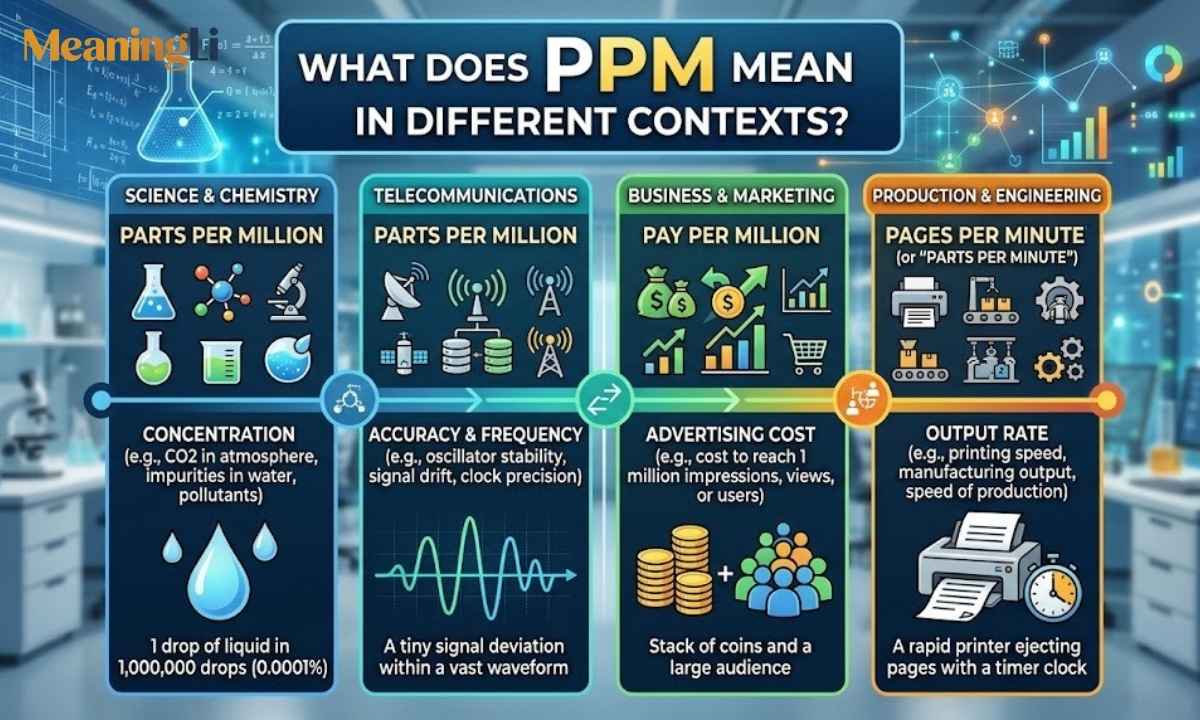
PPM Meaning in Chemistry
In chemistry, ppm describes the concentration of a solute in a solution or mixture. It is handy when a substance is present in trace amounts, such as a pollutant or an additive.
For dilute water-based solutions, 1 ppm is roughly equal to 1 mg per liter. Chemists also use ppm in spectroscopy, where it expresses chemical shifts in NMR readings.
PPM Meaning in Water Quality
Here, ppm tells you how much of a dissolved substance is in your water. It is used for chlorine, fluoride, nitrates, hardness minerals, and total dissolved solids (TDS).
A handheld TDS meter, for example, shows a reading in ppm. A lower number usually means fewer dissolved minerals, but it does not tell you whether the water is safe on its own.
PPM Meaning in Medicine
Medicine uses ppm in a few ways. Toxicology reports may express exposure to gases or chemicals in ppm, and fluoride toothpaste is labeled by its fluoride content, commonly around 1,000 to 1,500 ppm.
In clinical notes, PPM can also be shorthand for permanent pacemaker. The setting of the note makes the meaning clear.
PPM Meaning in Maintenance
In facilities management, PPM stands for Planned Preventive Maintenance. It means servicing equipment on a fixed schedule before it breaks down.
Typical PPM tasks include:
- Inspecting air-conditioning units every quarter
- Lubricating machinery parts
- Testing fire alarms and generators
- Replacing filters on a set timeline
PPM Meaning in Engineering
Engineers use ppm to describe tiny tolerances and drifts. A crystal oscillator rated at ±20 ppm may gain or lose about 20 seconds for every million seconds of operation.
It also appears in material science, such as ppm per degree Celsius for thermal expansion or resistor temperature coefficients.
PPM Meaning in Production
In manufacturing, PPM measures quality. It counts defective parts per million units produced, which makes it easy to compare factories of different sizes.
Automotive and electronics buyers often set a maximum ppm defect rate in supplier contracts. A lower number signals a more reliable process.
PPM Meaning in Business
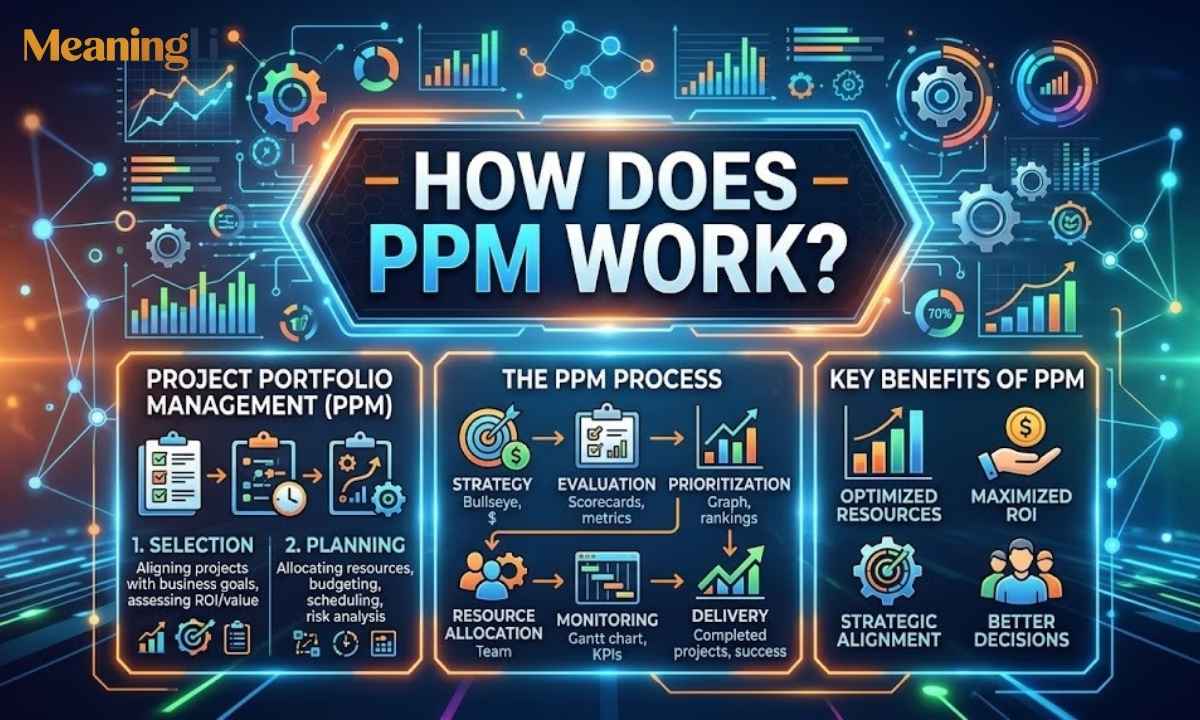
In business, PPM usually means Project Portfolio Management. It is the practice of selecting, prioritizing, and tracking a group of projects so they match company goals and budgets.
Finance professionals may also see PPM as a Private Placement Memorandum, a document that gives investors details about a private securities offering. Always check the surrounding text to know which one is meant.
PPM Tool Meaning
A PPM tool is software that helps teams manage many projects at once. It typically offers:
- Resource and capacity planning
- Budget and cost tracking
- Project roadmaps and dashboards
- Risk and dependency reports
- Portfolio-level forecasting
Well-known platforms in this space include Planview, Smartsheet, and Microsoft’s project tools. Features and pricing change often, so check each vendor’s site before choosing.
PPM Meaning in Printing
On printer spec sheets, ppm means pages per minute. It shows how fast a printer can output pages once it starts printing.
A home inkjet might manage 10 to 15 ppm, while an office laser printer can be much faster. Keep in mind that the first page often takes longer than the rated speed.
PPM Meaning in Texting and Slang
PPM is not an established slang acronym the way “LOL” or “BRB” is. When it appears in a chat, it is usually one of three things: a typo for “PM” (private message), a shortened work term, or a personal shorthand between friends.
Because there is no universal slang definition, guessing can lead to confusion. Context and a quick question to the sender are the safest ways to decode it.
PPM Meaning in Dating
PPM has no standard meaning in dating either. If someone uses it on a dating app, it may be a typo, an inside joke, or an abbreviation specific to that person.
Treat it as unclear until you confirm. Asking “What does PPM mean here?” is perfectly polite.
How Is PPM Used in Real Life?
Example of PPM in Water Testing
A homeowner tests tap water with a TDS meter and gets a reading of 180 ppm. That means about 180 mg of dissolved solids per liter of water.
As a rough guide, many people consider water under 300 ppm TDS to have a pleasant taste, while very high readings can taste salty or bitter. The number describes taste and mineral content, not safety by itself.
Example of PPM in a Workplace Conversation
A manager says, “Our PPM review is on Friday.” In an IT or consulting firm, that likely refers to a project portfolio management meeting.
In a building services team, the same sentence would mean a planned preventive maintenance review. Same letters, different job.
Example of PPM in Manufacturing
A factory ships 200,000 phone chargers in a month, and quality checks find 60 faulty units. Dividing 60 by 200,000 and multiplying by 1,000,000 gives 300 ppm.
The plant then tracks that number month by month. If it falls to 150 ppm, quality has improved.
How Does PPM Work?
What Does One PPM Mean?
One ppm means one part in one million parts. As a decimal, that is 0.000001. As a percentage, it is 0.0001%.
Some easy comparisons:
- 1 ppm ≈ 1 mg of substance in 1 liter of water
- 1 ppm ≈ 1 mg in 1 kg of material
- 1 ppm ≈ 1 second in about 11.5 days
How to Calculate PPM
Use this formula:
ppm = (amount of substance ÷ total amount of mixture) × 1,000,000
Both amounts must be in the same unit.
Step-by-step example:
- A soil sample weighs 5 kg and contains 25 mg of lead.
- Convert 5 kg to mg: 5 kg = 5,000,000 mg.
- Divide: 25 ÷ 5,000,000 = 0.000005.
- Multiply by 1,000,000: 5 ppm.
Shortcut for water: if you know the mass in milligrams and the volume in liters, ppm ≈ mg ÷ L.
PPM vs. Percentage
Both show a share of a whole, but they work at different scales. Percentage is out of 100, while ppm is out of 1,000,000.
| Percentage | PPM |
| 0.0001% | 1 ppm |
| 0.001% | 10 ppm |
| 0.01% | 100 ppm |
| 0.1% | 1,000 ppm |
| 1% | 10,000 ppm |
| 10% | 100,000 ppm |
To convert percent to ppm, multiply by 10,000. To go from ppm to percent, divide by 10,000.
Common PPM Examples and Applications
PPM in Drinking Water
Water utilities track contaminants and treatment chemicals in ppm or mg/L. In the United States, the EPA’s maximum residual disinfectant level for chlorine in drinking water is 4 mg/L, which is about 4 ppm.
Pool owners also rely on ppm. Many pools aim for roughly 1 to 3 ppm of free chlorine, though the ideal range depends on the pool type and local guidance.
PPM in Air Quality
For gases, ppm usually means a volume ratio. Outdoor carbon dioxide is currently a little above 420 ppm, which is about 0.042% of the air.
Indoor air monitors use ppm too. Carbon dioxide readings above 1,000 ppm in a room often suggest poor ventilation. For carbon monoxide, even small numbers matter, and a home CO alarm is a must for any space with fuel-burning appliances.
PPM in Chemical Concentrations
Labs use ppm to report trace metals in soil, nutrients in plant tissue, and additives in food. It is simpler to write “8 ppm” than “0.0008%.”
In agriculture, a nutrient solution for hydroponic plants might be given in ppm so growers can adjust it with precision.
PPM in Quality Control
Six Sigma and supplier audits often use defect ppm. The idea is to count failures per million opportunities or units, which keeps comparisons fair across different production volumes.
A simple table shows how ppm links to quality:
| Defect Rate (ppm) | Meaning |
| 10,000 ppm | 1 defect in every 100 items |
| 1,000 ppm | 1 defect in every 1,000 items |
| 100 ppm | 1 defect in every 10,000 items |
| 10 ppm | 1 defect in every 100,000 items |
PPM vs. Similar Abbreviations
PPM vs. PPB
PPB means parts per billion. It is 1,000 times smaller than ppm, so 1 ppm equals 1,000 ppb.
PPB is used for ultra-trace substances, such as some metals or pesticides in water. If a report shows 0.005 ppm of arsenic, that is the same as 5 ppb.
PPM vs. Percentage
Use percentage for larger shares, like alcohol by volume or a discount. Use ppm when the number would otherwise need many zeros after the decimal point.
For instance, 0.0025% looks awkward, while 25 ppm reads cleanly.
PPM in Project Management vs. Other Contexts
In project management, PPM is about strategy: which projects to fund, delay, or drop. It has nothing to do with concentration.
In science and quality work, PPM is a ratio. In maintenance, it is a schedule. Always read the sentence around the abbreviation before deciding.
Common Misunderstandings About PPM
Assuming PPM Always Has the Same Meaning
PPM is a multi-purpose acronym. A chemist, a facility manager, and a portfolio analyst can all use it in the same week and mean three different things.
Confusing PPM With Percentage
A common slip is treating ppm as if it were out of 100. A reading of 500 ppm is 0.05%, not 500%. Mixing these up can cause serious dosing and calculation errors.
Assuming a Low PPM Value Is Always Safe
A small number does not guarantee safety. Some substances, such as lead in drinking water or carbon monoxide in air, can be harmful at very low ppm levels.
Always compare readings with official limits for that specific substance.
Ignoring the Context of PPM
The same value can be fine in one setting and a problem in another. 1,000 ppm of dissolved solids in water is high for drinking, yet 1,000 ppm of fluoride in toothpaste is normal.
Check the substance, the medium (water, air, soil), and whether the figure is by mass or by volume.
Frequently Asked Questions
What does PPM mean in texting and online conversations?
PPM has no fixed meaning in texting. It is often a typo for “PM” or a personal shorthand, so context matters.
What is the full form of PPM in slang?
There is no official slang full form. The standard full form is “parts per million,” and any slang use is informal and unofficial.
What does PPM mean on Instagram, Snapchat, and WhatsApp?
None of these apps assign PPM a set meaning. It is usually a typo or a private abbreviation, so ask the sender what they meant.
How do you use PPM in a text message? Give some examples.
Use it only when the reader will understand, such as “The water test showed 150 ppm” or “My printer does 20 ppm.” Avoid using it as slang, since most people will not recognize it.
Does PPM have different meanings depending on the conversation?
Yes. It can mean parts per million, planned preventive maintenance, project portfolio management, or pages per minute, depending on the topic.
How can you tell what PPM means when someone sends it to you?
Look at the surrounding words and the field of the conversation. If it is still unclear, simply ask the sender.
Final Thoughts
PPM most commonly stands for parts per million, a simple way to express tiny concentrations in water, air, soil, and manufacturing. Once you know the formula and the quick percent conversion, reading ppm values becomes easy.
Because the abbreviation also covers maintenance, project portfolios, printing speed, and more, context is your best guide. When in doubt, check the field, look at the units, or ask for clarification before drawing conclusions.


2 thoughts on “PPM Meaning: Full Form, Definition, Common Uses & Examples (2026)”